Case Conversion

Change text to UPPERCASE, lowercase, Title Case, Sentence case, camelCase or snake_case.

100% Browser-Based Local Processing

Cases you would use in a document

Six rules for prose, headlines and labels. Start with the all-in-one if you want to compare a few against the same text, or go straight to the one you already know you need.

Cases that produce a code identifier

These two remove your spaces and punctuation, because a name cannot contain them. Everything else in this cluster leaves them exactly as they are.

Cases that are a tone of voice

Not formatting rules. These two carry a meaning of their own, which is why they belong nowhere near a document you are actually writing.

Prose Code Styling Only the two code tools change anything other than letters. The prose and styling tools leave your spacing, punctuation and line breaks exactly as you typed them.

Need to check the length of what you just converted? Count & Analyze Text measures words, characters and reading time. Or browse all 60 text tools.

Privacy Focused

🔒 Local Processing. Your text never leaves your device.

Instant Results

🌐 Fully Client-Side. Runs instantly in your browser.

No Signup

⚡ No accounts. No API keys. Just open and use.

Browser Based

🚀 No installs, no sign-ups, no character limits.

What is text case, and which one do you need?

Text case is which letters in a piece of text are capitals. Converting case means applying one rule to all of it — every letter up, every letter down, the first letter of each sentence, or a programming convention like camelCase. Randomly's ten tools each apply one of those rules in your browser.

Every tool in this group does the same small thing and differs only in the rule it applies, which is why they belong on one page: once you know which case you want, the tool is obvious. The hard part is never the conversion. It is knowing that a headline wants Title Case but a sentence in a paragraph wants Sentence case, that Capitalize Each Word and Title Case are not the same rule, and that a variable name wants camelCase while the file it lives in probably wants kebab-case.

Every one of these tools keeps your original text on screen beside the result. That is deliberate: case is a choice you make by looking at both, and a tool that overwrites your text on the first click forces you to undo before you can compare. Try Title Case, then Sentence case, and only then copy the one you wanted — or press Apply to my text when you are sure.

Nothing is uploaded. The conversion is a few lines of JavaScript running on your own machine, so a confidential headline, a client's copy deck or an internal variable name can be converted without leaving your browser.
How to convert text case

Step 1: Pick the tool named after the case you want, or open the all-in-one Case Converter if you want to try several against the same text

Pick the tool named after the case you want, or open the all-in-one Case Converter if you want to try several against the same text.

Step 2: Paste or type your text into the left pane

The result appears on the right as you type, and your original is never touched.

Step 3: Adjust the settings if the tool has any — Title Case has AP, Chicago, APA and MLA presets; UPPERCASE and lowercase have Turkish letter rules; Capitalize Each Word can leave the rest of each word alone

Adjust the settings if the tool has any — Title Case has AP, Chicago, APA and MLA presets; UPPERCASE and lowercase have Turkish letter rules; Capitalize Each Word can leave the rest of each word alone.

Step 4: Copy the result, download it as a .txt, or press Apply to my text to move it into the editor as a single undo step

Copy the result, download it as a .txt, or press Apply to my text to move it into the editor as a single undo step.

Step 5: Use Swap in on the identifier tools to chain conversions — take a phrase to snake_case, then take that result to CONSTANT_CASE, without retyping it

Use Swap in on the identifier tools to chain conversions — take a phrase to snake_case, then take that result to CONSTANT_CASE, without retyping it.

Case Conversion in action

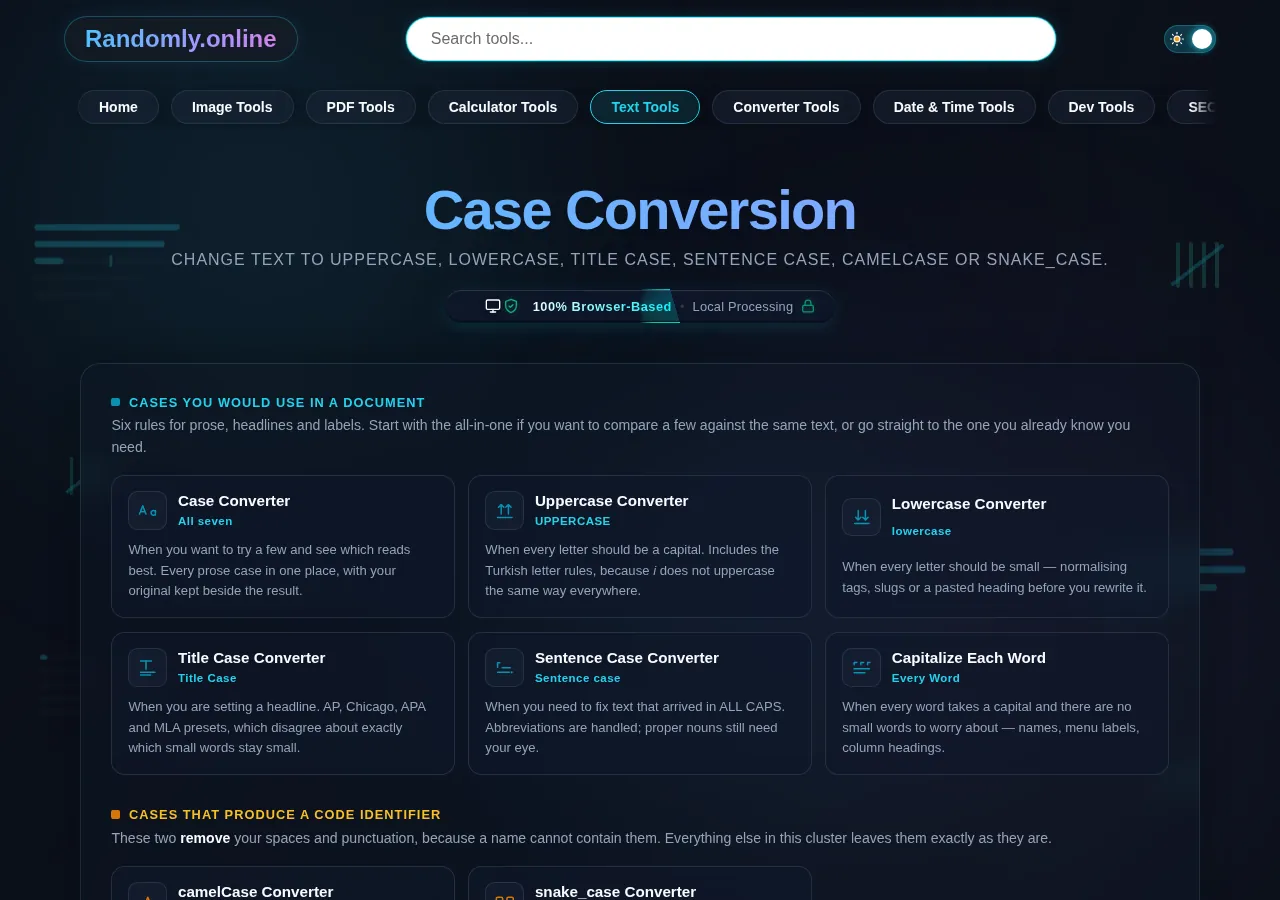
The Case Conversion cluster grid, ten text case tools each with the case it applies, dark mode
The ten-tool cluster grid
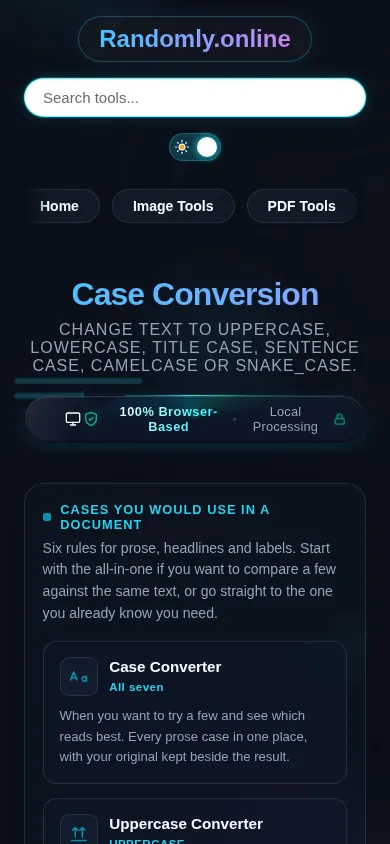
The Case Conversion cluster on a phone, the ten tool cards stacked in a single column
Mobile (grid stacked to one column)

Which case to use, and the three pairs people confuse

Start from where the text is going. A headline, title or heading takes Title Case, and which words stay lowercase depends on the style guide your publication uses — that is what the presets are for. A sentence inside a paragraph takes Sentence case. A short label, button or table header usually takes Sentence case too, despite the common instinct to title-case it. A variable, function or property name takes camelCase in JavaScript, Java and C#, PascalCase for classes and components, and snake_case in Python and Ruby. A URL slug, CSS class or file name takes kebab-case. A value that never changes takes CONSTANT_CASE.

Three pairs account for almost every mistake, and each has its own tool here because the difference is real. Title Case and Capitalize Each Word are not the same rule: Title Case leaves small words lowercase, so *a tale of two cities* becomes *A Tale of Two Cities*, while Capitalize Each Word capitalises all of them and gives *A Tale Of Two Cities*. Sentence case and lowercase differ in one letter that matters — Sentence case restores the capital at the start of each sentence, lowercase does not, so running lowercase over a paragraph leaves it looking broken. camelCase and PascalCase differ only in the first letter, and which one is correct depends entirely on what you are naming rather than on preference.

Two things worth being plain about, because both surprise people. Sentence case cannot restore proper nouns. If you paste text that was written in ALL CAPS, nothing in it marks *paris* as a city rather than a word, so it comes back lowercase and you have to fix names by eye — no tool can do otherwise. And case conversion is not always reversible. German *ß* has no single uppercase letter, so it becomes *SS* and cannot come back; Turkish treats dotted and dotless *i* as different letters, which is why the uppercase and lowercase tools offer Turkish rules rather than guessing from your browser's language.

Frequently Asked Questions

What is the difference between Title Case and capitalising every word?

Title Case leaves small words lowercase; capitalising every word does not. Under Title Case, *a tale of two cities* becomes *A Tale of Two Cities*, keeping *of* small. Capitalise every word and you get *A Tale Of Two Cities*. Style guides only ever mean the first. The second is still useful for names, menu labels and column headings, where there are no small words to worry about — which is why they are separate tools here.

Can Sentence case put my proper nouns back?

No, and no tool can. Sentence case lowercases everything and then capitalises the first letter of each sentence. If your text arrived in ALL CAPS, nothing in it distinguishes *paris* the city from *paris* the word, so names, places and brands come back lowercase and you have to restore them by eye. Abbreviations are handled — *Dr.*, *e.g.*, *etc.* and *p.m.* do not start a new sentence — but proper nouns need a human.

Which style guide should I pick for Title Case?

Use whichever your publication already uses; if there is none, AP is the safest default for the web. The practical difference is how they treat small words: AP and APA lowercase them only at three letters or fewer, so *with* keeps its capital, while Chicago and MLA lowercase articles, conjunctions and prepositions whatever their length. All four always capitalise the first and last word, and the first word after a colon. On short headlines they often agree entirely.

When should I use camelCase instead of snake_case?

Match the language, not your preference. JavaScript, Java, C# and Swift use camelCase for variables and functions, and PascalCase for classes, types and components. Python, Ruby and Rust use snake_case. SQL and environment variables use CONSTANT_CASE. URLs, CSS class names and file names use kebab-case, because underscores are hard to see in an underlined link. If you are editing an existing codebase, the answer is simply whatever the file next to yours does.

Why does my ß become SS and not come back?

Because German *ß* has no single uppercase letter. Uppercasing it produces two characters, *SS*, and lowercasing *SS* gives *ss* — there is nothing in the result to say it was ever an *ß*. This is correct behaviour defined by Unicode, not a bug in the tool, and it is the one case in this group where converting twice does not return your original text. Every other letter round-trips exactly.

Why is there a Turkish option on the uppercase and lowercase tools?

Because Turkish and Azerbaijani treat dotted and dotless *i* as two different letters. Uppercasing *i* gives *İ* in Turkish and *I* everywhere else; lowercasing *I* gives *ı* in Turkish and *i* everywhere else. The tools default to the standard mapping and offer Turkish as an explicit choice rather than reading your browser's language, because a setting that silently changes what a letter becomes should be one you made on purpose.

Does my text get uploaded anywhere?

No. Every conversion here runs in your browser as ordinary JavaScript, on your own machine. Nothing is sent to a server, nothing is stored on one, and the pages work with your network disconnected once loaded. The Send to button that carries text between tools keeps it inside the browser tab — it is never put in the address bar, where it would otherwise end up in analytics and browser history.

Will converting case change my line breaks, spacing or punctuation?

No. Every tool here changes letters only. Line breaks, blank lines, double spaces, digits, punctuation and emoji all come through exactly as you typed them. The identifier tools are the deliberate exception — camelCase and snake_case have to remove spaces and punctuation, because those characters cannot appear in a name — and the Title Case tool treats each line as its own headline so a pasted list converts correctly.

What happens to acronyms like NASA or HTTP?

They are kept. A word already in full capitals is treated as an acronym, so Title Case gives *The NASA Report* rather than *The Nasa Report*. The camelCase converter offers a choice, because both conventions are in real use: off gives *parseHttpResponse*, which most JavaScript and Java style guides prefer, and on gives *parseHTTPResponse*. Sentence case is the exception — it lowercases everything by definition, so acronyms need restoring by hand.

Can I convert a whole document, not just a headline?

Yes. Paste as much text as you like; the conversion is debounced so a long document stays responsive, and you can open a .txt file directly with the Open file button or by dropping it onto the editor. Your original stays in the left pane the whole time, so you can read the result before committing to it, and Apply to my text lands as a single undo step if you change your mind.

Still have questions?

If you can't find the answer you're looking for, feel free to contact our support team.

Contact Us