Randomly.online

Date to Roman Numerals Converter

Dot ( • )
Slash ( / )
Dash ( - )
Space
Roman Numeral Date
...
Day -
Month -
Year -

Experience the Timeless Elegance of Roman Numerals

The Roman numeral system, a method of writing numbers that dates back to ancient Rome, continues to captivate the modern world with its architectural beauty and ceremonial weight. Our Date to Roman Numerals Converter is designed for those who seek to bridge the gap between contemporary digital timekeeping and the classical aesthetics of antiquity. Whether you are planning a commemorative inscription for a building, designing a permanent tattoo for a significant life event like a wedding or birth, or simply curious about how your birthday looks in the language of emperors, this tool provides the precision you require. Unlike simple calculators, our system respects the strict subtractive rules (such as IV instead of IIII) that define authentic Latin numbering. By converting the day, month, and year into their respective symbolic forms, we offer a transformation that is both mathematically accurate and visually stunning. This process involves breaking down decimal numbers into their constituent parts—thousands, hundreds, tens, and units—and mapping them to the seven fundamental symbols: I, V, X, L, C, D, and M. In a world of fleeting digital displays, Roman numerals provide a sense of permanence and gravitas that modern digits often lack. This tool is frequently utilized by genealogists for historical record-keeping, by artists for aesthetic graphic design, and by academics wishing to present dates in a formal, scholarly manner. Our converter ensures that even complex years, such as those in the third millennium (MM), are handled with deterministic logic, leaving no room for error in your most important milestones.

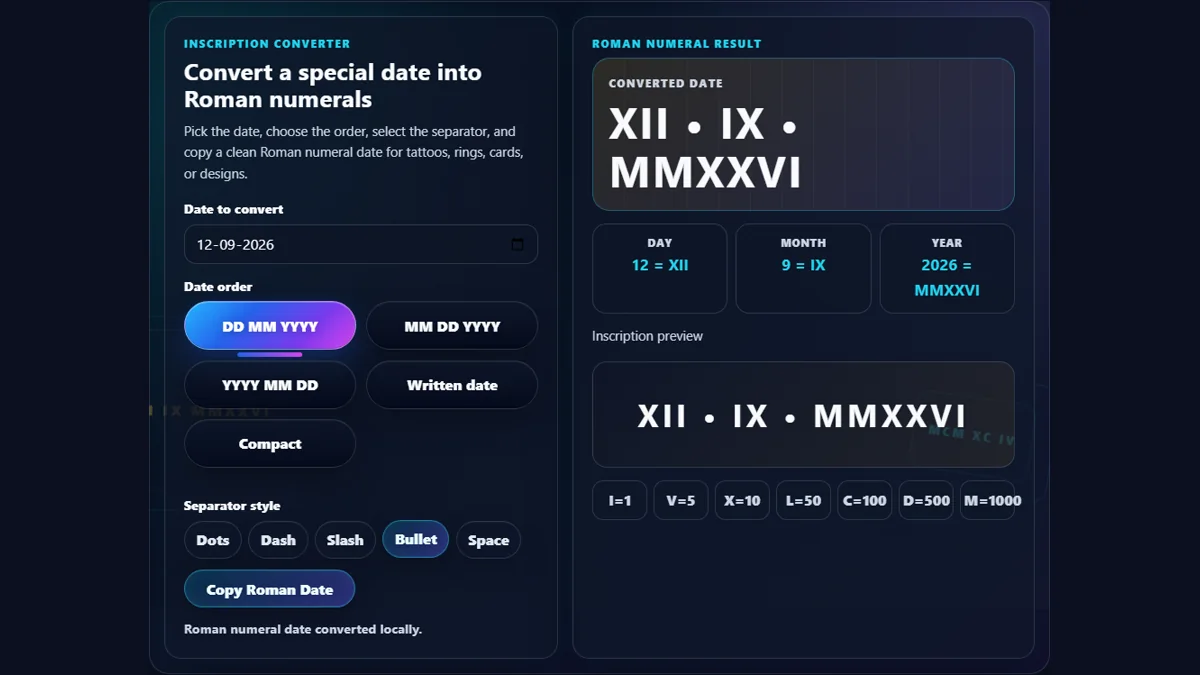
Using the Date to Roman Numerals Converter is an intuitive process designed for both desktop and mobile users. To begin, navigate to the "Single Date" tab where you will find three primary selectors. First, choose the specific day of the month using the scrollable dropdown; our system automatically adjusts the available days based on the month and year provided to ensure validity (preventing, for example, February 30th). Next, select the month. You will notice that the tool provides instant feedback; the moment you change a value, the large display panel updates to reflect the new Roman sequence. For the year, you can type any value between 1 and 3999—the traditional range for standard Roman numeral representation. Below the date inputs, you will find our "Formatting Strip." This allows you to toggle between different classical separators. For instance, the interpunct (•) provides a traditional stone-carved look, while slashes (/) offer a more contemporary interpretation. If you have a large list of dates, switch to the "Bulk Convert" tab. Here, you can paste dozens of dates in standard formats like YYYY-MM-DD. Our engine will process the entire list simultaneously, providing a clean list of Roman equivalents that you can copy and paste directly into your documents or design software. For educational purposes, the breakdown panel below the main display shows exactly how the day, month, and year are individually converted, helping you learn the logic behind the symbols. Once you are satisfied with the result, simply click the "Copy Text" button to save the conversion to your clipboard. This tool is entirely client-side, meaning your dates are never transmitted to a server, ensuring total privacy for your personal information and significant events.

1. Why does the year conversion stop at 3999?

The standard Roman numeral system used in modern contexts relies on seven symbols: I (1), V (5), X (10), L (50), C (100), D (500), and M (1,000). According to the additive and subtractive rules of this system, the largest number that can be formed without special overline notation (called vinculum) is 3,999 (MMMCMXCIX). To represent 4,000 and above, ancient Romans would draw a line over a numeral to multiply it by 1,000. However, most modern fonts, web browsers, and engraving tools do not support these overlines reliably. Since we prioritize precision and accessibility for common uses like certificates, tattoos, and monuments, we limit the year to 3,999 to ensure the output remains standard and readable across all devices. If you require dates beyond this range for specialized astronomical or historical research, we recommend consulting academic resources on the vinculum system.

2. Are there different ways to write Roman numerals for months?

In classical Latin, months were often named rather than numbered. However, in the centuries following the fall of Rome, a standard evolved where months are treated as simple integers (1-12). Our converter follows this universally accepted standard: January is I, February is II, March is III, and so on, ending with December as XII. Some European traditions occasionally use small-caps or lowercase Roman numerals for months (e.g., xii) to distinguish them from the day or year, but the uppercase format remains the gold standard for formal inscriptions. By using the uppercase format, our tool ensures your converted date remains legible and carries the appropriate ceremonial weight required for formal applications like wedding invitations or academic diplomas.

3. How does the subtractive rule work in dates?

The subtractive rule is what makes Roman numerals efficient. Instead of writing four as IIII, it is written as IV (one before five). Our converter strictly adheres to these rules to ensure "proper" Roman notation. Specifically, I can be placed before V and X; X can be placed before L and C; and C can be placed before D and M. This results in configurations like IX (9), XL (40), XC (90), CD (400), and CM (900). Understanding these rules is essential because "additive-only" formats (like VIIII instead of IX) are often considered incorrect or "gimmicky" in professional design. Our tool's deterministic conversion logic ensures that every date you generate follows these historical standards perfectly, providing a result that any historian or Latin scholar would recognize as authentic.