Julian Converter
Scientific precision calendar conversion.
Julian Outputs
Enter a JD to update the Gregorian calendar side instantly.
Scientific precision calendar conversion.
Enter a JD to update the Gregorian calendar side instantly.
The Julian Date Converter is a professional-grade astronomical tool designed to provide highly accurate transformations between the standard Gregorian calendar and the Julian Period counting system. Developed for astronomers, historical researchers, and software engineers, this platform leverages deterministic arithmetic to ensure zero approximation errors. Unlike standard date libraries that may fail at historical boundary conditions, our tool handles the transition between Julian and Gregorian calendars with extreme care, ensuring that every fractional day is accounted for with up to 12 decimal places of precision.
Julian Dates (JD) are a continuous count of days since the beginning of the Julian Period (January 1, 4713 BCE at Noon UTC). This system is preferred in computational science because it eliminates the complexity of varying month lengths, leap years, and calendar reforms when calculating the time difference between two events. Whether you are tracking celestial orbits or managing large-scale time-series data, the Julian Date serves as a universal baseline for temporal alignment. Our converter allows you to instantly visualize these values alongside the Unix Timestamp or standard UTC formats, providing a comprehensive bridge between human-readable calendars and machine-optimized metrics.
Accuracy is our primary mission. The interface is built to react to every keystroke, utilizing high-precision floating-point math to compute the Julian Day Number (JDN) and the Modified Julian Date (MJD). The MJD is particularly useful for satellite tracking and modern geodesy as it subtracts 2,400,000.5 days from the JD to make the numbers more manageable and align the day change with midnight rather than noon. By integrating tools like the Leap Year Checker and Day of Week Calculator logic, we ensure that every conversion is scientifically sound. This tool operates entirely in your browser, meaning no data is sent to servers, providing both speed and total privacy for your sensitive research data.
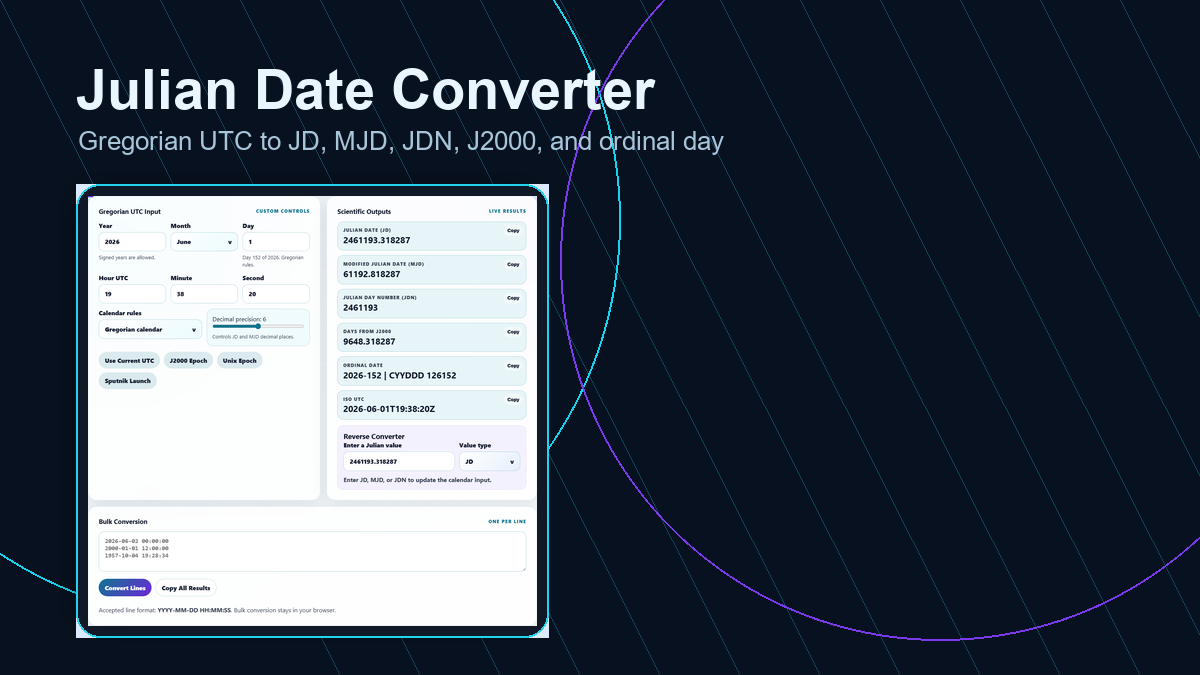
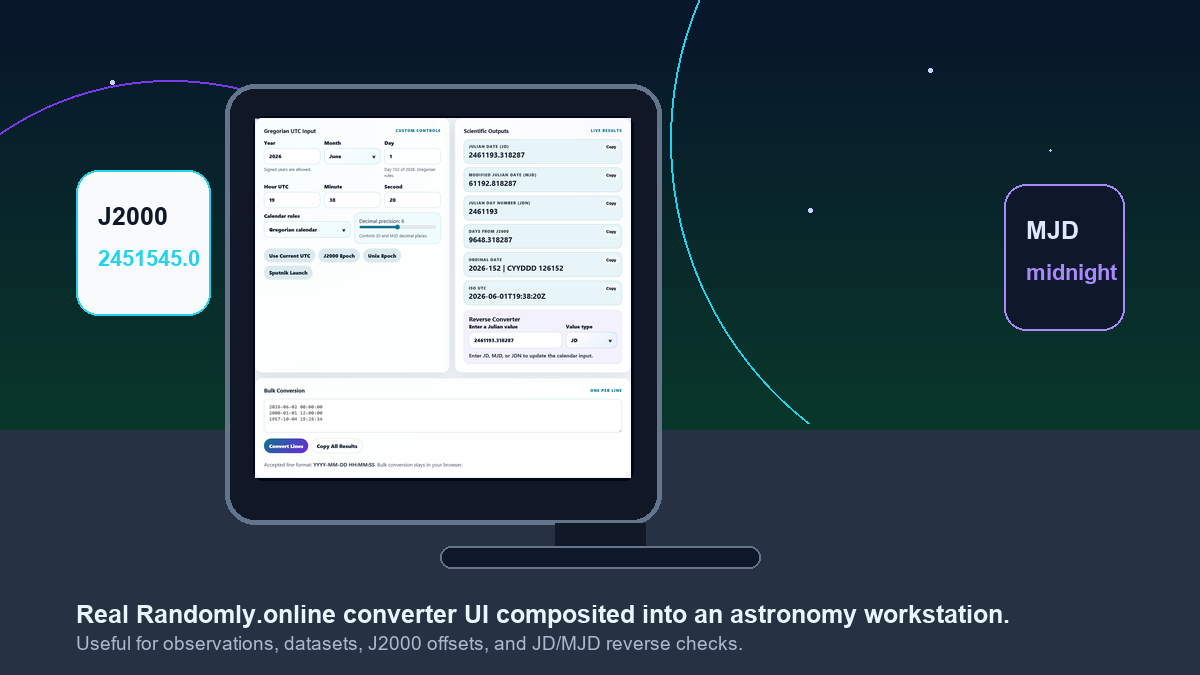
Navigating the Julian Date Converter is straightforward yet powerful. To begin a standard conversion, focus on the Gregorian Input panel. Select the year, month, and day using the selectors. For high-precision scientific work, you can include the hour, minute, and second. Our system supports negative years (BCE/BC) which are vital for historical chronology. As you adjust these values, the Julian Date (JD), Modified Julian Date (MJD), and Julian Day Number (JDN) in the right-hand panel will update in real-time. You do not need to click "Calculate"—the engine is live and reactive.
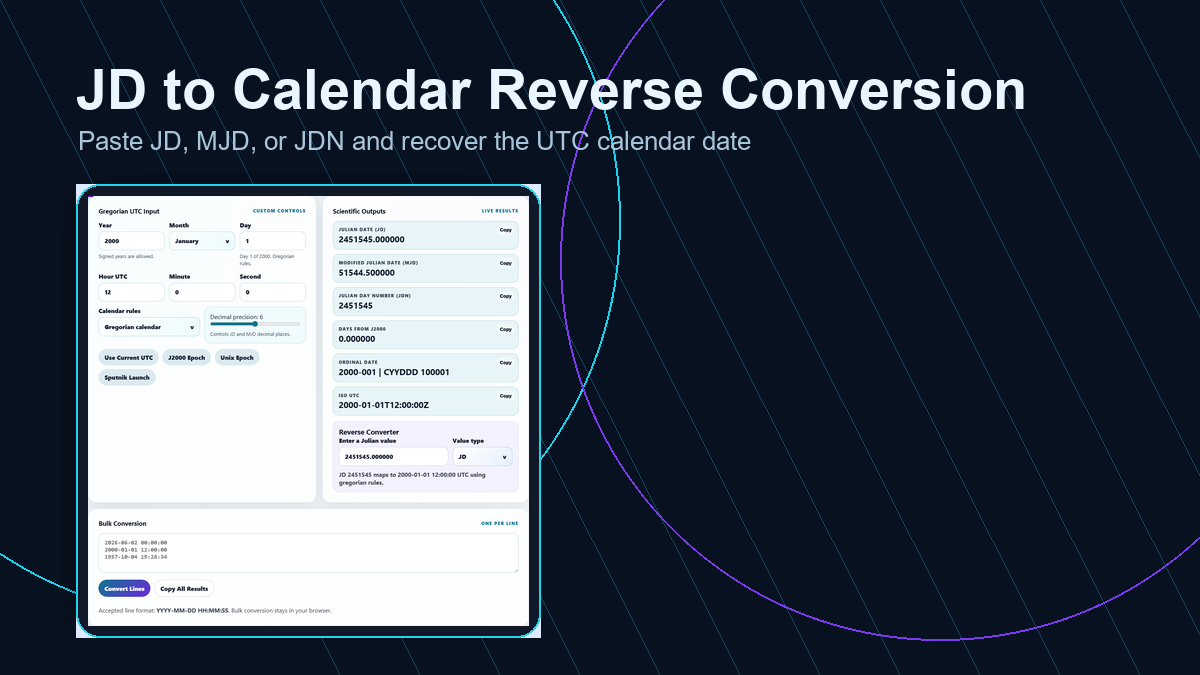
For those needing to convert from a Julian value back to a standard calendar date, use the "Reverse Engine" input located at the bottom of the Output panel. Simply paste or type your JD value into the field, and the Gregorian inputs will jump to the exact corresponding moment in time. This is exceptionally useful when you encounter JD values in scientific papers or astronomical databases and need to know the specific date and time they represent. You can also use the precision slider to adjust how many decimal places are displayed, catering to either general reference or deep computational requirements.
Advanced users can take advantage of the Bulk Conversion feature. By toggling "Bulk Mode," you can paste a list of multiple dates—one per line—and receive a list of converted Julian values instantly. This is a massive time-saver for researchers processing large datasets. Furthermore, if you are currently observing an event, use the "Use Current Time" button to snap the converter to the exact present moment. Don't forget to utilize the "Copy" buttons next to each result to quickly grab the data for your reports or code. If you need related metrics, such as the ISO Week Date or Epoch Time, check the related tools buttons provided above this section.
The Julian Date (JD) is the full fractional count of days that have elapsed since the start of the Julian epoch. It is a floating-point number where the decimal part represents the time of day. Crucially, a JD day starts at Noon UTC. The Julian Day Number (JDN) is simply the integer part of the JD, representing a whole day without the fractional time component. It is commonly used as a unique day identifier in historical databases. The Modified Julian Date (MJD) was introduced by the Smithsonian Astrophysical Observatory in 1957. It is calculated as MJD = JD - 2400000.5. By subtracting half a day, the MJD aligns the beginning of the day with midnight UTC, making it more compatible with civil timekeeping and significantly reducing the number of digits required for modern calculations.
The tradition of starting the astronomical day at noon dates back to Ptolemy and was formalized for the Julian Period by Joseph Scaliger in the 16th century. The logic was practical for astronomers: by starting the day at noon, all observations taken during a single night's session would fall under the same calendar date. If the day changed at midnight, an astronomer recording data at 1:00 AM would have to switch dates in the middle of their session, which could lead to errors in recording periodic events like lunar occultations or planetary positions. While modern civil time starts at midnight, scientific JD maintains the noon start to preserve continuity with centuries of historical astronomical records. Our tool handles this 12-hour offset automatically, ensuring you never have to manually subtract or add time when converting from a standard 24-hour clock.
The transition from the Julian Calendar to the Gregorian Calendar is one of the most complex aspects of chronology. In October 1582, many countries skipped ten days (October 5th through October 14th) to realign the calendar with the solar equinox. Our converter utilizes deterministic logic that recognizes this break. For dates before October 15, 1582, the converter applies the proleptic Julian calendar rules, and for dates after, it applies the Gregorian rules. This is vital for historical accuracy, as calculating the JD for a date in the 1400s using modern Gregorian leap year rules (which skip leap years on centuries not divisible by 400) would result in a significant error. By strictly adhering to the Date Validator standards for historical periods, we provide a tool that researchers can trust for both ancient and future dates. If you are verifying historical leap years, you may also find our Leap Year Checker specifically useful for clarifying which rules apply to a given century.