Retirement Calculators

Free retirement calculators — 401(k) with employer match, Roth IRA against traditional, pension, FIRE number, RMD, and how long a pot lasts in drawdown.

100% Browser-Based Local Processing

Retirement 7

Building the pot, and spending it down without running out.

More calculators

The other eight groups, and the full index of all 55.

An estimate, not financial advice. Figures are indicative, and the assumptions behind them are stated on the tool itself. Tax rules, rates and fees vary by country and change over time — check against your provider or a qualified adviser before acting on a number.

Privacy Focused

🔒 Local Processing. Your salary and balances never leave your device.

Instant Results

🌐 Fully Client-Side. Runs instantly in your browser.

No Signup

⚡ No accounts. No API keys. Just open and use.

Browser Based

🚀 No installs, no sign-ups, no bank account linking.

What are the Retirement Calculators?

Randomly’s retirement calculators cover both halves of the problem: building the pot — a 401(k) with its employer match, a Roth IRA measured against a traditional and a taxable account, a workplace pension, and the FIRE number that ends the accumulation — and spending it down, with required minimum distributions, a systematic withdrawal plan, and how long savings last once inflation is raising every payment.

Seven calculators, and they split cleanly into two groups that ask opposite questions. Four are about accumulation: how big does the pot get, and when is it big enough. Three are about decumulation: how much can come out, for how long, and what the rules require you to take whether you want it or not.

Decumulation is the half that most calculators skip, and it is the half where the arithmetic bites. A withdrawal that is 1% above what growth funds turns a plan with no end date into a countdown, and inflation raising the payment every year shortens it further — which is why these tools show the never-depleting figure beside the answer rather than leaving you to find the line by trial and error.

These are the most sensitive numbers on the site — salary, balances, what you expect to live on — and none of them leave the page. There is no account and no connection to a provider.
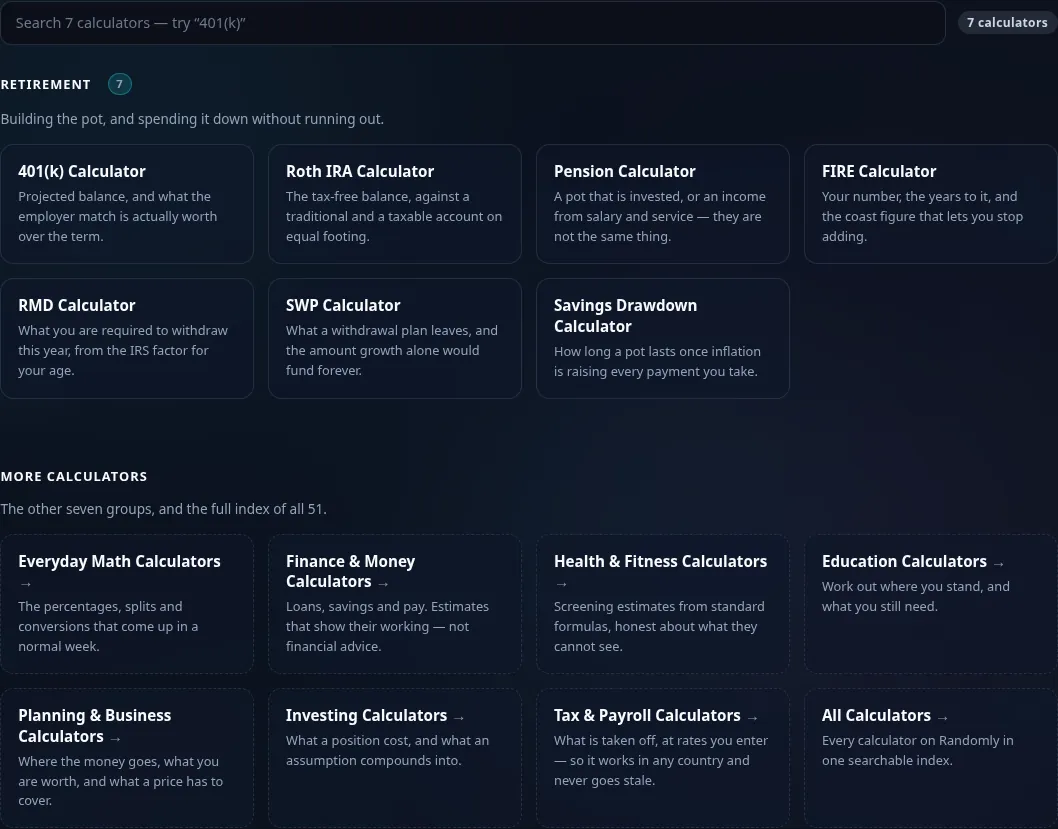
Retirement Calculators in action

The Retirement calculator grid on Randomly in dark mode — 7 cards: 401(k), Roth IRA, Pension, FIRE, RMD, SWP, Savings Drawdown
Tool grid (7 calculators)
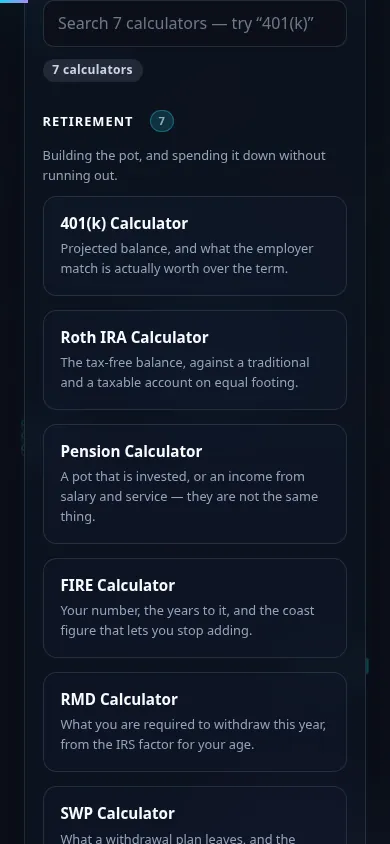
The Retirement calculators on a phone, the 7 cards stacked in a single column
Mobile (stacked grid)

Good to know

  • The employer match is modelled properly. “50% up to 6%” means 50 cents per dollar on the first 6% of salary — so contributing 20% earns exactly the same match as 6%. Getting that wrong overstates the projection of almost everyone who uses the tool.
  • Roth against traditional is compared on equal footing. Same out-of-pocket cost, both after tax, because a Roth balance is spendable and a traditional balance of the same size is not.
  • Drawdown says when a plan never ends. “Never depletes” is a real outcome and is stated as one, rather than shown as a very large number of years.
  • Contribution limits and IRS factors are dated references, flagged and overridable — never silently enforced. They change annually, and a tool that quietly clamps an input gives a wrong answer to anyone reading it in a later year.

Frequently Asked Questions

What retirement calculators are in this group?

Seven: 401(k), Roth IRA, Pension, FIRE, RMD, SWP and Savings Drawdown. The first four are about building the pot and deciding when it is enough; the last three are about taking money out — what the rules require, what a plan pays, and how long it lasts.

How does an employer 401(k) match actually work?

A match like “50% up to 6%” means the employer pays fifty cents for every dollar you contribute, on the first 6% of your salary. Contributing more than 6% earns no additional match — the extra still grows, it is simply not doubled. Contributing less than 6% leaves part of the match unclaimed, which is the one part of a retirement projection that is not a guess about markets.

Is a Roth IRA better than a traditional one?

It depends entirely on your tax rate now against your tax rate in retirement, and the calculator shows both rather than picking a side. If your rate will be higher later, the Roth wins; if lower, the traditional wins; if identical, they land in exactly the same place, because taking (1 − tax) off at the start or at the end is the same multiplication. The Roth still has the edge on certainty, since it is not a bet on future tax law.

What is the 4% rule, and is it safe?

It is a rule of thumb from historical US data suggesting that withdrawing 4% of a portfolio in the first year, then rising with inflation, survived most 30-year retirements. It is a starting point, not a guarantee. A retirement longer than 30 years, a lower-return decade, or a bad sequence of returns early on all argue for a lower rate — which is why the FIRE calculator makes the rate an input rather than a constant.

Why does my FIRE date depend on using a real return?

Because the target is expressed in today’s spending. If you enter a nominal return — say 8% — against expenses in today’s money, you are comparing two different currencies, and the date comes out years too early. Enter a return after inflation, typically a few points lower. It is the commonest error in FIRE arithmetic and it is completely silent.

When do required minimum distributions start?

Under current rules RMDs begin at 73, rising to 75 for later cohorts. The amount is your account balance on 31 December of the PRIOR year divided by a life expectancy factor from the IRS table — not today’s balance, which in a rising market gives a figure that is too high. Roth IRAs have no RMD during the owner’s lifetime.

Which IRS table should I use for an RMD?

Most people use the Uniform Lifetime table, which is prefilled here. Use the Joint Life table if your sole beneficiary is a spouse more than ten years younger, and the Single Life table for most inherited accounts. Both give a different factor, so the tool lets you enter it manually rather than assuming. The factors shown are a dated snapshot, not live data.

How much can I withdraw without running out?

The dividing line is the amount that growth alone funds — the portfolio multiplied by the periodic return. Below it, the balance rises indefinitely; above it, you are on a countdown. Both the SWP and the drawdown calculator show that figure beside your answer. With inflation raising the payment every year, though, no amount is permanently safe: every plan ends eventually.

Why do these say a fixed return is a simplification?

Because markets do not deliver a smooth percentage, and during drawdown the ORDER of returns matters as much as the average. A bad run early does disproportionate damage, since you are selling units to fund each payment while prices are down. A plan that only just survives in a smooth model would not survive in practice — treat a marginal result as a failure.

Is any of this financial advice?

No. These are arithmetic tools applying standard formulas to figures and assumptions you supply. They do not know your tax position, your health, your other income, your scheme’s specific rules or your tolerance for risk, and retirement decisions are largely irreversible. Speak to a qualified professional before acting on any of it.

Still have questions?

If you can't find the answer you're looking for, feel free to contact our support team.

Contact Us