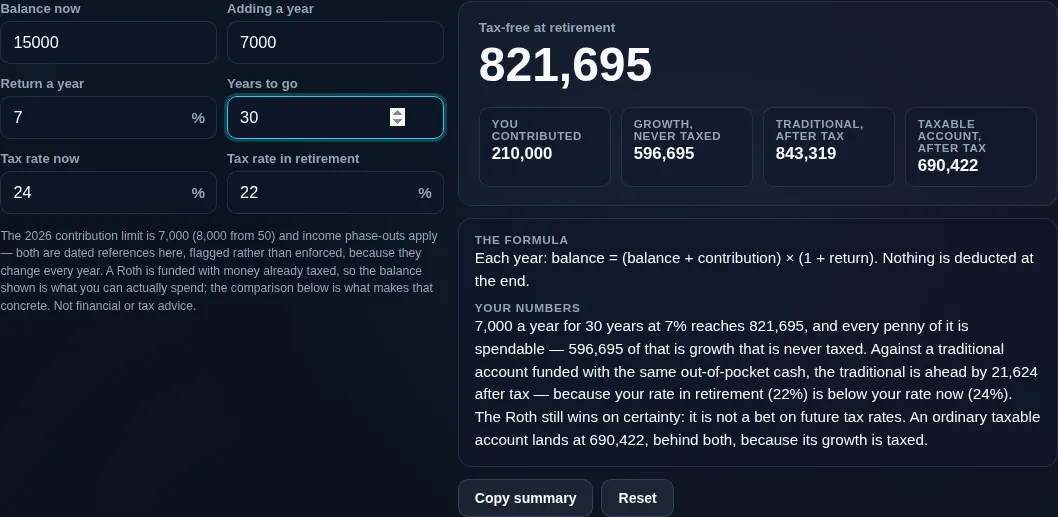
The honest framing matters here. This is US-specific: Roth IRA contribution limits, income phase-out ranges (which can limit or bar high earners from contributing directly), and the "5-year rule" all belong to US tax law and change most years. So the tool treats the contribution limit as a dated, adjustable reference rather than baking in a value that silently goes out of date, and it doesn't try to encode income eligibility. For current figures and your eligibility, check the IRS or a professional.
A few rules worth knowing: tax-free treatment of earnings generally requires being at least 59½ and having had the account five years (the 5-year rule); your contributions (not earnings) can usually be withdrawn anytime without tax or penalty. The projected balance is nominal, the return is an assumption, and this is not financial or tax advice. Everything runs privately in your browser — your figures are never uploaded. For a traditional pre-tax comparison, see the 401(k) Calculator.
- Retirement planning. Project your tax-free balance and the split of contributions vs growth.
- Roth vs traditional. Compare paying tax now (Roth) against later (traditional).
- Roth vs taxable. See the value of tax-free growth over a regular brokerage account.
- Contribution planning. Model maxing out (against the dated limit) or stepping up over time.
- Long-horizon compounding. See how decades of tax-free growth add up.
Realistic example. Starting at $10,000, contributing $6,000/year, at a 7% return for 30 years: the balance grows to roughly $620,000 — and because it's a Roth, all of it is tax-free in retirement. In a taxable account, tax on the gains along the way would leave noticeably less.
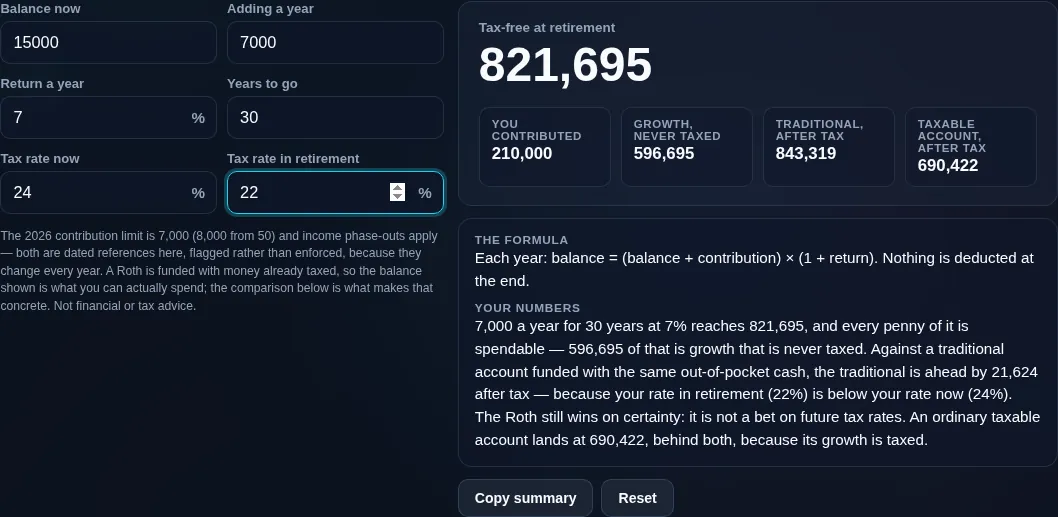
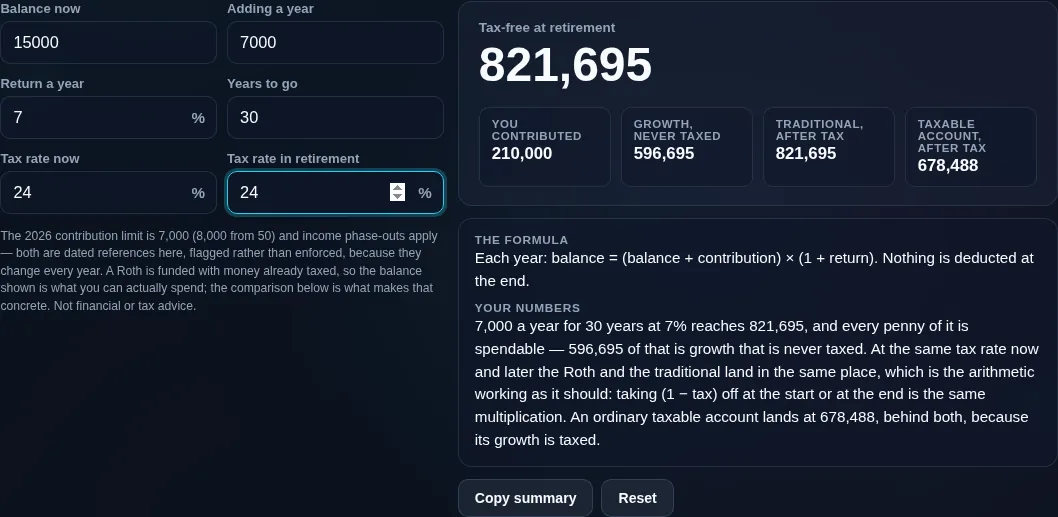
Advanced tip. A Roth generally wins if you expect a higher tax rate in retirement than today (you lock in today's lower rate); a traditional account can win if you expect a lower rate later. The comparison view helps you weigh this.
Common mistake to avoid. Don't assume you're eligible to contribute the full amount — high earners face income phase-outs. Check current limits with the IRS.
Related. For a pre-tax account with an employer match, see the 401(k) Calculator.
What this estimate is — and isn't
- Not financial or tax advice. It's an educational projection, not a recommendation.
- US-specific and dated. Roth limits, income phase-outs, and the 5-year rule are US and change yearly; the contribution limit here is an adjustable reference, not current-year law.
- Eligibility varies. Income limits can reduce or block direct contributions for high earners — check the IRS.
- Withdrawal rules apply. Tax-free earnings generally need age 59½ plus the 5-year rule; contributions are usually withdrawable anytime.
- Return is an assumption; balance is nominal. Markets vary, and inflation isn't removed.
- Your data stays private. All maths runs on your device; nothing is uploaded.