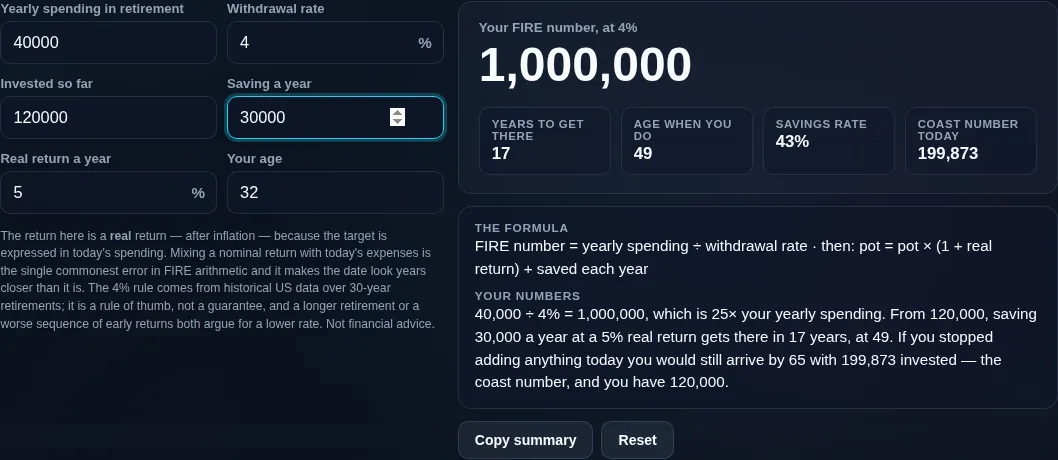
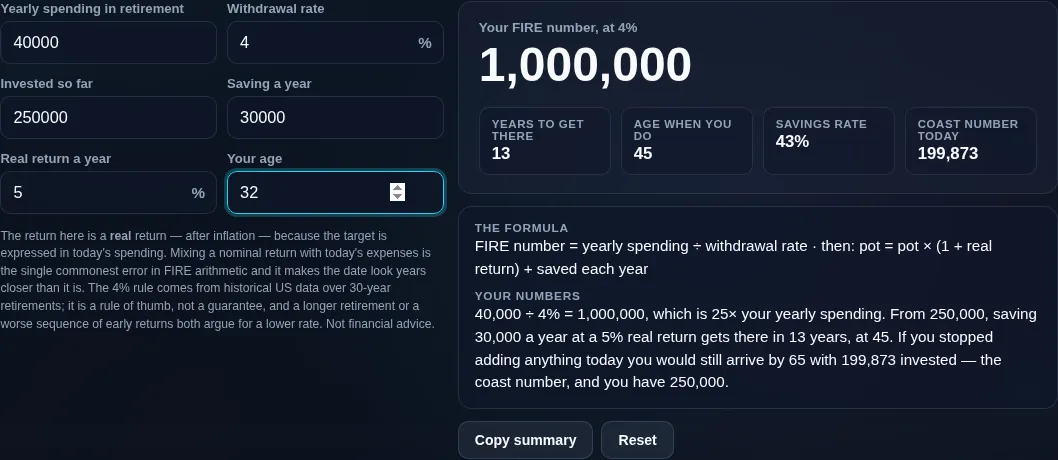
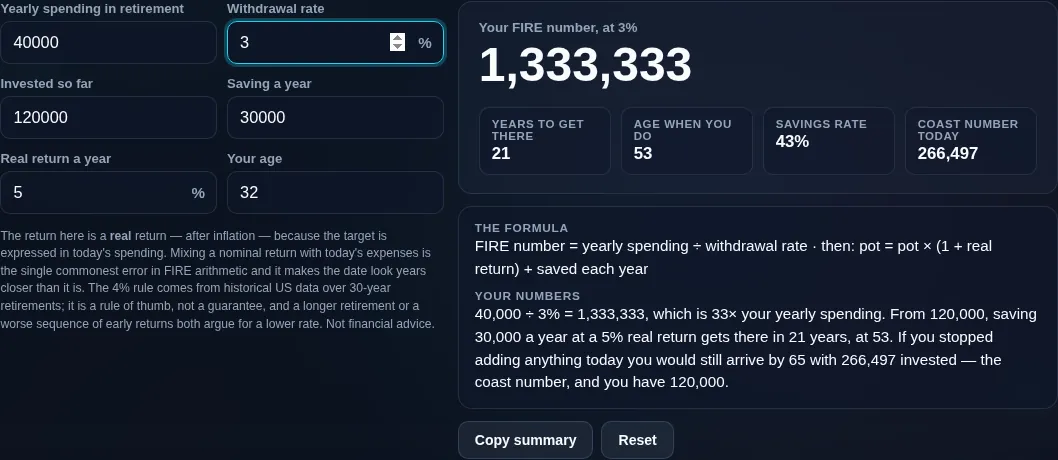
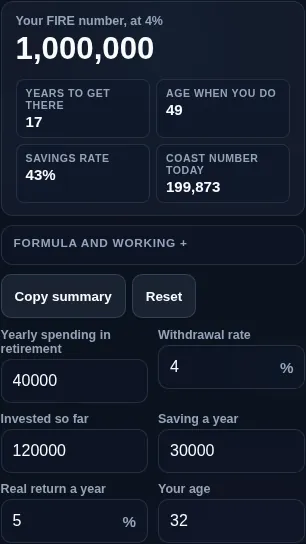
Two honest caveats deserve emphasis. First, the 4% rule is a guideline, not a law. It comes from historical US studies (the Trinity study) over roughly 30-year retirements; people retiring early with 40–50 year horizons often use a more cautious 3–3.5%, which raises the FIRE number. The tool lets you adjust the rate. Second, sequence-of-returns risk matters a lot for early retirees: a market slump in the first few years of drawdown can do outsized damage, so a smooth projection can be optimistic.
Use a real (inflation-adjusted) return so both the FIRE number and the timeline are in today's money, and remember the tool doesn't model taxes or healthcare, which are major real-world costs. It's an educational estimate, not financial advice. You can also explore Coast FIRE (enough invested that it grows to your number without more contributions), plus Lean and Fat FIRE for lower or higher spending. Everything runs privately in your browser — nothing uploaded.
- Setting a target. Turn your spending into a concrete FIRE number.
- Timeline planning. See how your savings rate changes the years to independence.
- Coast FIRE. Check if you've already saved enough to coast to your number.
- Comparing lifestyles. Test Lean vs Fat FIRE spending levels.
- Motivation. Watch how a higher savings rate dramatically shortens the path.
Realistic example. Expenses $40,000/year at a 4% rate → FIRE number $1,000,000. With $150,000 invested, $30,000 added yearly, and a 5% real return, the portfolio reaches $1M in roughly 15 years. Drop the withdrawal rate to 3.5% and the target rises to about $1.14M, adding a couple of years.
Advanced tip. Your savings rate is the biggest lever — spending less both lowers your FIRE number and frees more to invest, so it shortens the timeline from both ends.
Common mistake to avoid. Don't treat the 4% rule as guaranteed, especially for a long early retirement. Test a lower rate to build in a safety margin.
Related. For the drawdown phase and sequence risk, see the SWP Calculator; track progress with the Net Worth Calculator.
What this estimate does and doesn't include
- Not financial advice. It's an educational planning tool, not a recommendation or a guarantee you can retire.
- The 4% rule is a guideline. Based on historical ~30-year studies; early retirees often use 3–3.5%. The rate is adjustable.
- Sequence-of-returns risk isn't modelled. An early downturn in retirement can be more damaging than the average return implies.
- Use real returns. Enter inflation-adjusted returns so the number and timeline are in today's money.
- No taxes or healthcare. These are big real-world costs the tool doesn't include — budget for them separately.
- Your data stays private. All maths runs on your device; nothing is uploaded.