SWP Calculator

Model a systematic withdrawal plan: see your ending balance or how long a corpus lasts, and whether withdrawals are sustainable.

100% Browser-Based Local Processing
%
%
yr

One fixed return every month is a convenient fiction — real markets do not deliver 8% smoothly, and a run of bad years early in a withdrawal plan does far more damage than the same years later, because you sell units to fund each withdrawal while prices are down. Treat a plan that only just survives here as one that would not survive in practice. Nothing about tax on withdrawals is modelled. Not financial advice.

Left after 20 years

1,626,000

Total withdrawn1,440,000
It lastsIndefinitely
Growth earned2,066,000
Sustainable withdrawal6,666
Formula and working

The formula

Each month: balance = (balance − withdrawal) × (1 + return ÷ 12)

Your numbers

Waiting for your numbers.

An estimate, not financial advice. Figures are indicative, and the assumptions behind them are stated on the tool itself. Tax rules, rates and fees vary by country and change over time — check against your provider or a qualified adviser before acting on a number.

Privacy Focused

🔒 Local Processing. Your salary and balances never leave your device.

Instant Results

🌐 Fully Client-Side. Runs instantly in your browser.

No Signup

⚡ No accounts. No API keys. Just open and use.

Browser Based

🚀 No installs, no sign-ups, no bank account linking.

What is a SWP Calculator?

An SWP Calculator models regular withdrawals from an invested lump sum. Each month, Balance = Balance × (1 + i) − W, where i is the monthly return and W is your withdrawal. If W is smaller than the corpus's monthly growth, it can last indefinitely; otherwise it depletes. Returns are assumed, not guaranteed.

A Systematic Withdrawal Plan (SWP) is the mirror image of a SIP: instead of adding money regularly, you take a fixed amount out at a regular interval while the rest stays invested and keeps growing. It's how many people turn a retirement corpus, or any lump sum, into a monthly income. This calculator estimates either your balance after a set period, or how long the corpus lasts if you keep withdrawing — and it shows the mechanics so you can follow the maths.

Each month, the tool grows the balance by the monthly return and then subtracts your withdrawal: Balance = Balance × (1 + i) − W, where i is your annual return divided by 12. That leads to a simple but important insight it highlights: if your withdrawal is less than the corpus's growth (W ≤ corpus × i), the balance keeps rising and the plan is essentially perpetual; if it's more, the corpus shrinks and will eventually run out — and the tool tells you roughly when.

How to use the SWP calculator

Step 1: Enter your corpus. The lump sum you're withdrawing from

Enter your corpus. The lump sum you're withdrawing from.

Step 2: Enter your monthly withdrawal. How much you plan to take out each month

Enter your monthly withdrawal. How much you plan to take out each month.

Step 3: Enter an expected annual return. A realistic assumption for the invested balance

Enter an expected annual return. A realistic assumption for the invested balance.

Step 4: Choose a mode. Set a duration to see the ending balance, or pick "until depleted" to see how long it lasts

Choose a mode. Set a duration to see the ending balance, or pick "until depleted" to see how long it lasts.

Step 5: Read the result and breakdown. See the outcome, the sustainability flag, and a year-by-year balance, with the mechanics shown

Copy if needed.

SWP Calculator in action

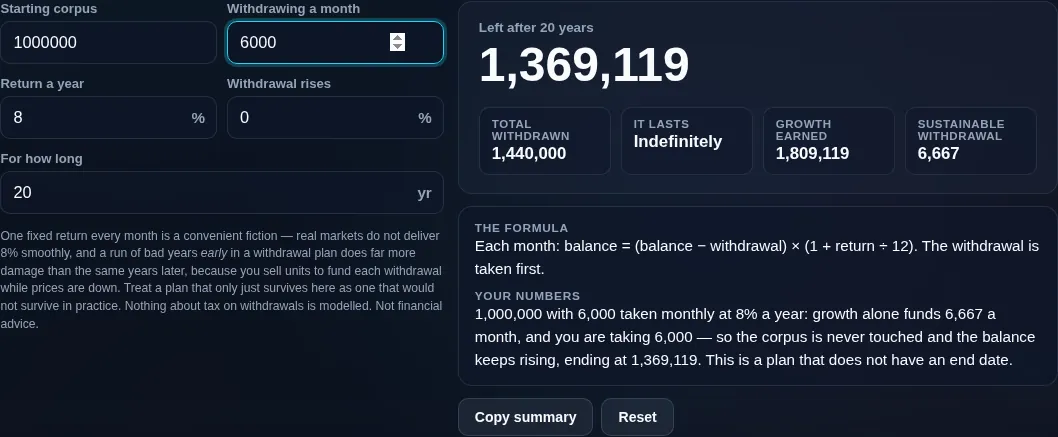
SWP calculator showing what is left of a corpus after a fixed monthly withdrawal, and the total drawn along the way
Inputs + result + mechanics
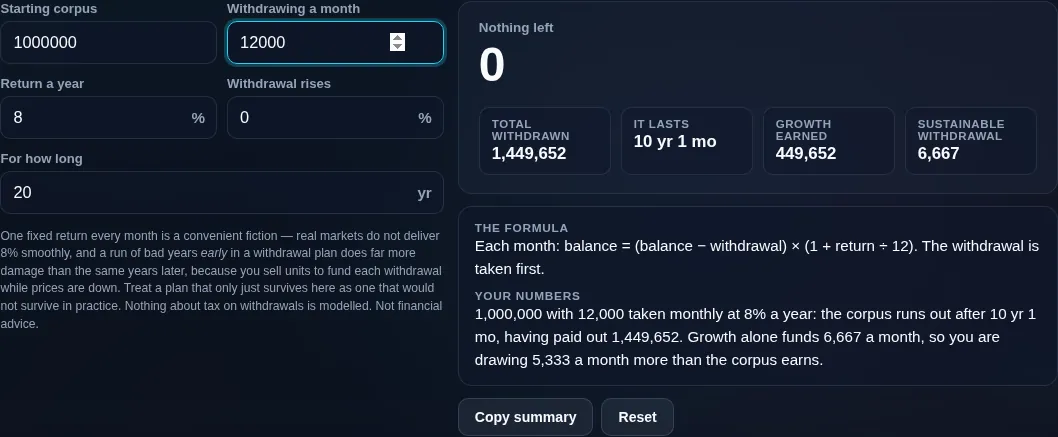
SWP calculator with a withdrawal the corpus cannot sustain, naming the year the money runs out instead of printing a negative balance
A withdrawal the pot cannot sustain, and the year it runs out
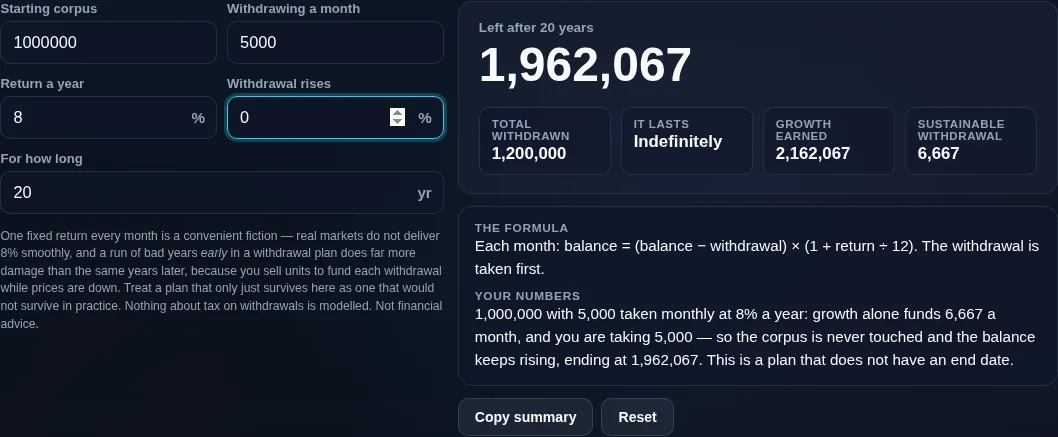
SWP calculator showing the withdrawal the corpus can sustain indefinitely, beside the one being taken
Sustainability flag (perpetual vs depleting)
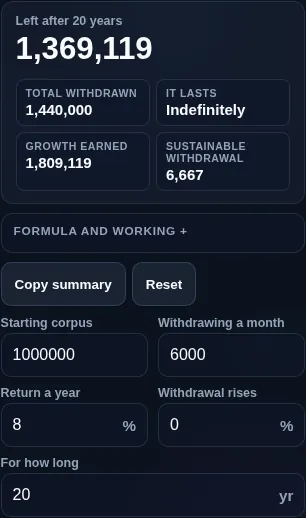
SWP calculator running in a phone browser with the corpus and withdrawal fields stacked
Mobile browser

When an SWP calculator helps

Now the honesty that matters most in the withdrawal phase: sequence-of-returns risk. When you're withdrawing, the *order* of returns matters enormously — a market fall in the first few years, while you're also taking money out, can drain a corpus far faster than the average return would suggest, even if the long-run average is fine. A constant-rate projection like this one can't capture that, so treat the result as an optimistic-ish baseline, not a promise. This is an educational estimate, not investment advice.

Two more notes: the figures are nominal (a fixed withdrawal loses purchasing power over time — use the step-up option to keep pace with inflation), and taxes on withdrawals or gains vary and aren't included. Everything runs in your browser; your corpus and withdrawal figures are never uploaded. For the saving-up phase, see the Compound Interest Calculator.

  • Retirement income. Turn a corpus into a monthly withdrawal and see how long it lasts.
  • Sustainable withdrawal. Find a rate the corpus can support without depleting.
  • Planning a drawdown. Test how a downturn or a bigger withdrawal changes longevity.
  • SWP vs dividends. Compare a controlled withdrawal against relying on payouts.
  • Inflation planning. Model rising withdrawals with the step-up option.

Realistic example. A 6,000,000 corpus, 40,000 withdrawn monthly, at an assumed 8% return: monthly growth is about 6,000,000 × 0.667% ≈ 40,000 — right at the threshold, so the corpus lasts a very long time. Nudge the withdrawal to 50,000 and it starts depleting; the tool shows roughly when.

Advanced tip. To keep your income's purchasing power, use the step-up option to raise withdrawals with inflation — but note that rising withdrawals shorten how long the corpus lasts.

Common mistake to avoid. Don't rely on the average return alone. A bad early sequence can deplete a corpus faster than a smooth projection implies — plan with a margin.

Related. For the accumulation phase, see the Compound Interest Calculator; for retirement drawdown, the Savings Drawdown Calculator.

What this estimate does and doesn't include

  • Not investment advice. It's an educational projection to help you plan a withdrawal.
  • Sequence-of-returns risk isn't modelled. A constant rate can be optimistic; an early downturn while withdrawing can deplete a corpus faster.
  • The return is an assumption. Actual returns vary and can be negative; past performance doesn't predict the future.
  • Figures are nominal. A fixed withdrawal loses value to inflation over time — use step-up for a real-terms view.
  • Taxes aren't included. Tax on withdrawals or gains varies by country and product.
  • Your data stays private. All maths runs on your device; nothing is uploaded.
Frequently Asked Questions

What is an SWP and how does this calculator work?

A Systematic Withdrawal Plan (SWP) takes a fixed amount out of an invested lump sum at a regular interval while the rest stays invested and grows. This calculator projects either the balance after a set period or how long the corpus lasts, by growing the balance each month and subtracting your withdrawal — and it shows the mechanics so you can verify it.

---

What is the SWP formula / how is the balance calculated?

Each month the tool applies: Balance = Balance × (1 + i) − W, where i is the monthly return (annual rate ÷ 12) and W is your monthly withdrawal. It grows the balance by the return, then subtracts the withdrawal, and repeats. Doing this month by month handles step-ups and timing exactly, rather than relying on a single closed-form figure.

---

How long will my corpus last?

It depends on the size of your withdrawal relative to the corpus's growth. If your monthly withdrawal is less than the corpus earns each month, it can last indefinitely. If it's more, the corpus shrinks and eventually depletes — and the calculator estimates roughly when, given your assumed return. Enter your figures and pick "until depleted" to see the number of years.

---

How much can I withdraw without running out?

As a rough guide, if your annual withdrawal stays at or below what the corpus earns, the balance shouldn't fall — a withdrawal of up to about the return rate (e.g. 6–8% of the corpus at those returns) can be broadly sustainable *on paper*. But because returns vary and can be negative early on, a lower, more cautious rate is safer. The tool flags when a withdrawal crosses into depletion.

---

What is sequence-of-returns risk?

It's the risk that the *order* of returns hurts you when you're withdrawing. Two portfolios with the same average return can have very different outcomes if one suffers a downturn early: withdrawing during a fall locks in losses and leaves less to recover, draining the corpus faster. Because this calculator assumes a constant return, it can't capture that risk — so treat its result as an optimistic-ish baseline.

---

What is a safe withdrawal rate (the 4% rule)?

The "4% rule" is a well-known guideline suggesting you can withdraw about 4% of a retirement portfolio in year one, then adjust for inflation, with a good chance the money lasts ~30 years. It comes from historical studies and isn't a guarantee — outcomes depend on returns, inflation, and sequence risk. Use it as a starting point; this tool lets you test your own rate and see the effect.

---

SWP vs SIP — what's the difference?

They're opposites. A SIP is the accumulation phase — you invest a fixed amount regularly to build a corpus. An SWP is the decumulation phase — you withdraw a fixed amount regularly from a corpus. Many people use a SIP for decades to build savings, then switch to an SWP in retirement to draw an income. For the SIP side, see the Compound Interest Calculator.

---

SWP vs taking dividends — which is better?

An SWP gives you a predictable, controlled amount regardless of what the investment pays out, and lets you decide the rate. Dividends depend on what companies or funds actually distribute, which varies and can be cut. An SWP offers more control and steadier income but sells units to fund withdrawals; dividends don't reduce your unit count but are less predictable. Which suits you depends on your goals and tax situation.

---

Does the result account for inflation and taxes?

By default, no. The figures are nominal, so a fixed withdrawal buys less over time as prices rise — use the step-up option to increase withdrawals with inflation for a real-terms view, though that shortens how long the corpus lasts. Taxes on withdrawals or capital gains vary by country and product and aren't modelled, so factor them in separately.

---

Is the return guaranteed?

No. The return you enter is an assumption, not a promise. Real markets fluctuate and can be negative, especially over short periods — and in the withdrawal phase that variability is more dangerous because of sequence-of-returns risk. Treat the projection as a planning estimate, run a cautious rate as well, and remember this isn't investment advice.

---

What return rate should I assume?

Use a realistic, slightly conservative figure for the mix your corpus is invested in, and test a range. During withdrawals it's wise to assume less than you might in pure accumulation, because a bad early stretch does disproportionate damage. Running an optimistic and a cautious scenario shows how sensitive the corpus's longevity is to the return.

---

Is my data uploaded, and does it work offline?

No upload, and yes it works offline. The whole simulation runs in your browser, so your corpus and withdrawal figures are never sent to a server, there's no account, and no tracking. Once the page has loaded it keeps working with no connection — useful for private retirement figures you'd rather not enter into an online service.

Still have questions?

If you can't find the answer you're looking for, feel free to contact our support team.

Contact Us