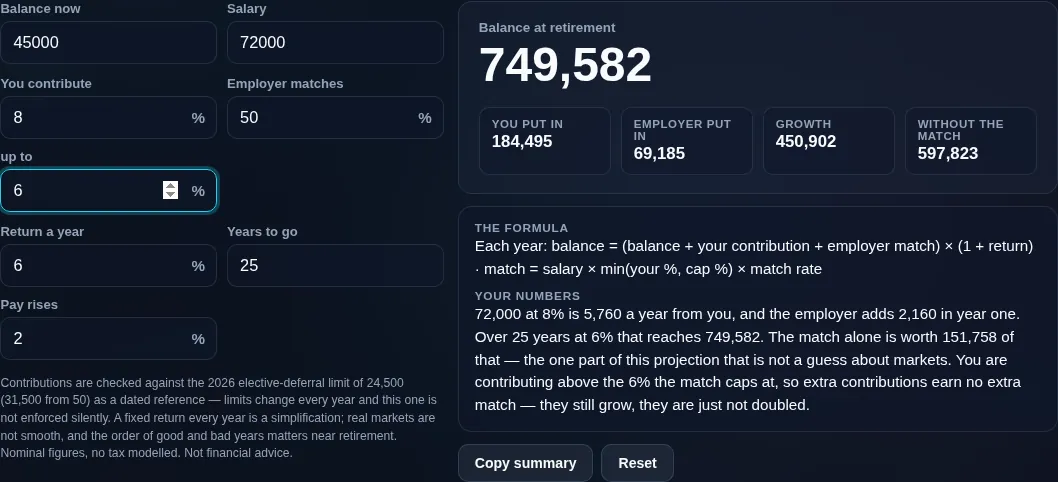
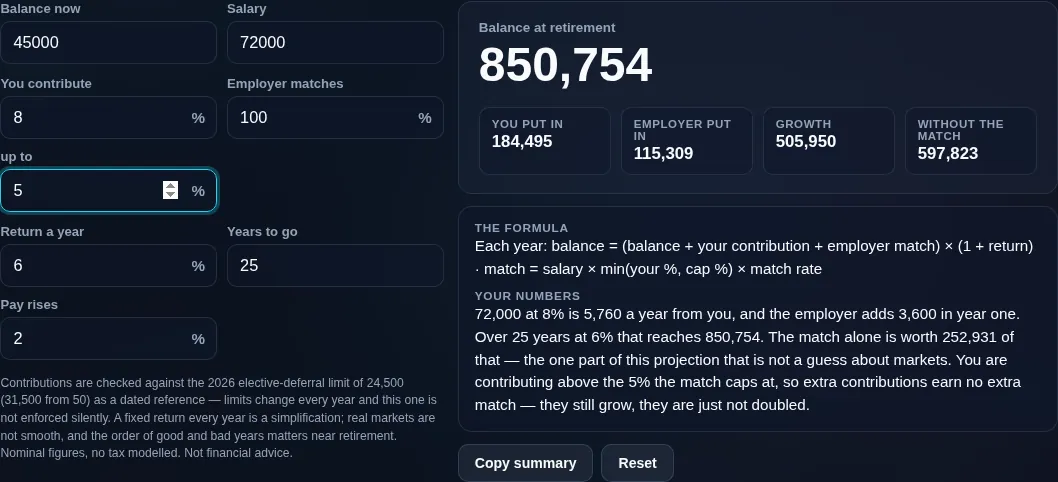
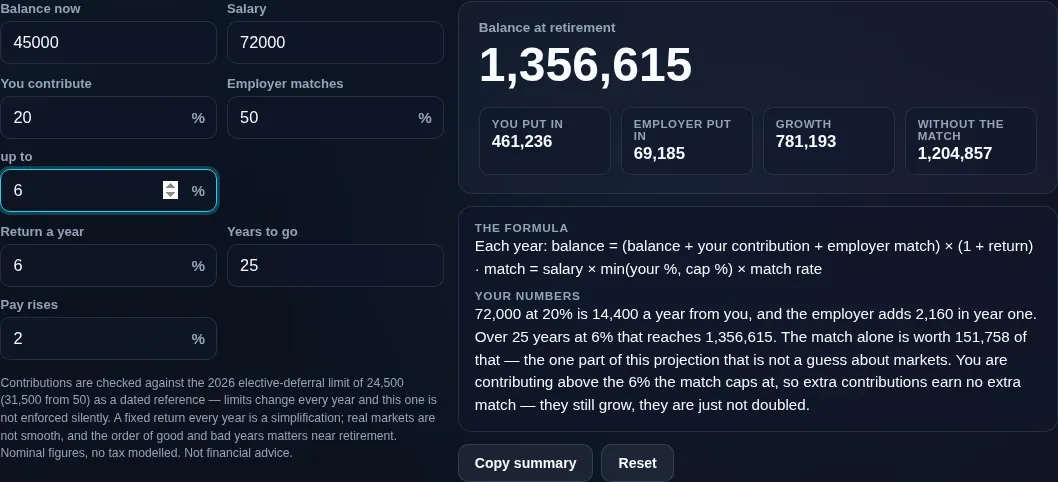
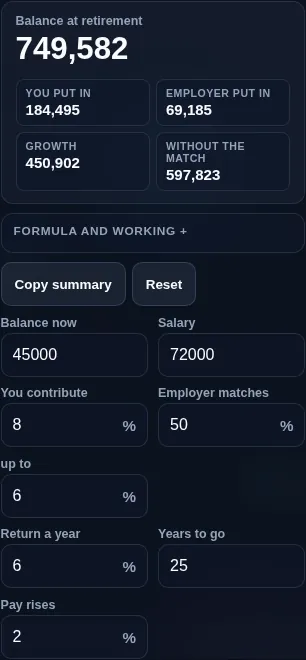
The single most important takeaway most people miss: the employer match is free money. If your employer matches up to 6% of salary and you contribute less than that, you're leaving guaranteed extra pay on the table. The calculator's with-versus-without-match view makes that value obvious — it's usually the highest-return part of the whole plan.
Now the honest framing. This is US-specific: 401(k) rules, the annual IRS contribution limit, catch-up amounts, and vesting all belong to the US system and change every year, so the tool treats the contribution limit as a dated reference you can adjust, not a hard rule it silently enforces. The projected balance is nominal (inflation not removed) and, for a traditional 401(k), pre-tax — meaning withdrawals in retirement are taxed, so your spendable amount is lower. A Roth 401(k) is funded with after-tax money and qualified withdrawals are tax-free. Returns are an assumption, not a guarantee, and this is not financial or tax advice.
Your salary and balance are sensitive, so everything runs in your browser — nothing is uploaded, and it works offline.
- Capturing the full match. Check the contribution rate that earns your entire employer match.
- Retirement planning. Project your balance and see the contribution/match/growth split.
- Comparing contribution rates. See the long-run effect of contributing 6% vs 10%.
- Modelling raises. Add salary growth and a step-up to see the compounding effect.
- Understanding tax treatment. Grasp why a traditional balance is pre-tax.
Realistic example. Salary $70,000, you contribute 6% ($4,200/yr), employer matches 50% up to 6% (so $2,100/yr free), starting balance $20,000, assumed 7% return, 25 years. The projection compounds all of it; the match alone adds a large share, which the with-vs-without view highlights.
Advanced tip. Always contribute at least enough to get the full match — it's an immediate, guaranteed return no market can promise. Beyond that, weigh a traditional vs Roth 401(k) on your tax situation.
Common mistake to avoid. Don't read the traditional-401(k) balance as spendable cash — withdrawals are taxed, so the after-tax amount is lower.
Related. For a general nest-egg view, see the Retirement Calculator; for tax-free growth, the Roth IRA Calculator.
What this estimate is — and isn't
- Not financial or tax advice. It's an educational projection, not a recommendation.
- US-specific and dated. 401(k) limits, catch-up amounts, and rules are US and change yearly; the contribution limit here is an adjustable reference, not current-year law.
- Traditional is pre-tax. The projected balance for a traditional 401(k) will be taxed on withdrawal; a Roth 401(k) is after-tax with tax-free qualified withdrawals.
- Return is an assumption; value is nominal. Markets vary, and inflation isn't removed — real spending power is lower.
- Match assumes vesting. Employer match may vest over time; if you leave early you might forfeit unvested amounts.
- Your data stays private. All maths runs on your device; nothing is uploaded.