Pension Calculator

Project a pension pot from contributions and growth, or estimate a defined-benefit pension: salary × service × accrual.

100% Browser-Based Local Processing
%

A defined-contribution figure is a pot, not an income — what it pays depends on what you buy with it and how long you live. A defined-benefit figure is an income for life, which is why the two cannot be compared by size alone. Neither models tax, the state pension, a tax-free lump sum, early-retirement reductions or a scheme's own revaluation rules; a career-average scheme in particular revalues each year's accrual, which this simplifies. Check your scheme's own statement. Not financial advice.

Pot at retirement

565,000

Paid in240,000
Growth265,000
Income at 4%22,600
A month1,883
Formula and working

The formula

Each month: pot = (pot + contribution) × (1 + growth ÷ 12)

Your numbers

Waiting for your numbers.

An estimate, not financial advice. Figures are indicative, and the assumptions behind them are stated on the tool itself. Tax rules, rates and fees vary by country and change over time — check against your provider or a qualified adviser before acting on a number.

Privacy Focused

🔒 Local Processing. Your salary and balances never leave your device.

Instant Results

🌐 Fully Client-Side. Runs instantly in your browser.

No Signup

⚡ No accounts. No API keys. Just open and use.

Browser Based

🚀 No installs, no sign-ups, no bank account linking.

What is a Pension Calculator?

A Pension Calculator works out retirement provision two ways. For a defined-benefit pension: annual pension = pensionable salary × years of service × accrual rate. For a defined-contribution pot, it projects your fund from contributions and growth. You enter the rules, so it fits any country.

Pensions come in two main shapes, and this calculator handles both. A defined-contribution (DC) pension is a pot: you and often your employer pay in, it's invested, and it grows — what you retire with depends on contributions and returns. A defined-benefit (DB) pension pays a guaranteed income based on your salary and years of service, regardless of investment returns.

For a DC pot, enter your current balance, your regular contributions (yours and your employer's), an assumed growth rate, and the years to retirement; the tool projects the pot at retirement and splits it into contributions versus growth. You can optionally grow contributions with pay and show inflation-adjusted (real) values. For a DB pension, the estimate uses the standard formula: annual pension = pensionable salary × years of service × accrual rate. The accrual rate is how much you earn per year of service — commonly expressed as a fraction like 1/60 or 1/80, or as a percentage. For example, 30 years of service at 1/60 of a £45,000 salary is 30/60 × 45,000 = £22,500 a year.
How to estimate your pension

Step 1: Choose a mode. Defined-contribution pot projection, or defined-benefit income estimate

Choose a mode. Defined-contribution pot projection, or defined-benefit income estimate.

Step 2: DC: enter pot, contributions, growth, and years. Include your employer's contributions

DC: enter pot, contributions, growth, and years. Include your employer's contributions.

Step 3: DB: enter salary, years of service, and accrual rate. As a fraction (1/60) or a percentage

DB: enter salary, years of service, and accrual rate. As a fraction (1/60) or a percentage.

Step 4: Add inflation (optional). To see values in today's money

Add inflation (optional). To see values in today's money.

Step 5: Read the result. Projected pot (DC) or annual and monthly pension (DB)

Copy any figure.

Pension Calculator in action

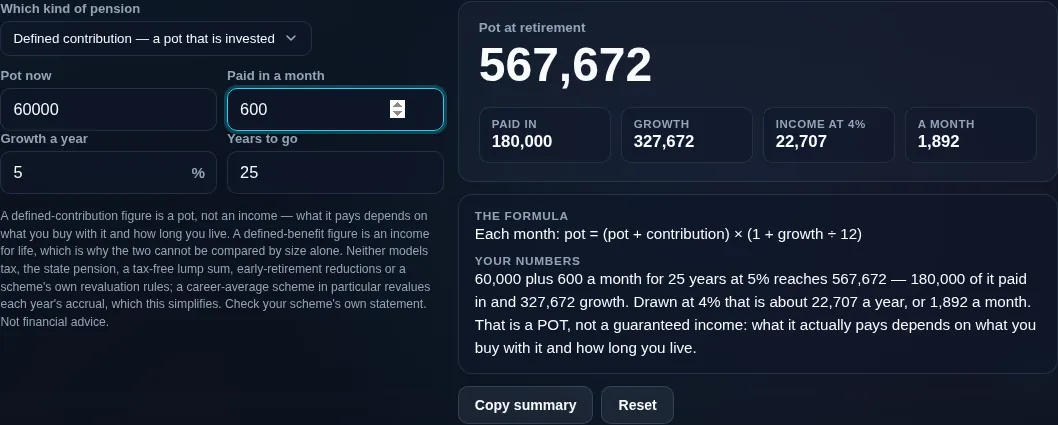
Pension calculator projecting a defined-contribution pot from monthly contributions, and showing the income that pot would yield rather than leaving the pot to be read as a salary
A defined-contribution pot, and the income that pot would yield
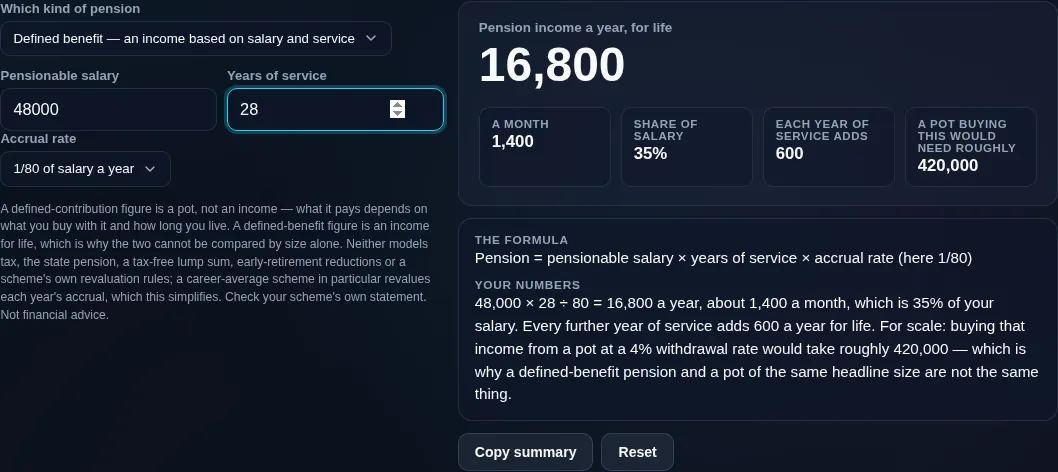
Pension calculator working out a defined-benefit pension from salary, years of service and the accrual rate — an income for life, not a pot
A defined-benefit pension, which is an income for life rather than a pot
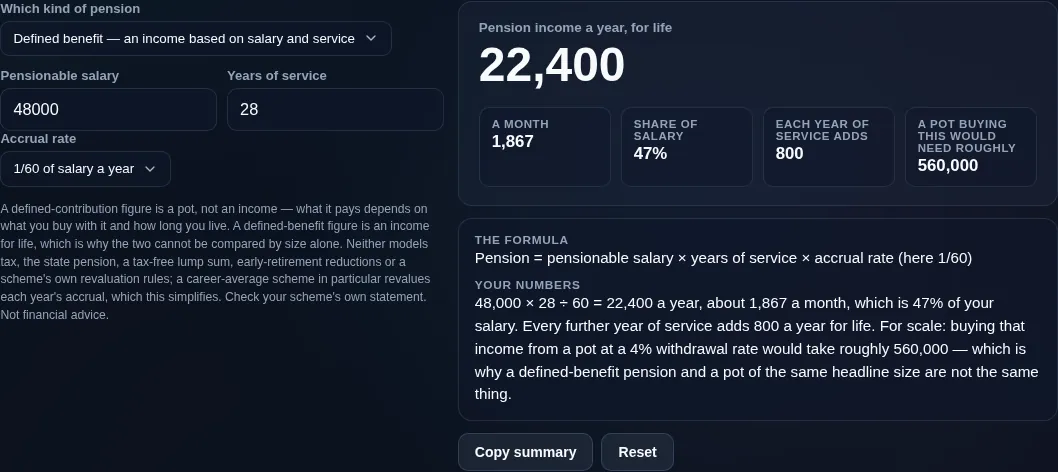
Pension calculator on a 1/60 accrual rate, paying more than the 1/80 rate because the accrual rate is a divisor
The accrual rate as a divisor, where 1/60 is better than 1/80
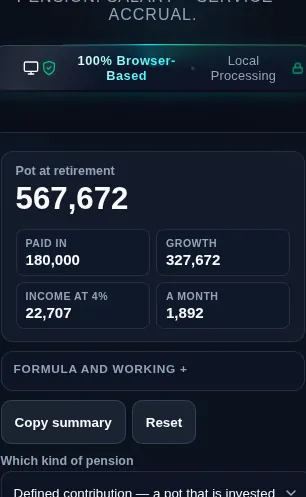
Pension calculator running in a phone browser with the scheme selector at the top
Mobile browser

When a pension calculator helps

Honesty matters here because pension schemes vary enormously. This tool is input-driven — it ships with no built-in national or scheme rules, so you enter your own accrual rate, salary basis, and growth assumption. That keeps it usable anywhere and stops it going stale, but it also means the result is only as good as your inputs. It's an estimate on a fixed rate; real returns and salaries change. It doesn't include the state pension unless you add it, and DB features like revaluation, inflation caps, tax-free lump sums (commutation), and survivor benefits are simplified. Pension income and lump sums are usually taxable, which this doesn't model.

None of this is financial or pension advice. See the 401(k) Calculator, Annuity Calculator, and Savings Drawdown Calculator for related planning. Everything runs privately in your browser.

  • DC pot projection. See what your fund could be worth at retirement.
  • DB income estimate. Work out a final-salary or career-average pension.
  • Contribution planning. Test how paying in more changes the pot.
  • Comparing schemes. Understand DB accrual vs a DC pot.
  • Any country. Enter your scheme's rules — nothing is hard-coded.

Realistic example (DB). 30 years of service, a £45,000 pensionable salary, and a 1/80 accrual rate gives 30/80 × 45,000 = £16,875 a year, about £1,406 a month.

Realistic example (DC). A £50,000 pot plus £500/month at 5% growth for 20 years projects to roughly £340,000, of which a large share is growth.

Advanced tip. For DC, small increases in contributions or years compound heavily — try nudging each to see the effect.

Common mistake to avoid. Don't forget the state pension and tax — this tool excludes both unless you add the state pension yourself.

Related. To turn a DC pot into income, see the Annuity Calculator or Savings Drawdown Calculator.

What to keep in mind

  • Input-driven, not built-in scheme rules. You enter the accrual rate, salary basis, and growth; nothing is hard-coded, so it works anywhere but depends on your inputs.
  • A fixed-rate estimate. Real returns and salaries vary; DB features like revaluation and caps are simplified.
  • State pension excluded. Add it yourself if you want a total.
  • Tax not modelled. Pension income and lump sums are usually taxable, varying by country.
  • Not financial or pension advice, and private. An estimate — and all math runs on your device, nothing uploaded.

Frequently Asked Questions

How is a defined benefit pension calculated?

A defined-benefit (final salary or career average) pension uses: annual pension = pensionable salary × years of service × accrual rate. The accrual rate is how much you build up each year, often written as a fraction like 1/60 or 1/80. For example, 30 years at 1/60 of a £45,000 salary is 30/60 × 45,000 = £22,500 a year. Enter your figures and the tool does this.
---

How much will my pension pot be worth?

For a defined-contribution pot, the tool projects the future value of your current balance plus regular contributions, grown at your assumed rate to retirement. For example, £50,000 plus £500 a month at 5% for 20 years reaches roughly £340,000. Change the contributions, growth, or years to see the effect. It's an estimate on a fixed rate, not a guarantee.

---

What's the difference between defined benefit and defined contribution?

A defined-benefit pension promises an income based on your salary and service — the employer carries the investment risk. A defined-contribution pension is a pot you and your employer pay into and invest; what you get depends on contributions and returns, and you carry the risk. DB is increasingly rare in the private sector; DC is now the norm. This tool estimates both.

---

What is an accrual rate (1/60, 1/80)?

The accrual rate is the fraction of your pensionable salary you earn as pension for each year of service. A 1/60 rate means each year adds 1/60th of salary; over 40 years that's 40/60, or two-thirds of salary. A 1/80 scheme builds up more slowly (often alongside a separate lump sum). You can also enter it as a percentage. The lower the denominator, the more generous the scheme.

---

What is pensionable or final salary?

Pensionable salary is the pay your pension is based on, which may exclude bonuses or overtime depending on the scheme. Final salary schemes use your salary at or near retirement; career average schemes use an inflation-adjusted average of your salary across your career. Enter whichever your scheme uses — it directly scales the pension, so use the correct definition from your scheme booklet.

---

Does this include the state pension?

No, not unless you add it. The tool estimates a workplace or personal pension — a DC pot or a DB income — based on what you enter. State or national pensions have their own rules and amounts that vary by country and contribution record, so add your expected state pension separately to get a total retirement income picture.

---

What growth rate should I assume for a DC pot?

Use a realistic, ideally conservative, long-run return for how the pot is invested, after charges — equities, bonds, and cash differ widely. Because the projection uses one constant rate, a high assumption can flatter the result significantly over decades. It's safer to under-estimate and treat the figure as a ballpark; real returns vary year to year and aren't guaranteed.

---

Does this account for inflation?

It can. Turn on the inflation option to see values in today's money (real terms), which is more meaningful over long horizons — a large pot in 30 years buys less than the same number today. Without it, figures are nominal. For DB pensions, real schemes often revalue benefits with inflation up to a cap, which this simplifies.

---

Is my pension income taxed?

Usually, yes. In most countries, pension income is taxable like other income, and any tax-free lump sum is limited by rules that vary by country and scheme. This tool shows gross figures and doesn't model tax. To estimate the tax on pension income, use an income tax tool with your own brackets, and check your scheme's specific tax treatment.

---

Does this use my country's scheme rules?

No — and that's deliberate. The tool is input-driven, with no built-in national or scheme rules, so you enter your own accrual rate, salary basis, and growth assumption. That's why it works for any country and never goes out of date, but it also means you must supply the correct figures from your scheme. Check your scheme booklet or provider for the exact rules.

---

Is this financial advice?

No. This calculator does arithmetic on the pension figures you enter — it projects a pot or estimates a DB income, but it doesn't recommend contribution levels, schemes, or retirement decisions, and it simplifies many real scheme features. For pension planning, consult a qualified financial adviser or your scheme administrator.

---

Is my data uploaded, and does it work offline?

No upload, and yes it works offline. Every calculation runs entirely in your browser, so your salary and pension details are never sent to a server, there's no account, and no tracking. Once the page has loaded it keeps working with no connection — useful for private retirement planning.

Still have questions?

If you can't find the answer you're looking for, feel free to contact our support team.

Contact Us