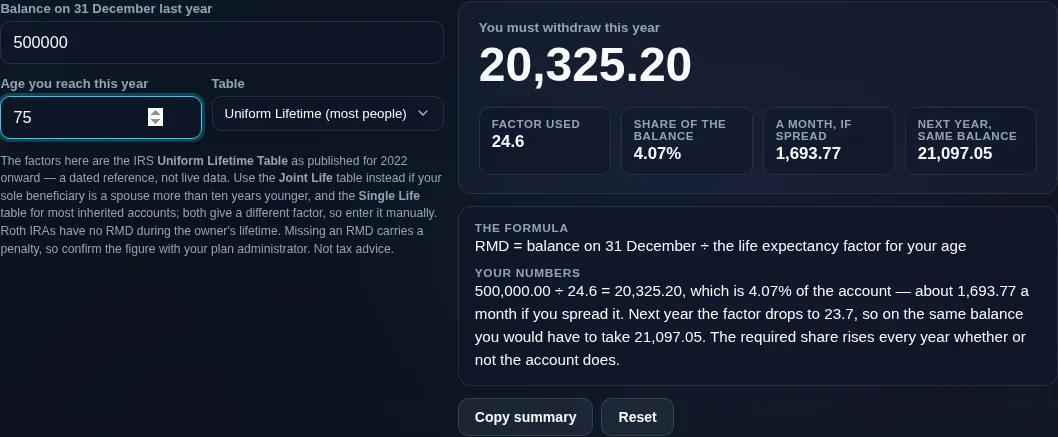
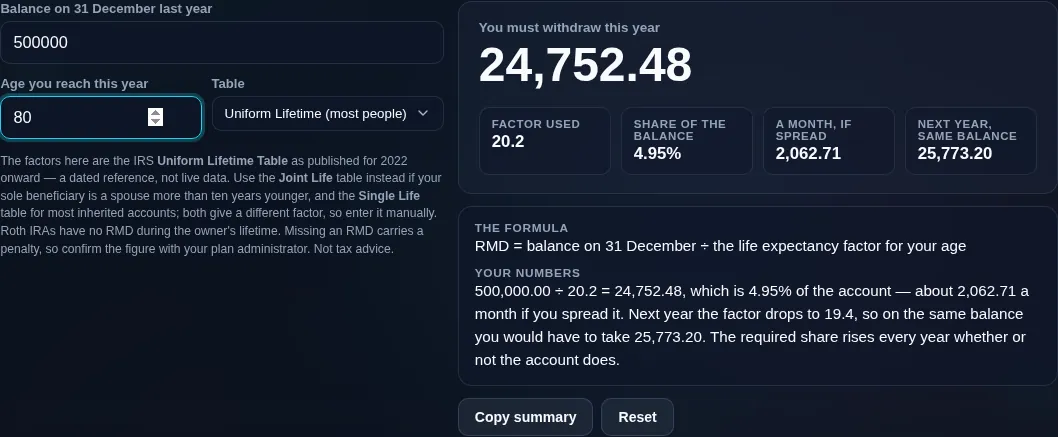
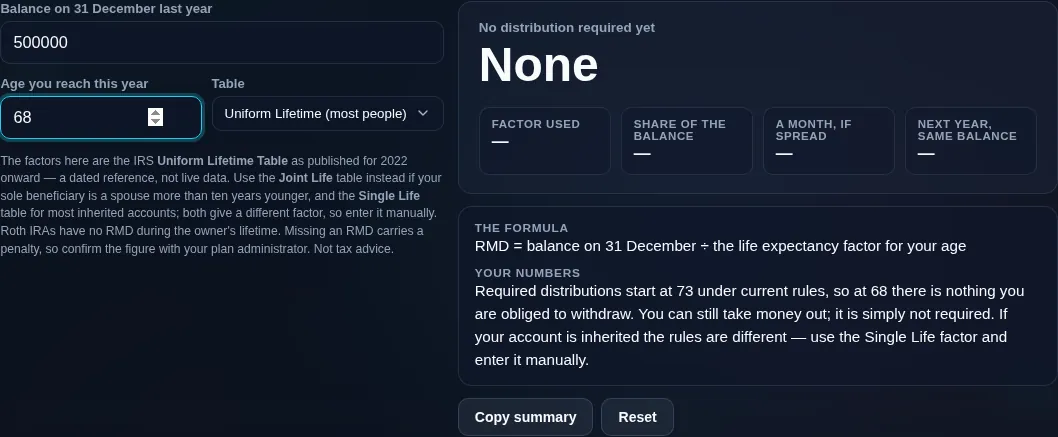
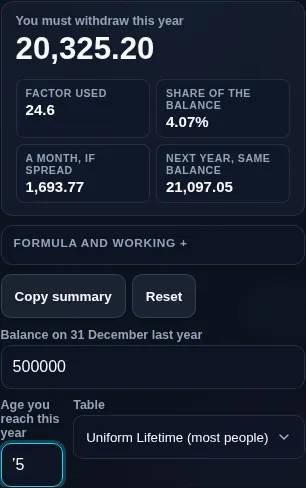
This is where honesty matters most, because RMDs are US-specific and change over time. The age RMDs begin was raised to 73 under the SECURE 2.0 Act (for those reaching it in 2023–2032) and is scheduled to move to 75 in 2033; the life-expectancy tables were updated in 2022. So this tool ships with dated factors and lets you edit them — treat it as an estimate, not a statement of current law, and always confirm the age and factor against IRS Publication 590-B. Two more important caveats: Roth IRAs have no RMD for the original owner, and inherited accounts follow different rules (often a 10-year drawdown). Missing an RMD can trigger an IRS excise penalty — real, but not something this tool computes.
None of this is tax or financial advice. For related planning, see the 401(k) Calculator and the Savings Drawdown Calculator. Everything runs privately in your browser.
- Yearly RMD. Work out the minimum you must withdraw this year.
- Planning withdrawals. Convert the annual figure into a monthly amount.
- Multiple IRAs. Sum like-account balances to size the total RMD.
- Checking a brokerage figure. Sanity-check the number your custodian gives you.
- Understanding the rules. See how the factor and age drive the amount.
Realistic example. A $500,000 traditional IRA balance at age 73, with a Uniform Lifetime factor of 26.5, gives an RMD of 500,000 ÷ 26.5 = about $18,868 for the year, or roughly $1,572 a month — an effective withdrawal of about 3.8%.
Advanced tip. The factor shrinks as you age, so the same balance produces a larger RMD (and a higher effective percentage) each year.
Common mistake to avoid. Don't assume Roth IRAs need an RMD — for the original owner they don't. Inherited accounts follow separate rules.
Related. For drawing down a pot flexibly beyond the minimum, see the Savings Drawdown Calculator.
What to keep in mind
- US-specific and dated. RMDs are an IRS rule; the age (73, rising to 75 in 2033) and tables change — factors here are dated and editable.
- Verify against IRS Publication 590-B. Confirm your age and life-expectancy factor before acting.
- Roth and inherited accounts differ. Roth IRAs have no RMD for the original owner; inherited accounts follow different (often 10-year) rules.
- Penalty exists but isn't computed. Missing an RMD can trigger an IRS excise tax.
- Not tax or financial advice, and private. An estimate — and all math runs on your device, nothing uploaded.