Comparing two texts, or comparing two lists?
These four tools read text rather than rewrite it. Two compare: a diff checker for two versions of the same text, where order and position matter, and a list comparison for two sets of items, where they do not. Two extract: emails and URLs, and numbers.
Every other group of text tools on this site hands your text back to you changed — tidied, recased, restyled, rewritten in another notation. Not one of these four does. They answer questions about text and leave the original exactly where it was. That is why none of them has an undo button: there is nothing to undo.
They divide into two pairs, and the split between the first pair is the one worth getting right before you click.
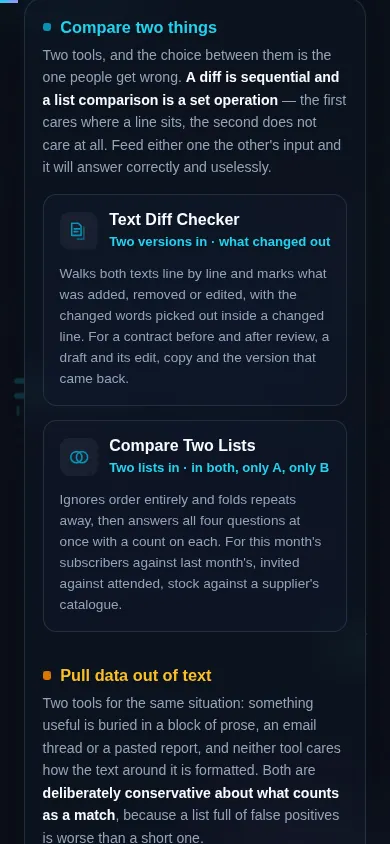
A diff is sequential. It walks two texts line by line, in order, and tells you what was inserted, deleted or edited between one version and the next. Position is the whole point: the same sentence moved from the top of a document to the bottom is a change, and a diff will say so. Reach for it when you have two versions of the same thing — a contract before and after review, a draft and its edit, a page of copy and the version that came back.
A list comparison is a set operation. It ignores order completely, folds duplicates away, and answers three questions: what appears in both lists, what is only in the first, and what is only in the second. The same item at the top of one list and the bottom of the other is simply in both. Reach for it when you have two collections of separate things — this month's subscribers against last month's, invited against attended, the SKUs you stock against the ones the supplier lists.
Feed a diff two shuffled lists and it will report almost every line as changed, correctly and uselessly. Feed a list comparison two drafts of a paragraph and it will tell you which sentences the two have in common, which is rarely the question. Both tools are working; only one of them was asked the right question.
The other two pull structured data out of unstructured text. One finds email addresses, web links and optionally phone numbers; the other finds numbers, and will total and average them for you. Both are for the same situation — something useful is buried in a block of prose, an email thread, a pasted report — and neither cares how the surrounding text is formatted.
Everything runs in your own browser. Two of these tools take two inputs rather than one, and both of those keep your original and your comparison side by side on screen the whole time. Nothing is uploaded.