Randomly.online
×

UUID Generator

Generation Controls


Validate UUID

Waiting for input...
Paste a UUID to identify its version and variant.

Generated Output

About The UUID Generator

Universally Unique Identifiers (UUIDs), also known as GUIDs, are 128-bit identifiers designed to guarantee uniqueness across space and time without requiring a centralized registration authority. Our free online UUID Generator provides a developer-focused, zero-latency environment designed strictly around the RFC-4122 specification. Whether you are scaffolding a new database, setting up primary keys, or assigning tracking IDs in distributed systems, this tool generates valid compliant formats immediately within your browser.

Unlike server-side generators, this application functions 100% locally. It means absolute privacy, zero network delay, and the ability to process bulk generation—creating up to 10,000 UUIDs instantly. If you deal with extensive string manipulations, you might also find our Text to Binary Converter or our Hash Generator highly complementary to your data processing workflow.

How to Use This Tool

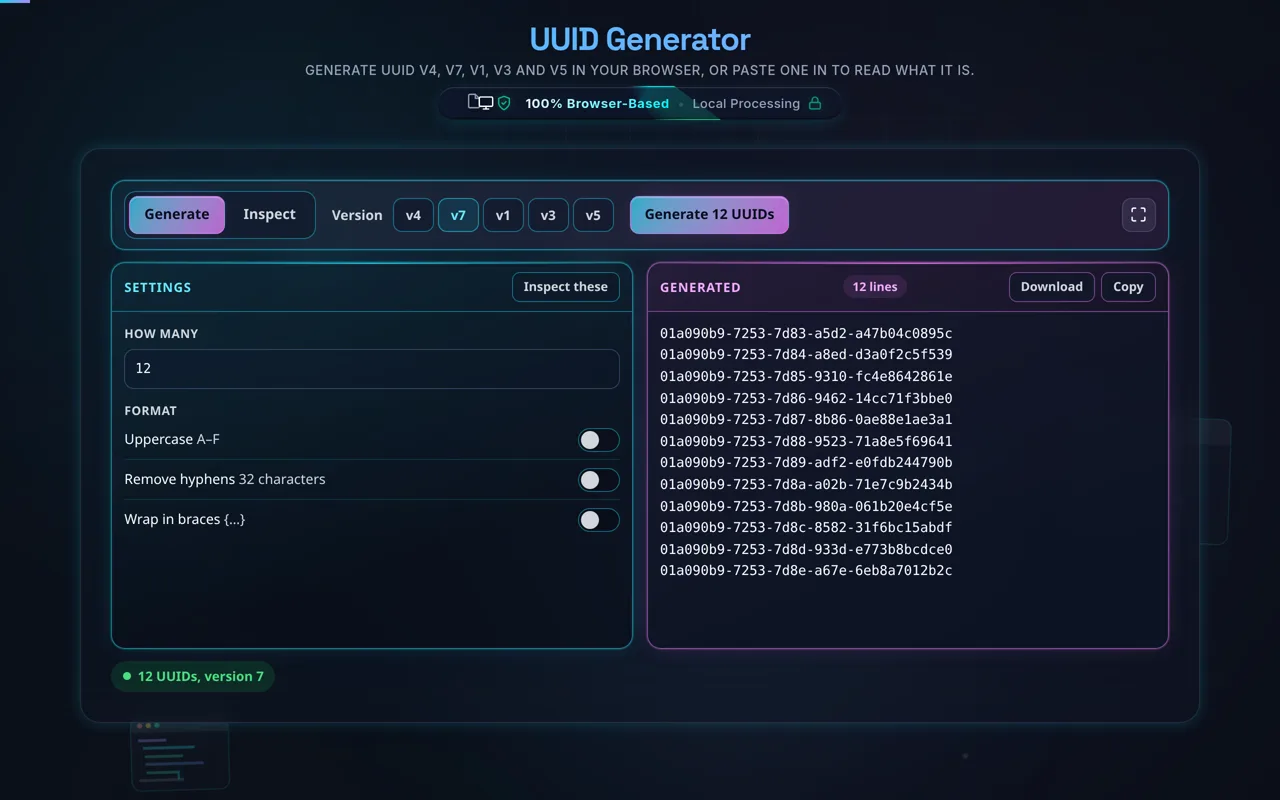
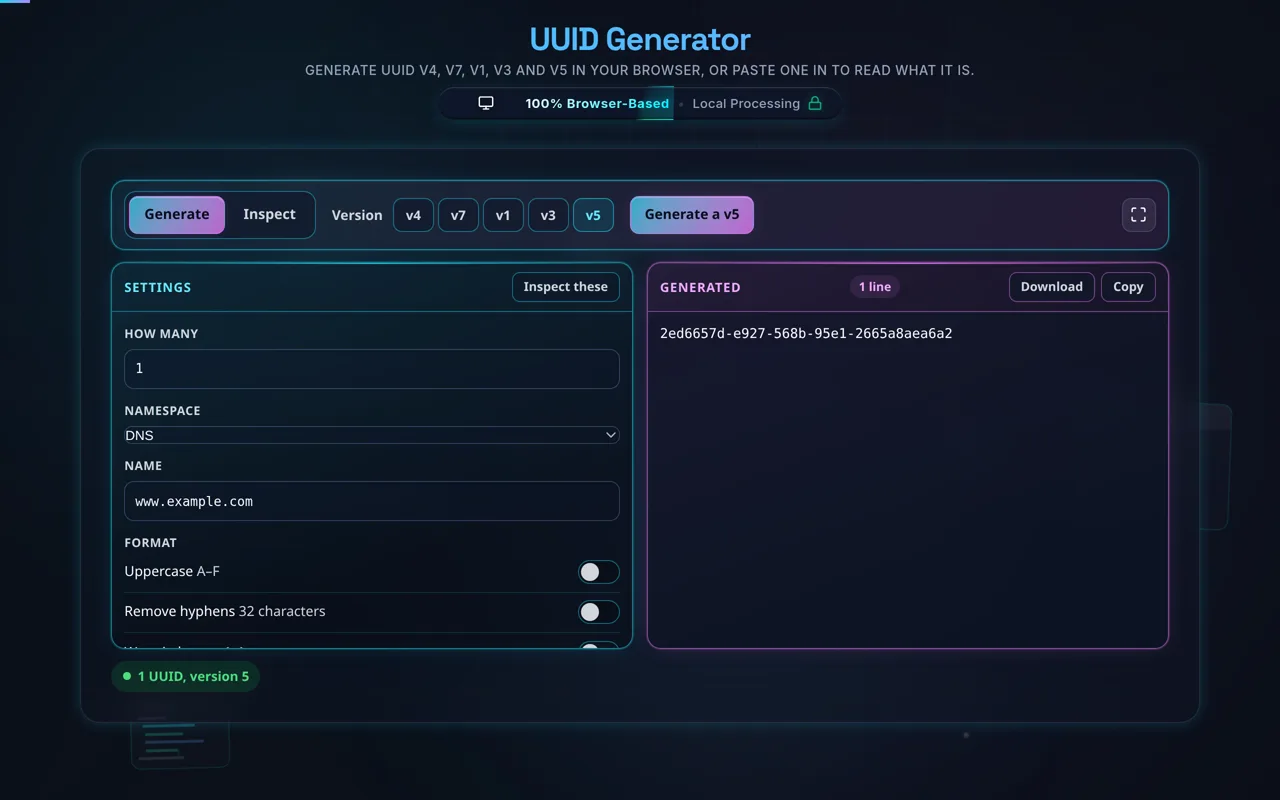
1. Select the Version: Choose between Version 1 (Time-based), Version 4 (Randomized - most common), Version 3 (MD5 Deterministic), or Version 5 (SHA-1 Deterministic). If using v3 or v5, you will be prompted to enter a specific Namespace ID and a Name string. For standard web and app development, v4 is generally recommended.

2. Configure Options: Specify the batch quantity. You can generate a single UUID or thousands simultaneously. You can also customize the output format by toggling "Uppercase output" or "Remove hyphens" depending on the strictness of your database schemas or API contracts.

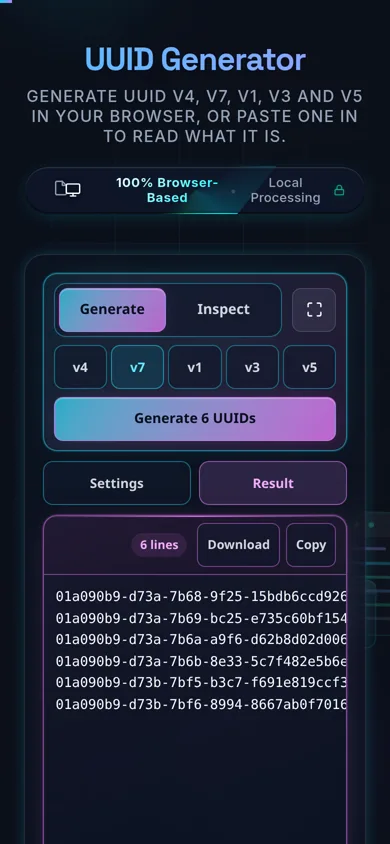
3. Generate and Export: Click the "Generate UUID(s)" button. The IDs will populate instantly. Use the 'Copy All' button to send them directly to your clipboard, or use the 'Download .txt' feature to save the bulk list directly to your local machine.

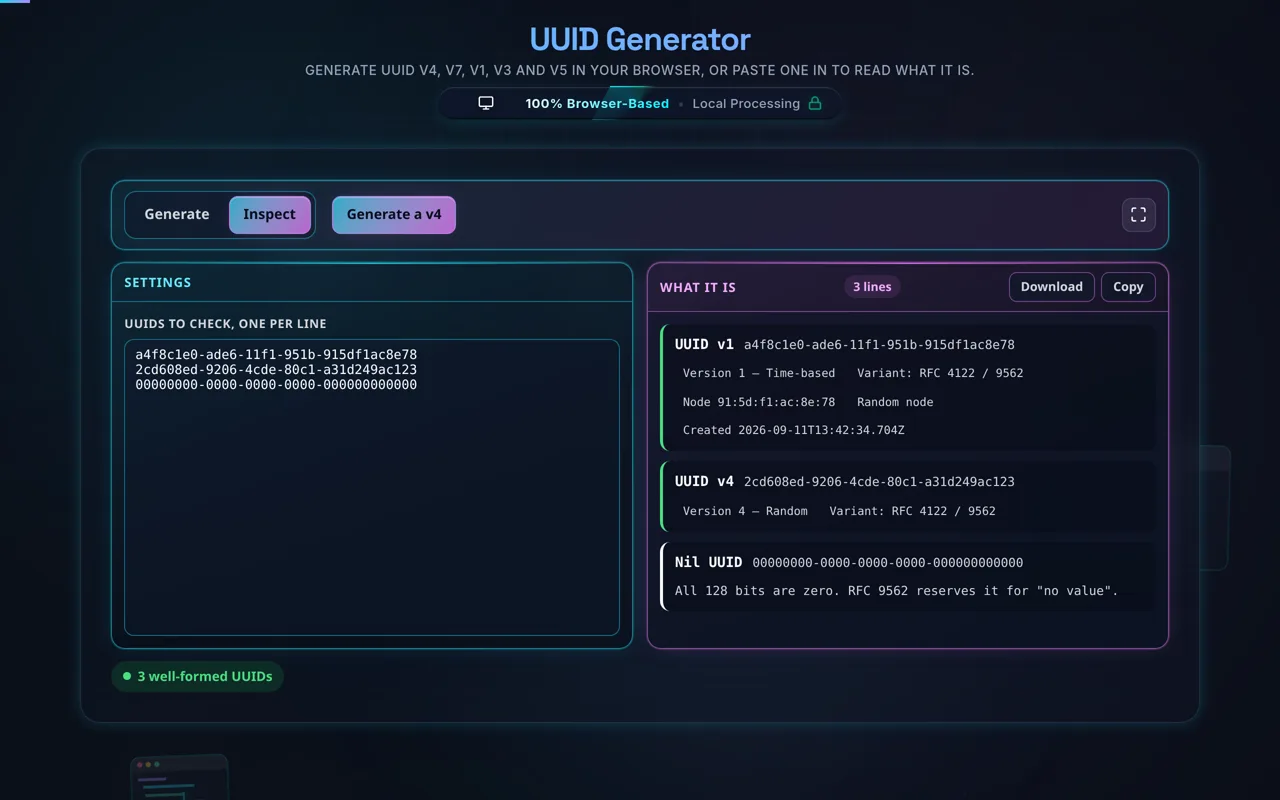
4. Validation: Paste any existing UUID into the validation box at the bottom of the control panel. The tool will instantly parse it, check it against standard formatting rules, and reveal its version number and variant structure.

Frequently Asked Questions

UUID versions serve different architectural needs based on how they derive uniqueness. Version 1 relies on the current time (down to 100-nanosecond intervals) combined with the MAC address of the generating machine. Version 4 is generated using entirely pseudorandom or secure random numbers, making it the most common choice for general usage. Version 3 and Version 5 are deterministic; they produce identical UUIDs if provided with the identical Namespace and Name inputs. The only difference is that Version 3 uses an MD5 hash, while Version 5 uses a mathematically stronger SHA-1 hash.

Yes, for all practical purposes. This tool utilizes modern Web Cryptography APIs (`crypto.randomUUID()` and `crypto.subtle`) available in modern browsers to ensure cryptographically secure random number generation for Version 4. The statistical probability of a collision (generating the exact same v4 UUID twice) is so infinitesimally small that it is considered zero. You would need to generate 1 billion UUIDs per second for about 85 years to reach a 50% chance of a single collision. For timestamp conversions often related to v1 UUIDs, developers often pair this with our Unix Timestamp Converter.

Absolutely. Security is central to how we engineered this application. All generation, hashing (for v3 and v5), and validation calculations execute locally within your browser's JavaScript engine. We do not send your Namespaces, Name strings, or any generated data to an external server. Your data never leaves your device, making it completely safe for enterprise and proprietary software development. If you need to manipulate authentication strings based on these UUIDs, refer to our Base64 Encoder / Decoder or our secure JWT Decoder.