Sunrise & Sunset Calculator
Sunrise
Sunset
Daylight
Everything You Need to Know About Sunrise & Sunset
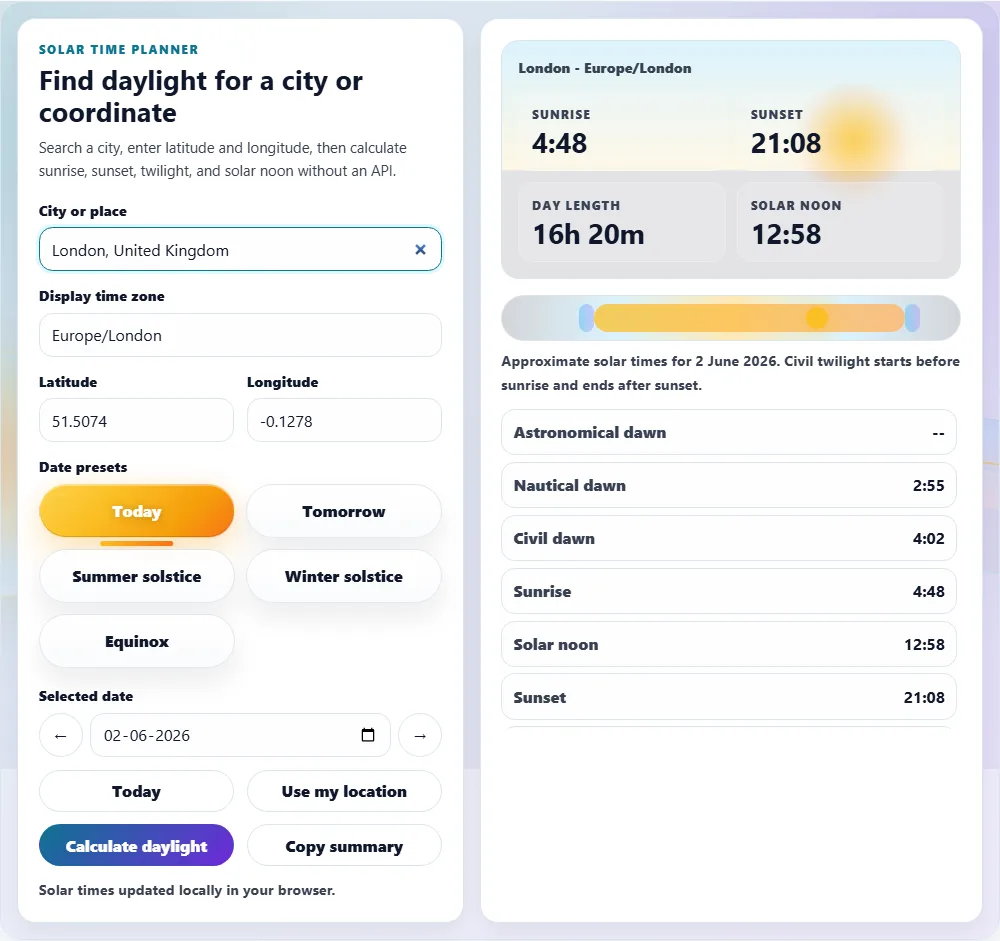
Understanding the precise moment the sun crests the horizon or dips below it is more than just a matter of curiosity. For photographers, hikers, gardeners, and those tracking their circadian rhythms, knowing the exact sunrise and sunset times is essential. This tool provides a deterministic window into the solar cycle, calculating events with high accuracy based on your specific latitude and longitude. By using our world clock integration alongside these solar metrics, you can plan your day with extreme precision.
The solar day varies significantly throughout the year due to the Earth's axial tilt and its elliptical orbit around the Sun. Near the summer solstice, northern latitudes experience their longest daylight duration, while the winter solstice brings the shortest. Our interface automatically identifies these seasonal proximity markers, helping you understand where you stand in the yearly cycle. Whether you are using a stopwatch to time a sunset photo shoot or simply checking for a morning run, the data provided here is computed instantly on your device without ever sending your location to a server.
To begin, select your location from the pre-defined city list or input your exact geographic coordinates. If you allow browser location access, the tool can resolve your coordinates instantly. Once the location is set, use the date selector to choose the specific day you want to analyze. The interface will immediately recalculate the times for sunrise, sunset, and total daylight duration.
The visual horizon strip is a powerful way to see your day at a glance. It maps the 24-hour cycle from midnight to midnight, highlighting the daylight band in yellow. You can also toggle "Advanced Mode" to see civil, nautical, and astronomical twilight times—crucial for stargazers and maritime navigation. For those working across time zones, combining this with our time zone converter ensures you never miss a solar event regardless of your current offset. Simply tap the "Copy" button to export your results in a clean text format for sharing or personal logs.
What is the difference between Sunrise and Civil Twilight? Sunrise occurs when the upper limb of the sun appears on the horizon. Civil twilight, however, begins (or ends) when the sun is 6 degrees below the horizon. During this period, there is enough light for most outdoor activities to continue without artificial illumination. This is often referred to as the "golden hour" in photography. Tracking these differences is easy with our military time converter which helps visualize these shifts on a 24-hour scale.
Why do sunrise times change every day? The changing times are a result of the Earth's 23.5-degree axial tilt and its path around the sun. This causes the "solar noon"—the moment the sun is highest in the sky—to shift slightly throughout the year, a phenomenon described by the Equation of Time. Because the Earth's orbit is elliptical, its speed also varies, meaning the length of a solar day isn't exactly 24 hours every day. You can use our day of week calculator to see how these patterns repeat across different calendar years.
How accurate are these solar calculations? Our tool uses standard astronomical algorithms that account for atmospheric refraction, which typically makes the sun appear slightly higher than it actually is. While these are highly accurate (within 1-2 minutes for most inhabited latitudes), extreme polar regions may see variations. For most practical uses, such as calculating work hours or planning outdoor events, these approximations are perfectly reliable and run entirely in your browser for maximum privacy.