Retirement Calculator

Project your retirement savings from your current balance, contributions, and expected return, with an inflation option.

100% Browser-Based Local Processing
%/yr
%/yr

A projection at a steady rate, not a forecast. Real markets do not return the same percentage every year, and the order those returns arrive in matters as much as the average. Tax, fees and any employer match are not modelled. Not financial advice — talk to a qualified adviser.

Pot at 65

1,122,621.35

In today's money 473,040.16
You put in 235,000.00
Growth 887,621.35
Income at 4% a year 1,576.80/mo
Formula and working

The formula

FV = S(1 + i)ⁿ + PMT × ((1 + i)ⁿ − 1) ÷ i, then discounted for inflation

Your numbers

Waiting for your numbers.

Privacy Focused

🔒 Local Processing. Your numbers never leave your device.

Instant Results

🌐 Fully Client-Side. Runs instantly in your browser.

No Signup

⚡ No accounts. No API keys. Just open and use.

Browser Based

🚀 No installs, no sign-ups, no server round-trip.

What is a Retirement Calculator?

A Retirement Calculator projects how big your retirement savings could grow. From your current age and savings, your regular contributions, your retirement age, and an expected annual return, it estimates your nest egg at retirement — optionally adjusted for inflation. It uses compound-growth math and runs privately in your browser, as an illustration of the long-term effect of saving.

Retirement saving is the ultimate compounding exercise: decades of contributions and returns building on each other. Seeing a projected number — even a rough one — helps you judge whether you're on track and how changes (saving more, retiring later) move the needle.

This calculator projects your balance at retirement from your inputs, with an option to view it in today's money. It runs entirely in your browser, so your financial details stay private.
How to project your retirement savings

Step 1: Enter your current age, planned retirement age, and current savings

Enter your current age, planned retirement age, and current savings.

Step 2: Add your regular contribution and an expected annual return

Add your regular contribution and an expected annual return.

Step 3: Read your projected nest egg at retirement; toggle inflation to see it in today's money

Read your projected nest egg at retirement; toggle inflation to see it in today's money.

Retirement Calculator in action

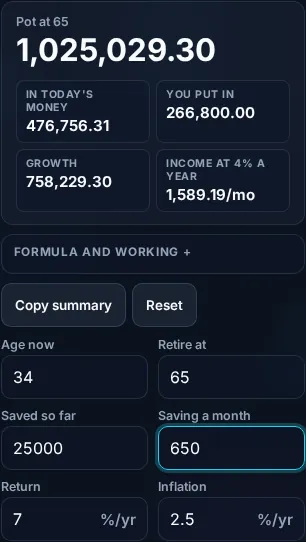
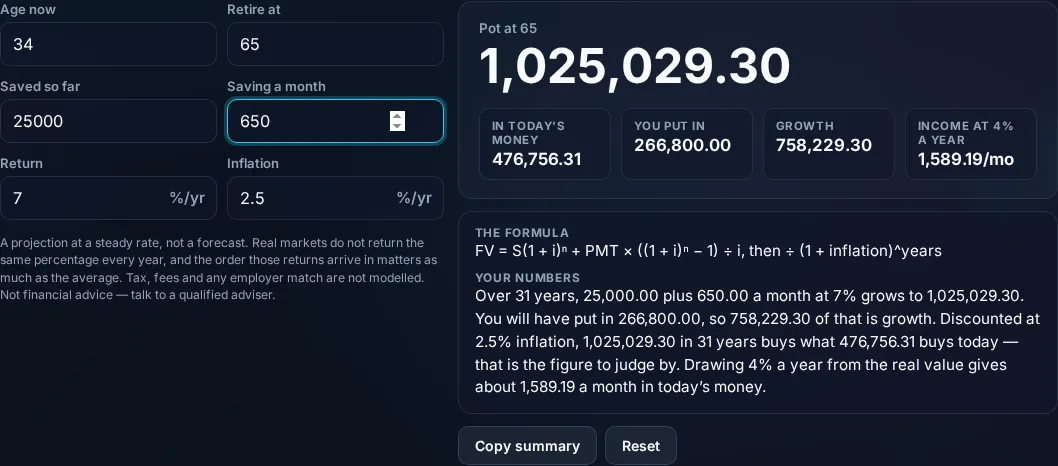
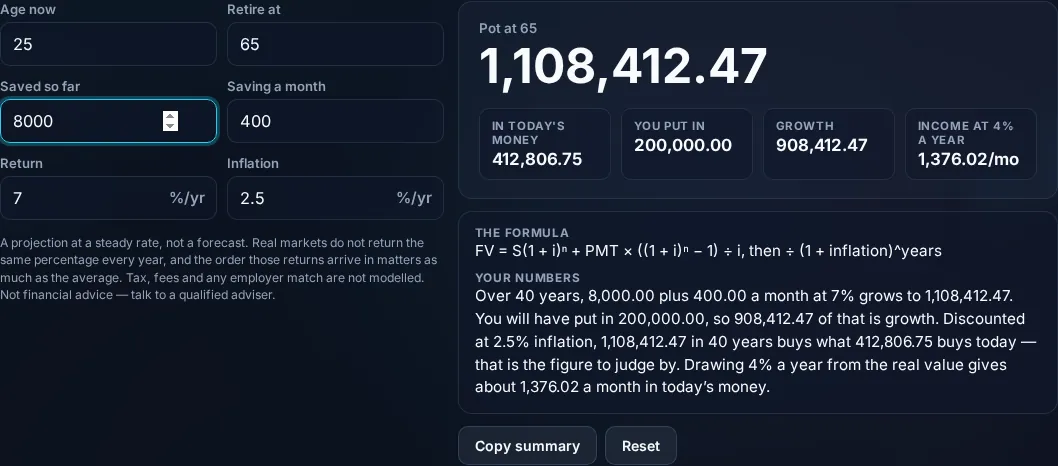
Retirement Calculator projecting a nest egg in the browser.
Nest egg projection
Retirement savings growth chart over the years.
Growth chart
Projecting retirement savings on a phone, no app installed.
Mobile (stacked)

Compounding over decades — and big assumptions

The projection compounds your current savings forward to retirement and adds the growing future value of your ongoing contributions, using your expected annual return. Over long horizons the result is dominated by compounding and time, which is why two levers matter most: the years you have (starting earlier dramatically increases the final figure) and the return rate (small differences compound into large gaps). Contributions matter too, especially early ones, which have the longest to grow. The inflation option is important because a big number in 30 years buys less than today — viewing the nest egg in 'today's money' (by using a real, after-inflation return) gives a more honest sense of its purchasing power. Now the essential honesty: this is a projection built on assumptions that won't hold exactly — real investment returns vary year to year and can be negative, contributions change, and tax treatment (401(k), IRA, pension rules) differs and isn't modelled in detail. It is not financial advice, and it can't tell you if you'll have 'enough' — that depends on your spending needs and other income. Treat it as a directional illustration and a way to compare scenarios, and consult a qualified financial professional for real planning. Everything computes locally. See also the Compound Interest and Savings Goal calculators.

Frequently Asked Questions

How does a retirement calculator project my savings?

It grows your current savings to your retirement age and adds the future value of your ongoing contributions, all compounded at your expected annual return. The longer the time and the higher the return, the larger the projected nest egg. It's the same compounding math applied over decades.

What return rate should I assume?

Use a realistic long-term estimate for your investment mix — historically diversified stock-and-bond portfolios have returned roughly mid-single digits to ~7% annually before inflation, but this varies and isn't guaranteed. Lower it for a more conservative projection. Trying a range of rates shows how sensitive the result is to this assumption.

Why should I account for inflation?

Because money loses purchasing power over time — a nest egg of $1 million in 30 years won't buy what $1 million buys today. Viewing the projection in 'today's money' (using an after-inflation return) gives a truer sense of what you'll actually be able to spend, which matters for long retirement horizons.

How much difference does starting early make?

A large one. Because growth compounds, contributions made early have the most time to grow and can outweigh much larger contributions made later. Delaying even a few years can noticeably shrink the final figure at the same monthly saving. The calculator makes this trade-off visible when you change the start age.

Does this tell me if I'll have enough to retire?

No. It projects a balance, but 'enough' depends on your future spending, life expectancy, other income (pensions, social security), and circumstances — none of which it knows. Use the projected nest egg as one input into that bigger question, and work with a financial professional to assess whether you're on track.

Is this retirement calculator financial advice?

No. It's an illustration based on the assumptions you enter, using simplified compounding and not modelling specific tax rules, account types, or market risk. Real outcomes will differ. Use it to explore scenarios and understand the mechanics, and consult a qualified financial adviser for decisions about retirement planning.

Is it free, and do I need to sign up?

Yes, it's completely free with no account, no trial, and no limit on how many times you use it. It runs entirely in your browser, so there's no sign-in wall — just open the page and calculate.

Is my data private?

Yes. Everything is calculated in your browser — the numbers you enter are never sent to a server, and nothing is stored once you close the tab. That keeps any personal figures (salary, loan, health) on your own device.

Does it work on mobile?

Yes. It runs in your phone's browser with nothing to install, so you can calculate on Android or iOS. The layout adapts to small screens, so entering numbers and reading the result is easy on the go.

Does it work offline?

Once the page has loaded, the calculation runs entirely on your device, so it keeps working without a connection. You only need to be online to open the page the first time — which is also why nothing you enter is uploaded.

Can I copy or share the result?

Yes. You can copy the result to your clipboard with one click, and many results can be shared. Because everything is calculated locally, copying is instant with no upload step.

How accurate is it, and is this professional advice?

The math is accurate for the inputs you give, and the formula is shown so you can verify it. But results are estimates for general use, not professional advice — finance calculators use simplified assumptions and ignore fees and rate changes, and health calculators are general estimates, not medical advice. For important decisions, consult a qualified professional.

Still have questions?

If you can't find the answer you're looking for, feel free to contact our support team.

Contact Us