Mortgage Refinance Calculator

See if refinancing pays off: monthly savings, break-even months, and an honest total-interest comparison (a lower payment can cost more).

100% Browser-Based Local Processing

The loan you have

%

The loan you are offered

%
yr
yr

A refinance is two questions, not one. The first is whether the monthly saving ever repays the closing costs — that is the break-even. The second is whether you pay less in total, and resetting 24 years left into a fresh 30 can lower the payment while costing more, because you pay for six years longer. Both are below. A "no-cost" refinance usually pays the fees out of a higher rate rather than not charging them. Compare offers on APR, not on the rate. An estimate from your figures, not a lender quote.

Break-even

1 yr 3 mo

New payment1,546.17
Saved each month419.63
Interest, staying put286,150.10
Interest, refinancing282,621.33
Formula and working

The formula

Payment = P × i ÷ (1 − (1 + i)^−n) · Break-even months = closing costs ÷ monthly saving

Your numbers

Waiting for your numbers.

An estimate, not financial advice. Figures are indicative, and the assumptions behind them are stated on the tool itself. Tax rules, rates and fees vary by country and change over time — check against your provider or a qualified adviser before acting on a number.

Privacy Focused

🔒 Local Processing. Your salary and balances never leave your device.

Instant Results

🌐 Fully Client-Side. Runs instantly in your browser.

No Signup

⚡ No accounts. No API keys. Just open and use.

Browser Based

🚀 No installs, no sign-ups, no bank account linking.

What is a Mortgage Refinance Calculator?

A Mortgage Refinance Calculator shows whether refinancing pays off. It finds your monthly savings and the break-even point — break-even months = closing costs ÷ monthly savings. It also compares total interest, because a lower payment can cost more overall if the new loan resets to a longer term.

Refinancing replaces your current mortgage with a new one — usually to get a lower rate, a lower payment, or a different term. Whether it's worth it comes down to two questions this calculator answers honestly: how long until the savings recover the cost, and do you actually save over the life of the loan?

Enter your current balance, rate, and remaining term, then the new rate and term and the closing costs. The tool computes the new monthly payment, your monthly savings (current payment minus new), and the break-even point — the number of months of savings it takes to recover the closing costs: break-even months = closing costs ÷ monthly savings. If you'll keep the mortgage well past break-even, refinancing generally pays off; if you might move or sell before then, it may not.

How to use the refinance calculator

Step 1: Enter your current loan. Balance, current rate, and remaining term

Enter your current loan. Balance, current rate, and remaining term.

Step 2: Enter the new loan. The new rate and term you're considering

Enter the new loan. The new rate and term you're considering.

Step 3: Enter the closing costs. Lender fees, appraisal, title, and other refi costs

Enter the closing costs. Lender fees, appraisal, title, and other refi costs.

Step 4: Read the results. See the new payment, monthly savings, break-even months, and the total-interest comparison

Read the results. See the new payment, monthly savings, break-even months, and the total-interest comparison.

Step 5: Judge it against your plans. Compare break-even to how long you expect to keep the mortgage, and check whether total interest actually falls

Copy if needed.

Mortgage Refinance Calculator in action

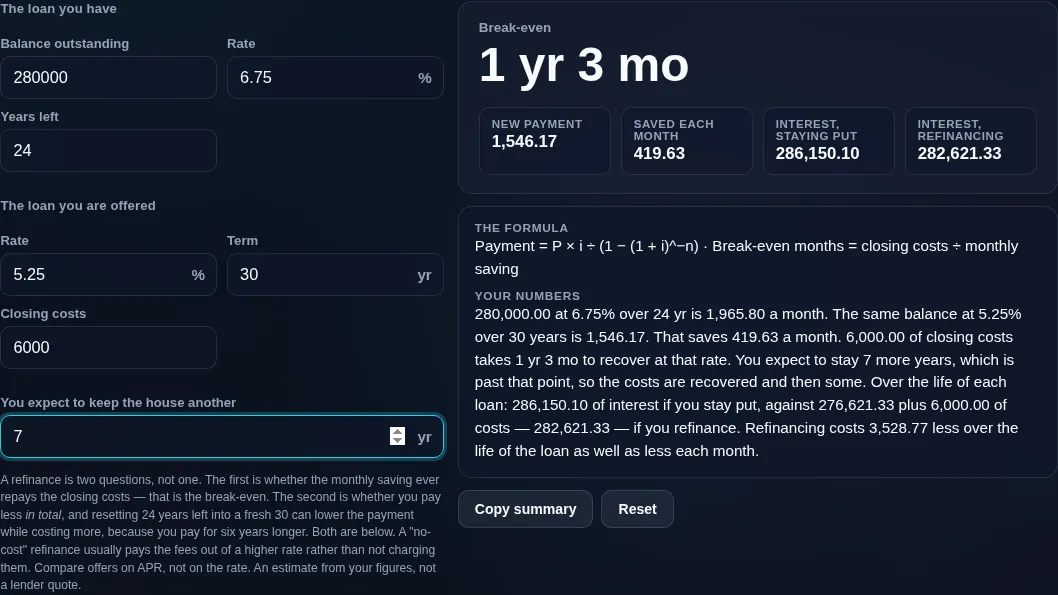
Refinance calculator taking 280,000 from 6.75% over 24 years to 5.25% over 30, saving 419.63 a month and recovering 6,000 of closing costs in 1 yr 3 mo
Savings + break-even result
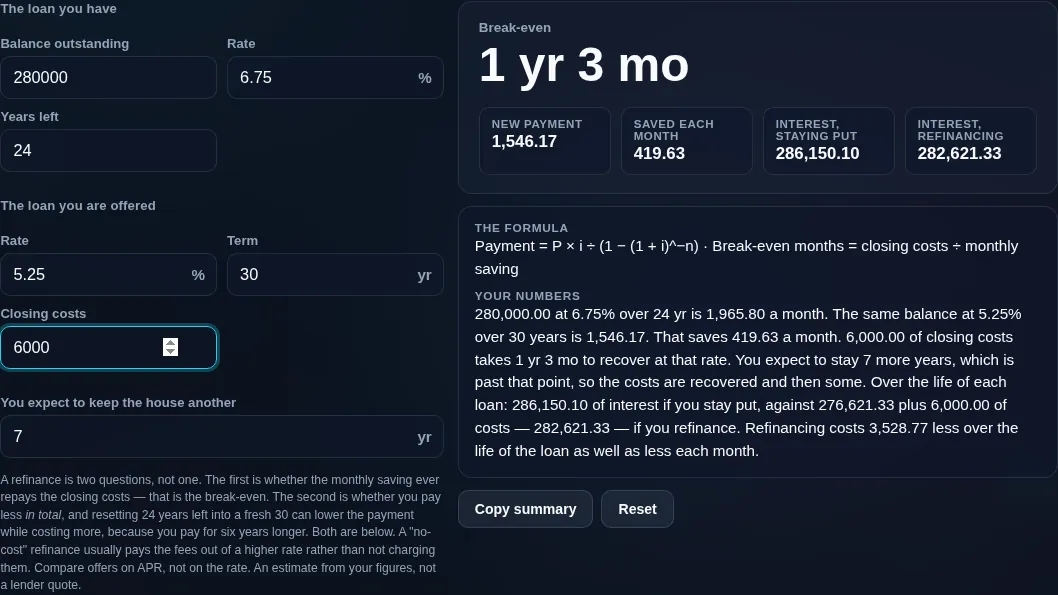
The same refinance with the lifetime columns side by side — 286,150.10 of interest on the current loan against 282,621.33 including closing costs on the new one
Total-interest comparison (old vs new)
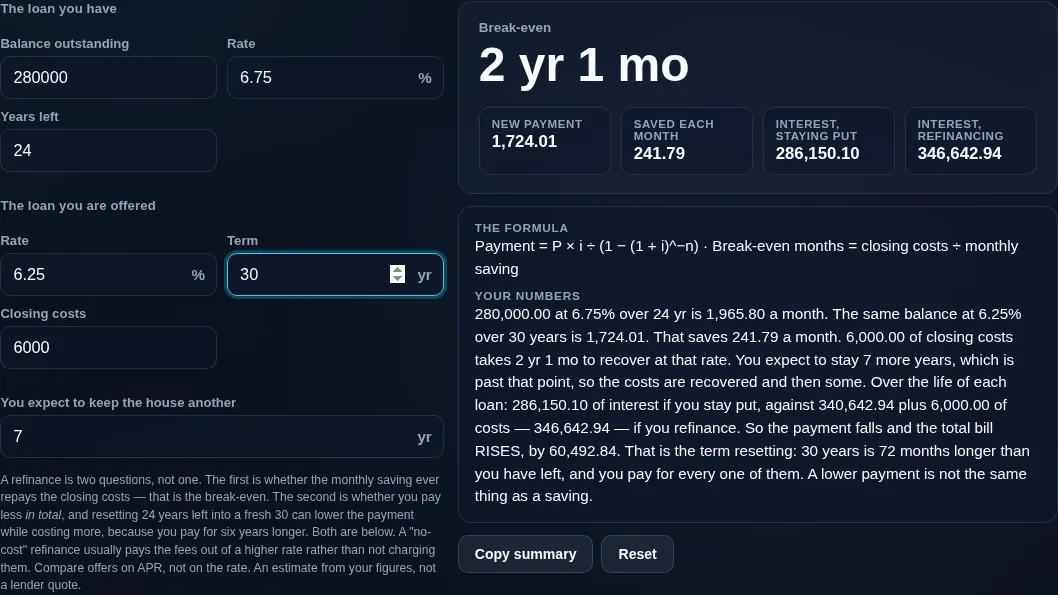
The same balance refinanced at 6.25% over 30 years, where the payment falls by 241.79 a month and the total bill rises by 60,492.84 because the term resets
Term-reset / longer-term-costs-more note
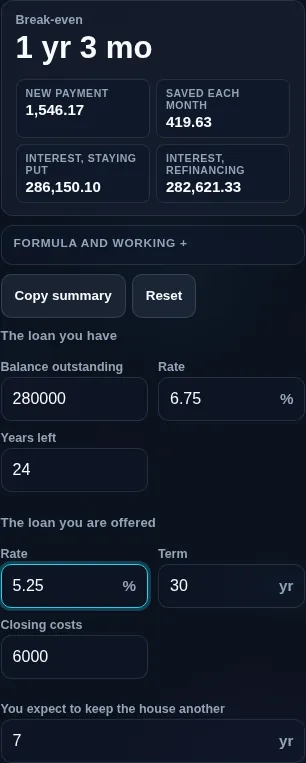
Mortgage refinance calculator running in a phone browser, with both loans and the break-even stacked
Mobile browser

When a refinance calculator helps

Here's the honesty most refinance calculators gloss over: a lower monthly payment doesn't always mean you save money. If you refinance a mortgage with 22 years left into a fresh 30-year loan, the payment drops — but you're now paying for eight more years, so the total interest can actually rise even at a lower rate. This tool shows the total interest both ways (what's left on your current loan versus the new loan plus closing costs), so the real trade-off is visible, not buried under a smaller monthly figure.

Two more notes: "no-cost" refinances usually aren't free — the fees are baked into a higher rate, so compare carefully. And compare APR, not just rate, since the true cost includes fees (see the APR Calculator).

This is an educational estimate, not financial advice or a lender quote — get real quotes for exact figures. Everything runs privately in your browser; your loan details are never uploaded, unlike lender refi tools that capture your information.

  • Deciding to refinance. See break-even and whether you truly save.
  • Rate-drop check. Test if a new, lower rate is worth the closing costs.
  • Payment vs total cost. Compare a lower payment against lifetime interest.
  • Timing. Weigh break-even against how long you'll stay in the home.
  • Term change. See the effect of shortening (or lengthening) the term.

Realistic example. You owe $250,000 at 7% with 25 years left (payment ≈ $1,767). A refinance to 5.5% over a new 30-year term drops the payment to ≈ $1,419 — saving $348/month. With $6,000 closing costs, break-even = 6,000 ÷ 348 ≈ 17 months. But the fresh 30-year term means you pay for 5 more years, so check the total-interest comparison before deciding.

Advanced tip. To capture the rate cut *without* extending the term, refinance into a term close to your remaining years (or keep paying the old amount) — you get the lower rate and avoid resetting the clock.

Common mistake to avoid. Don't judge a refinance on the monthly payment alone; a smaller payment over a longer term can cost more overall.

Related. For the full payoff table, see the Loan Calculator.

What to keep in mind

  • A lower payment can cost more. Extending the term can raise total interest even at a lower rate — check the total-interest comparison.
  • Include closing costs. Break-even only makes sense with fees factored in.
  • "No-cost" isn't free. Those fees are usually built into a higher rate.
  • Mind your timeline. If you'll move before break-even, refinancing may lose money.
  • Not advice or a quote. It's an educational estimate; get lender quotes for exact figures.
  • Your data stays private. All maths runs on your device; nothing is uploaded.
Frequently Asked Questions

How does this refinance calculator work?

You enter your current mortgage (balance, rate, remaining term) and the new loan you're considering (rate, term, closing costs). The tool computes the new monthly payment, your monthly savings, the break-even point, and — crucially — a comparison of total interest on the old versus the new loan, so you see whether refinancing saves money over the loan's life, not just each month.

---

How is the break-even point calculated?

Break-even months = closing costs ÷ monthly savings. If refinancing costs $6,000 and saves you $300 a month, break-even is 6,000 ÷ 300 = 20 months. That's how long it takes for the monthly savings to recover the upfront cost. Refinancing generally pays off if you keep the mortgage well beyond the break-even point.

---

Is it worth refinancing my mortgage?

It depends on the break-even point versus how long you'll stay, and on the total cost. If you'll keep the loan long past break-even and the total interest falls, it's usually worth it. If you might move before break-even, or the new loan resets to a much longer term and raises total interest, it may not be — even with a lower payment. The calculator shows both angles.

---

Can a lower monthly payment actually cost more?

Yes — and it's the most common refinancing trap. If you refinance a loan with, say, 22 years left into a new 30-year term, the monthly payment drops because it's spread over more years — but you pay for eight extra years, so the total interest can be higher even at a lower rate. Always check the total-interest comparison, not just the payment.

---

What counts as closing costs?

Refinance closing costs typically include lender origination or application fees, an appraisal, title search and insurance, recording fees, and sometimes points (prepaid interest to lower the rate). They often run a few percent of the loan amount. Because break-even depends on them, enter your total closing costs accurately — a refinance with high fees takes much longer to pay off.

---

What is a "no-cost" refinance?

A "no-cost" refinance doesn't charge upfront closing costs — but the fees don't vanish. The lender usually recovers them by giving you a slightly higher interest rate, or by rolling the costs into the loan balance. So you pay over time instead of upfront. It can make sense if you'll move soon, but compare the total cost against a standard refinance before assuming it's cheaper.

---

How much lower does the rate need to be?

There's no fixed threshold — the old "1% rule" is a rough guide, not a rule. What actually matters is the break-even point and your timeline: a small rate cut with low closing costs can be worth it if you'll stay long enough, while a bigger cut with high fees might not pay off if you move soon. Use the break-even figure rather than the rate drop alone.

---

Should I refinance if I might move soon?

Probably not, if you'll move before the break-even point. Since break-even is when your monthly savings finally recover the closing costs, selling or moving before then means you paid the fees without recouping them. Compare the break-even months to how long you realistically expect to keep the mortgage — if it's shorter, refinancing likely loses money.

---

Does refinancing reset my loan term?

It can, and this is easy to overlook. A refinance is a new loan, so if you choose a fresh 30-year term you restart the clock — extending how long you pay and often increasing total interest, even at a lower rate. To avoid resetting, pick a new term close to your remaining years, or keep paying the previous monthly amount so you finish on schedule.

---

What's the difference between rate and APR here?

The interest rate determines your monthly payment. The APR folds in most fees and points, so it reflects the true yearly cost of the loan and is better for comparing offers. Two loans with the same rate can have different APRs if their fees differ. This tool works from the rate for the payment; for the fee-inclusive cost, use the APR Calculator.

---

Is this financial advice or a lender quote?

Neither. It's an educational estimate to help you understand whether refinancing might pay off. It isn't financial advice, and it can't give you an actual rate or approve a loan. Real closing costs, rates, and terms come from lender quotes and depend on your credit and property, so get formal quotes before deciding.

---

Is my data uploaded, and does it work offline?

No upload, and yes it works offline. Every calculation runs entirely in your browser, so your loan details are never sent to a server, there's no account, and no lead-gen or tracking. Once the page has loaded it keeps working with no connection — a private alternative to lender refinance tools that capture your information.

Still have questions?

If you can't find the answer you're looking for, feel free to contact our support team.

Contact Us