APR Calculator

Work out a loan's true annual cost — the APR — by folding fees into the rate, so you can compare offers fairly.

100% Browser-Based Local Processing
%
yr

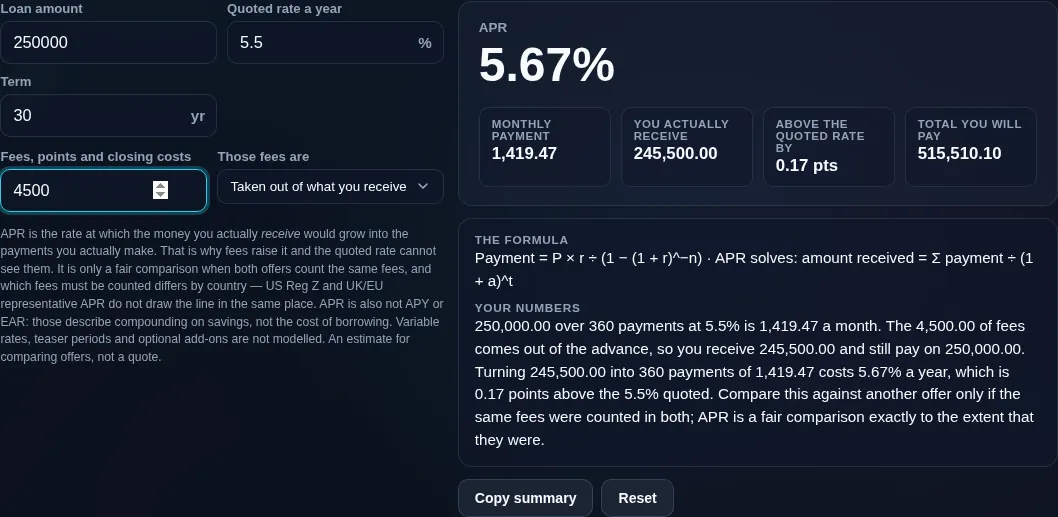
APR is the rate at which the money you actually receive would grow into the payments you actually make. That is why fees raise it and the quoted rate cannot see them. It is only a fair comparison when both offers count the same fees, and which fees must be counted differs by country — US Reg Z and UK/EU representative APR do not draw the line in the same place. APR is also not APY or EAR: those describe compounding on savings, not the cost of borrowing. Variable rates, teaser periods and optional add-ons are not modelled. An estimate for comparing offers, not a quote.

APR

5.67%

Monthly payment1,419.47
You actually receive245,500.00
Above the quoted rate by0.17 pts
Total you will pay515,510.10
Formula and working

The formula

Payment = P × r ÷ (1 − (1 + r)^−n) · APR solves: amount received = Σ payment ÷ (1 + a)^t

Your numbers

Waiting for your numbers.

An estimate, not financial advice. Figures are indicative, and the assumptions behind them are stated on the tool itself. Tax rules, rates and fees vary by country and change over time — check against your provider or a qualified adviser before acting on a number.

Privacy Focused

🔒 Local Processing. Your salary and balances never leave your device.

Instant Results

🌐 Fully Client-Side. Runs instantly in your browser.

No Signup

⚡ No accounts. No API keys. Just open and use.

Browser Based

🚀 No installs, no sign-ups, no bank account linking.

What is a APR Calculator?

An APR Calculator finds a loan's true yearly cost. APR — the annual percentage rate — folds the loan's fees and points into the interest rate, so it's usually higher than the quoted rate. Enter the amount, rate, term, and fees to compare offers on a like-for-like basis.

The interest rate a lender advertises isn't the whole story. Two loans with the same rate can cost very different amounts once you add fees, points, and closing costs. The annual percentage rate (APR) rolls those costs into a single yearly rate, which is why it's the fairest way to compare offers — and usually a little higher than the headline interest rate.

This calculator works out the APR from your loan amount, nominal interest rate, term, and upfront fees. It first finds your monthly payment from the nominal rate, then solves for the rate that would produce those same payments if you'd only received the amount *net of fees* — that solved rate, annualised, is the APR. You'll see the APR, the monthly payment, the total cost over the term, and the gap between the nominal rate and the APR. A compare mode lets you put two offers side by side so the genuinely cheaper one is obvious.

How to calculate APR

Step 1: Enter the loan. Amount, nominal interest rate, and term

Enter the loan. Amount, nominal interest rate, and term.

Step 2: Add the fees. Points, origination, and closing costs paid upfront

Add the fees. Points, origination, and closing costs paid upfront.

Step 3: Read the APR. The fee-inclusive annual rate, alongside the monthly payment and total cost

Read the APR. The fee-inclusive annual rate, alongside the monthly payment and total cost.

Step 4: Compare the gap. See how much higher the APR is than the quoted rate

Compare the gap. See how much higher the APR is than the quoted rate.

Step 5: Optional: compare offers. Enter a second loan to see which is cheaper overall

Copy any figure.

APR Calculator in action

APR calculator on a 250,000 loan quoted at 5.5% with 4,500 of fees deducted from the advance, giving an APR of 5.67%
A quoted rate with the fees taken out of the advance
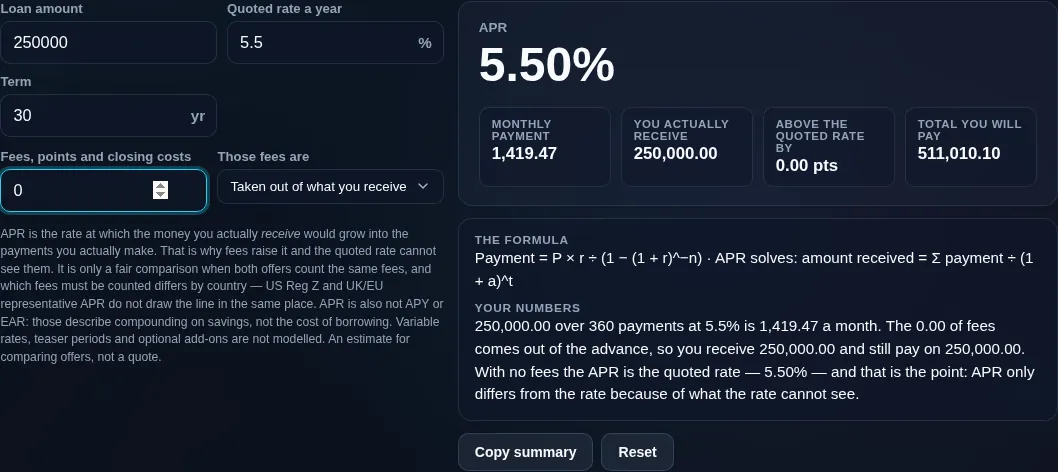
The same loan with the fees set to zero, where the APR reads 5.50% — identical to the quoted rate
The same loan with no fees, where the APR is the quoted rate exactly
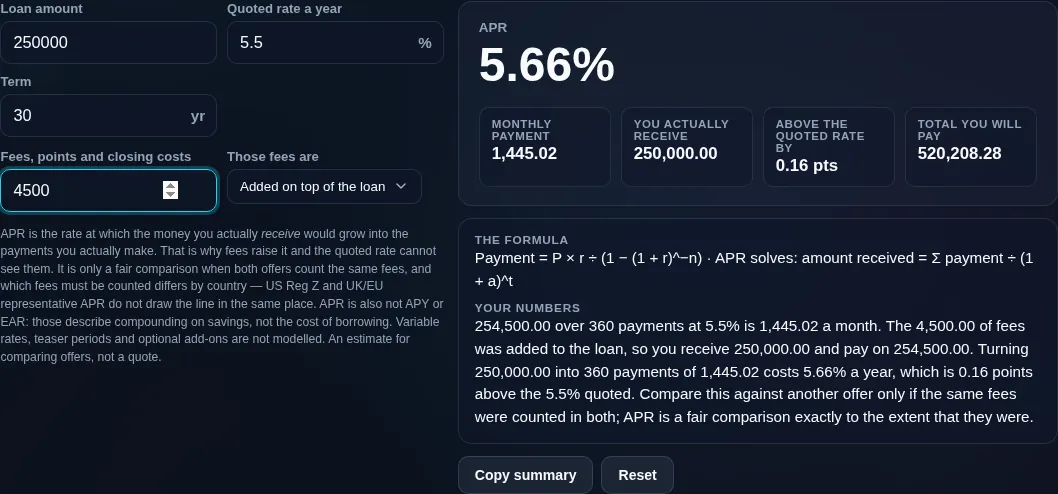
The same 4,500 of fees financed into the loan instead of deducted, giving an APR of 5.66% and a higher monthly payment
The same fees financed into the loan instead, which is a different APR
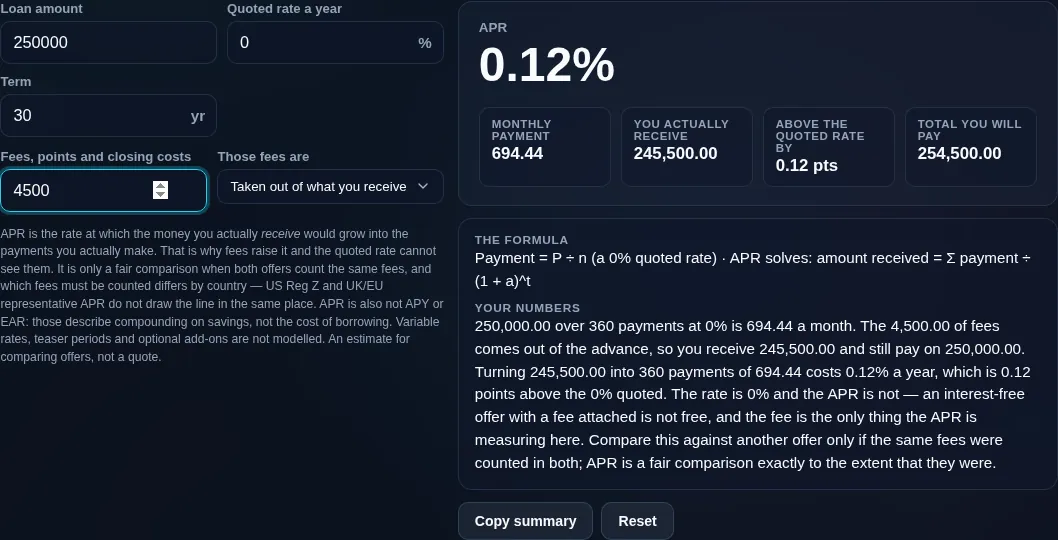
APR calculator on a 0% interest-free offer carrying 4,500 of fees, reporting an APR of 0.12% rather than zero
A 0% offer with a fee attached, where the APR is not 0
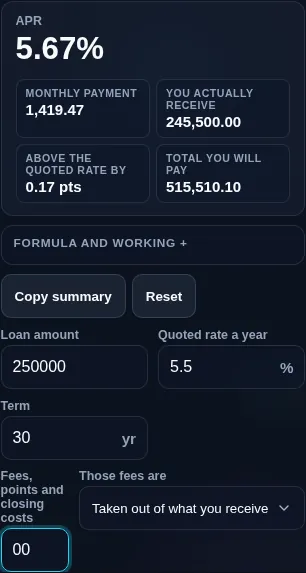
APR calculator running in a phone browser, with the offer inputs and the APR result stacked
Mobile browser

When an APR calculator helps

A few honest points. First, APR definitions vary by country and by which fees are included — US rules (Truth in Lending / Reg Z), UK/EU "representative APR", and others don't count fees identically. This tool includes exactly the fees *you* enter, so an APR is only comparable when the same costs are counted. Second, APR is not the same as APY or EAR: APR measures the cost of *borrowing* including fees, while APY/EAR describes the effect of *compounding* on savings or the effective annual rate — the tool can show EAR separately so you don't confuse them. Third, APR still can't capture everything, such as variable rates or teaser periods.

These figures are an estimate to help you compare, not financial or legal advice. For the full payment breakdown, see the Loan Calculator; to weigh financing against leasing, the Lease vs Buy Calculator. Everything runs privately in your browser.

  • Comparing loan offers. Fold fees in so two quotes are truly comparable.
  • Mortgages with points. See what buying points does to the real rate.
  • Car and personal loans. Check the cost behind a low advertised rate.
  • Understanding a quote. See why your APR is higher than the interest rate.
  • APR vs APY. Keep borrowing cost and compounding straight.

Realistic example. A $200,000 loan at 6% over 30 years has a monthly payment of about $1,199. Add $6,000 in fees and the APR rises to roughly 6.28% — the fees make the loan cost more than the 6% rate suggests, even though the payment is unchanged.

Advanced tip. When comparing, a loan with a lower rate but higher fees can have a *higher* APR than one with a slightly higher rate and no fees — APR is what settles it.

Common mistake to avoid. Don't compare an APR that includes fees against a plain interest rate — compare APR to APR, with the same fees counted.

Related. To see every payment split into interest and principal, use the Loan Calculator.

What to keep in mind

  • APR definitions vary. Countries and lenders include different fees, so APRs are only comparable when the same costs are counted.
  • APR is not APY or EAR. APR is fee-inclusive borrowing cost; APY/EAR is about compounding. The tool can show EAR separately.
  • It can't capture everything. Variable rates, teaser periods, and optional add-ons change real cost.
  • Not financial or legal advice. It's an estimate to help you compare offers.
  • Private. All math runs on your device — nothing is uploaded.
Frequently Asked Questions

What is APR?

APR — annual percentage rate — is the yearly cost of borrowing expressed as a percentage, including not just the interest but also fees and points rolled in. Because it captures those extra costs, it's usually higher than the quoted interest rate and is the fairest single number for comparing loan offers. This tool calculates it from your loan amount, rate, term, and fees.

---

How is APR different from the interest rate?

The interest rate is just the cost of borrowing the money; the APR is that rate *plus* the loan's fees and points, expressed as one annual percentage. So a 6% loan with $6,000 of fees might have an APR of about 6.28%. If a loan has no fees, its APR and interest rate are essentially the same. APR is what lets you compare offers fairly.

---

Does APR include fees?

Yes — that's the whole point of it. APR folds in the finance charges tied to the loan: origination fees, points, and many closing costs, spread across the term as an annual rate. Which specific fees count can differ by country and lender, though. This calculator includes exactly the fees you enter, so make sure you compare loans using the same set of costs.

---

How is APR calculated?

The tool first works out your monthly payment from the nominal rate and term. Then it treats the amount you actually receive as the loan minus upfront fees, and solves for the rate that makes those same payments equal that smaller net amount. Annualised, that solved rate is the APR. Because fees mean you effectively borrowed less for the same payments, the APR comes out higher than the nominal rate.

---

What's the difference between APR and APY (or EAR)?

APR is about borrowing — the fee-inclusive annual cost of a loan, quoted without intra-year compounding in the US sense. APY (annual percentage yield) and EAR (effective annual rate) are about compounding — how a rate grows over a year on savings or the true effective rate. Don't compare a loan's APR to a savings APY; they answer different questions. The tool can show EAR separately.

---

Why is my APR higher than the quoted rate?

Because of fees. The interest rate covers only the interest, but the APR adds the loan's upfront costs — origination, points, and closing fees — and spreads them over the term as an annual rate. The more fees a loan has, the bigger the gap between its rate and its APR. A no-fee loan has almost no gap.

---

What is a good APR?

It depends entirely on the loan type, your credit, and current market rates — a good mortgage APR is very different from a good credit-card APR, and both move with central-bank rates. Rather than chasing an absolute number, use APR to compare the specific offers in front of you: the lower APR, for the same loan and term, is the cheaper one. This tool isn't advice on what's "good".

---

Can I use this to compare two loan offers?

Yes. Enter each loan's amount, rate, term, and fees, and the compare mode shows both APRs and total costs side by side. This is where APR earns its keep: a loan with a lower interest rate but higher fees can be more expensive overall than one with a slightly higher rate and no fees. APR settles it — as long as you count the same fees on both.

---

Does the APR here match my lender's exactly?

Not necessarily. Lenders follow country-specific rules about which fees must be included in APR (for example US Truth in Lending, or UK/EU representative APR), and they may round differently. This tool includes the fees you enter using a standard method, which is ideal for comparing offers on equal terms — but for the legally disclosed APR, rely on your lender's official documents.

---

Does this work for mortgages, car loans, and credit cards?

It works for any amortizing installment loan — mortgages, car loans, personal loans, student loans — where you enter an amount, rate, term, and fees. Credit cards are different: they're revolving credit, and their APR is applied to a changing balance rather than a fixed schedule, so a card's stated APR (and any cash-advance or penalty APRs) is best read from the card's terms.

---

Is this financial advice?

No. This calculator computes APR and total cost from the numbers you enter — it helps you compare loans, but it doesn't recommend a lender, a loan, or whether to borrow at all. Results are estimates and depend on the fees you include. For a borrowing decision, consult a qualified financial professional.

---

Is my data uploaded, and does it work offline?

No upload, and yes it works offline. Every calculation runs entirely in your browser, so your loan and fee details are never sent to a server, there's no account, and no tracking. Once the page has loaded it keeps working with no connection — handy for comparing quotes privately before you talk to a lender.

Still have questions?

If you can't find the answer you're looking for, feel free to contact our support team.

Contact Us