Temperature Converter

Convert temperature between Celsius, Fahrenheit, and Kelvin.

100% Browser-Based Local Processing

How this conversion works

The relation

Worked example

    4

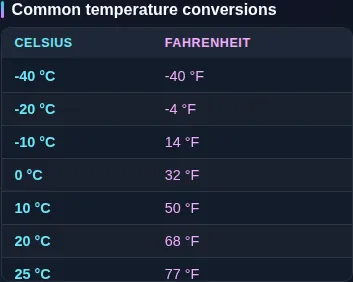
    Common temperature conversions

    CelsiusFahrenheit

    Privacy Focused

    🔒 Local Processing. The values you enter never leave your device.

    Instant Results

    🌐 Fully Client-Side. Runs instantly in your browser.

    No Signup

    ⚡ No accounts. No API keys. Just open and use.

    Browser Based

    🚀 No installs, no sign-ups, no conversion limits.

    What is a Temperature Converter?

    > Temperature Converter converts between Celsius, Fahrenheit, and Kelvin. Enter a value, pick your scales, and read the result with the exact formula shown — °F = °C × 9/5 + 32, and K = °C + 273.15. For reference, water freezes at 0 °C = 32 °F and boils at 100 °C = 212 °F. Works offline. ---

    ### H2: Convert Celsius, Fahrenheit, and Kelvin — with the formula shown

    Temperature is the one everyone second-guesses. A recipe from the US sets the oven in Fahrenheit while your dial is Celsius; a weather app abroad reads 30° and you're not sure whether to pack a coat or shorts; a science problem wants an answer in Kelvin. Unlike converting metres to feet, you can't just multiply by a single number — the scales start from different zero points — so it's easy to get wrong in your head.

    This converter handles the three scales people use: Celsius (°C), Fahrenheit (°F), and Kelvin (K). Type a value, choose what you're converting *from* and *to*, and the answer appears instantly. A swap button reverses the direction, and the all-scales panel shows your value in all three at once, so "37 °C" appears as 98.6 °F and 310.15 K on one screen.

    The key feature is that it shows the exact formula it used. Going from Celsius to Fahrenheit is °F = °C × 9/5 + 32; the reverse is °C = (°F − 32) × 5/9; and Kelvin is simply °C + 273.15. Seeing the formula means you can follow the math, learn it, and trust the result rather than guessing.

    To make conversions memorable, the tool includes a strip of reference points: water freezes at 0 °C = 32 °F = 273.15 K, water boils at 100 °C = 212 °F = 373.15 K, absolute zero is −273.15 °C = 0 K, and the two everyday scales famously cross at −40 (−40 °C = −40 °F). Everything runs on your own device, so there's nothing to upload and no connection needed once the page loads.
    ---

    How to use the Temperature Converter

    Step 1: Enter your value. Type the temperature into the input box

    Celsius and Fahrenheit can be negative; Kelvin cannot go below zero.

    Step 2: Pick the "from" scale. Choose the scale your number is currently in — for example, Celsius (°C)

    Pick the "from" scale. Choose the scale your number is currently in — for example, Celsius (°C).

    Step 3: Pick the "to" scale. Choose the scale you want the answer in — for example, Fahrenheit (°F)

    The result updates instantly.

    Step 4: Read the result and the formula. The converted value appears with the exact formula used (for example, °F = °C × 9/5 + 32), so you can see how it was reached

    Read the result and the formula. The converted value appears with the exact formula used (for example, °F = °C × 9/5 + 32), so you can see how it was reached.

    Step 5: Copy, swap, or expand. Use Copy to grab the number, the swap button to reverse the direction, or open the all-scales panel to see Celsius, Fahrenheit, and Kelvin together

    Adjust the decimal places for more precision.

    Temperature Converter in action

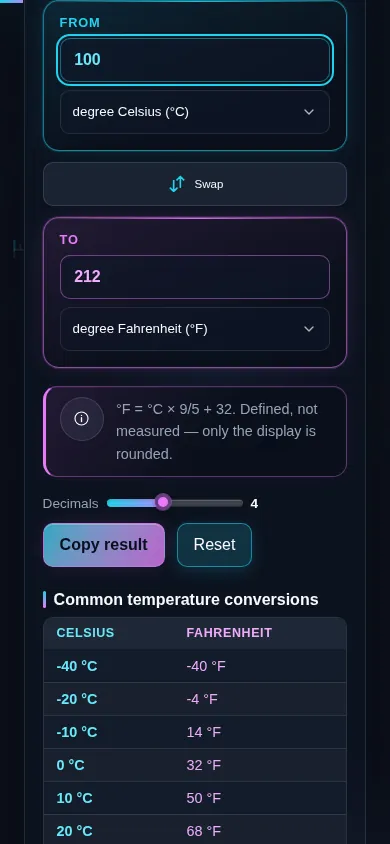
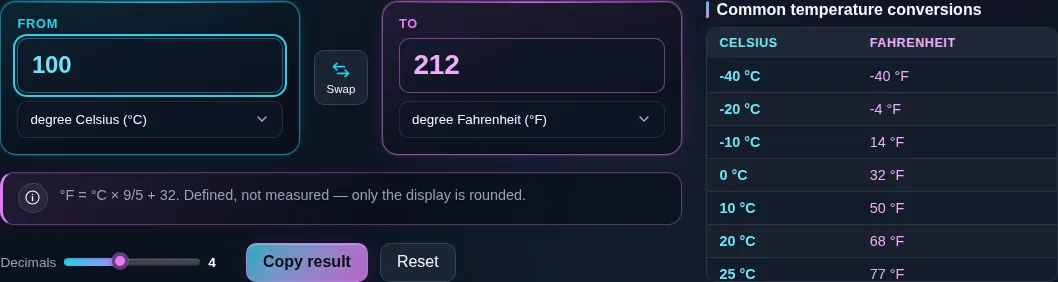
    Temperature converter turning 100 degrees Celsius into 212 degrees Fahrenheit, with the formula degrees Fahrenheit equals degrees Celsius times nine fifths plus thirty-two printed underneath.
    Converting, with the formula underneath
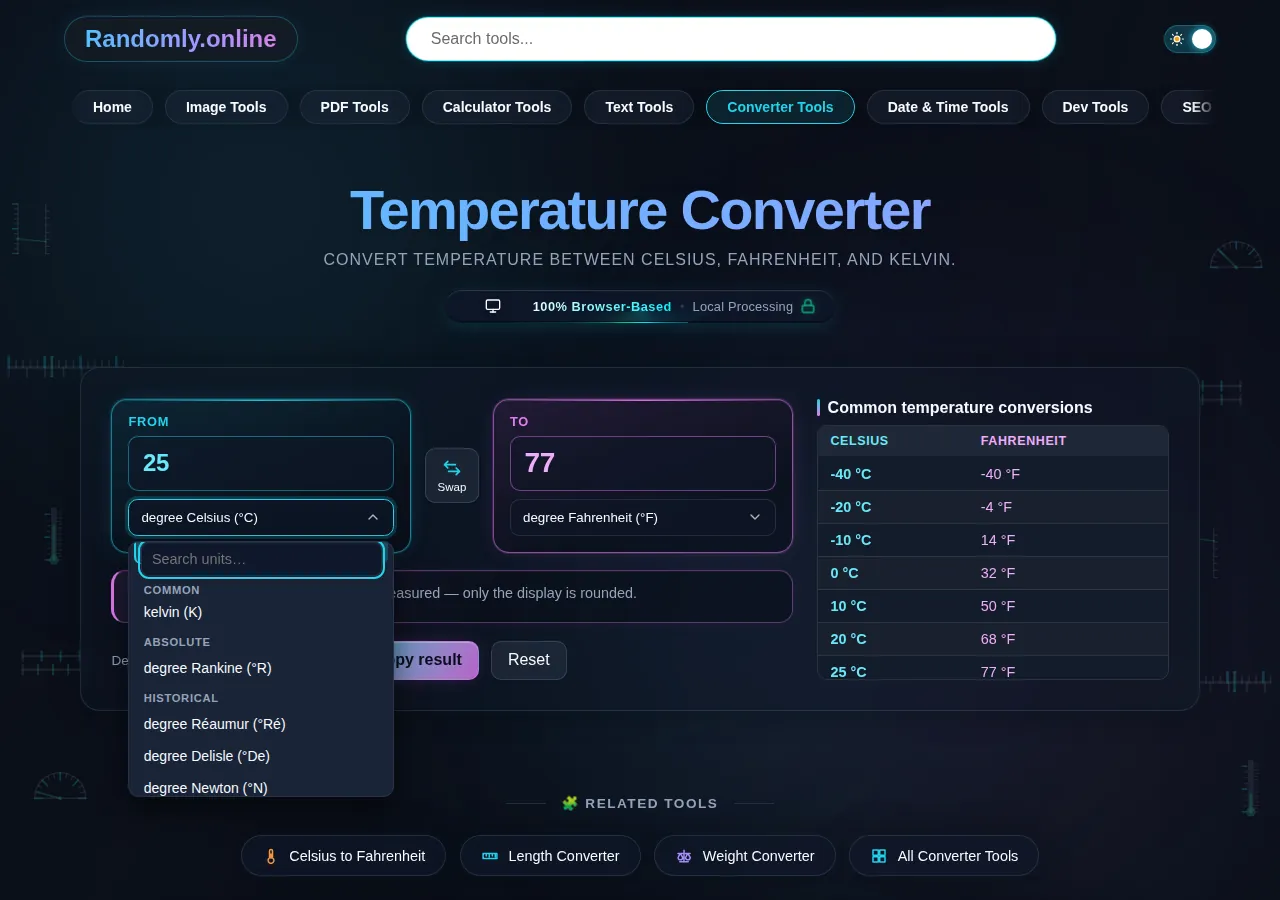
    The temperature converter scale list open at its absolute group, showing Kelvin and Rankine kept apart from the common scales above them.
    The scale list, grouped and searchable
    The Celsius-to-Fahrenheit reference table listing common temperatures side by side beneath the converter.
    The reference table for the pair on screen
    The temperature converter on a phone screen, the two scales stacked with the swap control between them.
    The same tool on a phone

    Frequently Asked Questions

    What's the formula to convert Celsius to Fahrenheit?

    °F = °C × 9/5 + 32. Multiply the Celsius value by 9/5 (that's 1.8), then add 32. For example, 20 °C × 1.8 = 36, plus 32 = 68 °F. The tool shows this formula with every Celsius-to-Fahrenheit result, so you can follow the math yourself.

    ---

    What's the formula to convert Fahrenheit to Celsius?

    °C = (°F − 32) × 5/9. Subtract 32 from the Fahrenheit value first, then multiply by 5/9 (about 0.5556). For example, (68 − 32) × 5/9 = 36 × 5/9 = 20 °C. Subtracting first matters, because the two scales don't share a zero point. The tool displays this formula with each result.

    ---

    What is 37 °C in Fahrenheit?

    98.6 °F, which is the standard figure for normal human body temperature. Using °F = °C × 9/5 + 32: 37 × 1.8 = 66.6, plus 32 = 98.6 °F. A reading of 38 °C (100.4 °F) or higher is generally considered a fever. Enter any Celsius temperature and the tool converts it with the formula shown.

    ---

    What is 100 °C in Fahrenheit?

    212 °F. That's the boiling point of water at sea level: 100 × 1.8 = 180, plus 32 = 212 °F, which is also 373.15 K. It pairs with water's freezing point, 0 °C = 32 °F. These two fixed points define the Celsius scale, which is why the tool includes them in its reference strip.

    ---

    How do I convert Celsius to Kelvin?

    Add 273.15. Kelvin uses the same size of degree as Celsius but starts from absolute zero, so K = °C + 273.15. For example, 25 °C + 273.15 = 298.15 K. To go back, subtract 273.15. There's no multiplication involved because the scales share the same step size — only the starting point differs.

    ---

    At what temperature are Celsius and Fahrenheit equal?

    At −40. Minus 40 degrees Celsius equals minus 40 degrees Fahrenheit exactly — it's the one point where the two scales read the same number. You can prove it with the formula: −40 × 9/5 + 32 = −72 + 32 = −40. It's a handy sanity check when you're converting very cold temperatures.

    ---

    What is absolute zero?

    Absolute zero is the lowest possible temperature, where molecular motion stops. It's 0 Kelvin, which equals −273.15 °C or −459.67 °F. Nothing can be colder, which is why the Kelvin scale starts there and never uses negative numbers. If you try to enter a temperature below absolute zero, it isn't physically valid.

    ---

    Why can't I just multiply to convert temperature?

    Because the scales have different zero points. Length and weight units share a zero (0 cm is 0 inches), so you multiply by one factor. But 0 °C is 32 °F, not 0 °F — so you must also add or subtract an offset. That's why Celsius to Fahrenheit multiplies by 9/5 *and* adds 32, rather than using a single multiplier.

    ---

    Does Kelvin have negative values or a degree symbol?

    No to both. Kelvin is written without the degree symbol — you say "310 K", not "310 °K" — and it never goes negative, because 0 K is absolute zero, the coldest anything can be. It's the SI base unit for temperature and is used mainly in science. Celsius and Fahrenheit, by contrast, both use the degree symbol and can be negative.

    ---

    What are the common oven temperature conversions?

    Useful ones: 160 °C = 320 °F, 180 °C = 356 °F (often rounded to 350 °F), 200 °C = 392 °F (about 400 °F), and 220 °C = 428 °F (about 425 °F). Recipes usually round to the nearest common oven setting. Enter the exact Celsius or Fahrenheit value and the tool gives the precise conversion with the formula shown.

    ---

    Is this converter exact, or does it round the answer?

    The math is exact — it applies the precise formulas (°F = °C × 9/5 + 32, K = °C + 273.15). Only the *displayed* value is rounded for readability, and you can increase the decimal places if you need more precision. Because the formula is shown with each result, you can always check the figure by hand.

    ---

    Does the tool work offline, and does it upload my data?

    It works fully offline once the page has loaded, and it never uploads anything. Each conversion is a small formula calculated on your own device — no server, no account, no tracking. That makes it reliable when travelling with no signal, and private by design, since there's nothing to send anywhere.

    Still have questions?

    If you can't find the answer you're looking for, feel free to contact our support team.

    Contact Us