Energy Converter

Convert energy — joules, calories, kcal, kJ, watt-hours, kWh, BTU.

100% Browser-Based Local Processing

How this conversion works

The relation

Worked example

    4

    Common energy conversions

    KilocaloriesKilojoules

    Privacy Focused

    🔒 Local Processing. The values you enter never leave your device.

    Instant Results

    🌐 Fully Client-Side. Runs instantly in your browser.

    No Signup

    ⚡ No accounts. No API keys. Just open and use.

    Browser Based

    🚀 No installs, no sign-ups, no conversion limits.

    What is a Energy Converter?

    > Energy Converter turns any energy value between joules, calories, kilocalories, kilojoules, watt-hours, kWh, and BTU. Enter a value, pick your units, and read the result with the exact factor shown (1 cal = 4.184 J; 1 kcal = 4184 J). Note: food "calories" are really kilocalories. It works offline. ---

    ### H2: Convert energy — joules, calories, kWh, and BTU

    Energy shows up in more units than almost any other quantity, because science, nutrition, electricity, and heating each have their own. This converter covers the ones people actually meet: joule (J) and kilojoule (kJ) for science, calorie (cal) and kilocalorie (kcal) for food, watt-hour (Wh) and kilowatt-hour (kWh) for electricity, and BTU for heating and cooling. Type a value, choose *from* and *to*, and the answer appears instantly, with a swap button, an all-units table, and the exact factor shown for every result.

    The single most important thing this tool clears up is the calorie versus kilocalorie muddle. The "calories" printed on food labels are actually kilocalories — one food Calorie (with a capital C) equals one kcal, which equals 1000 small calories. So a snack listed as "250 calories" really holds 250 kcal, or about 1046 kJ. Many countries label food in kilojoules for exactly this reason, and the tool makes the kJ ↔ kcal conversion (1 kcal = 4.184 kJ) simple and clearly labelled.

    The exact factors it uses: one calorie is 4.184 joules (the thermochemical/nutritional calorie), one watt-hour is 3600 joules, one kilowatt-hour is 3.6 million joules, and one BTU is about 1055 joules. A couple of honest details: there are slightly different definitions of the "calorie" and the "BTU"; this tool uses the standard nutritional calorie (4.184 J) and the IT BTU (1055.06 J), and says so.

    The kilowatt-hour is worth knowing because it's the unit on your electricity bill — one kWh is the energy of a 1000-watt appliance running for an hour. For power (the *rate* of energy use, in watts) rather than total energy, use the Power Converter. Everything here runs on your own device, offline, with nothing uploaded.
    ---

    How to use the Energy Converter

    Step 1: Enter your value. Type the energy you want to convert into the input box

    Decimals are fine.

    Step 2: Pick the "from" unit. Choose the unit your number is currently in — for example, kilocalories (kcal)

    Pick the "from" unit. Choose the unit your number is currently in — for example, kilocalories (kcal).

    Step 3: Pick the "to" unit. Choose the unit you want the answer in — for example, kilojoules (kJ)

    The result updates instantly.

    Step 4: Read the result and the factor. The converted value appears with the exact relationship used (for example, 1 kcal = 4.184 kJ), so you can verify it

    Read the result and the factor. The converted value appears with the exact relationship used (for example, 1 kcal = 4.184 kJ), so you can verify it.

    Step 5: Copy, swap, or expand. Use Copy to grab the number, the swap button to reverse the direction, or open the all-units table to see your value in every unit at once

    Adjust the decimal places for more precision.

    Energy Converter in action

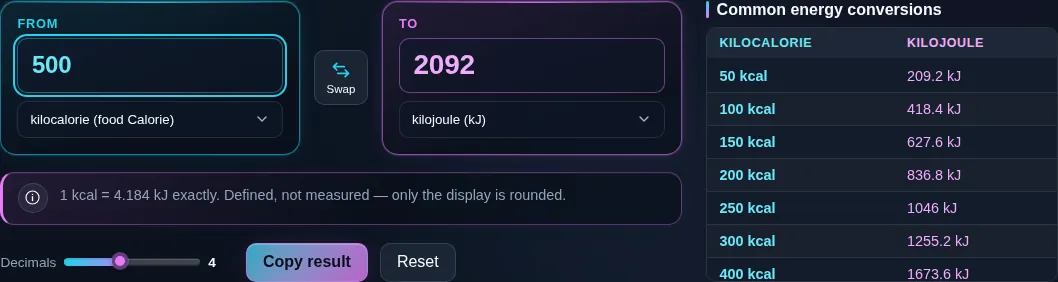
    Energy converter turning 500 kilocalories into 2092 kilojoules, with the note underneath reading that one kilocalorie is exactly 4.184 kilojoules.
    Converting kilocalories to kilojoules, with the exact factor underneath
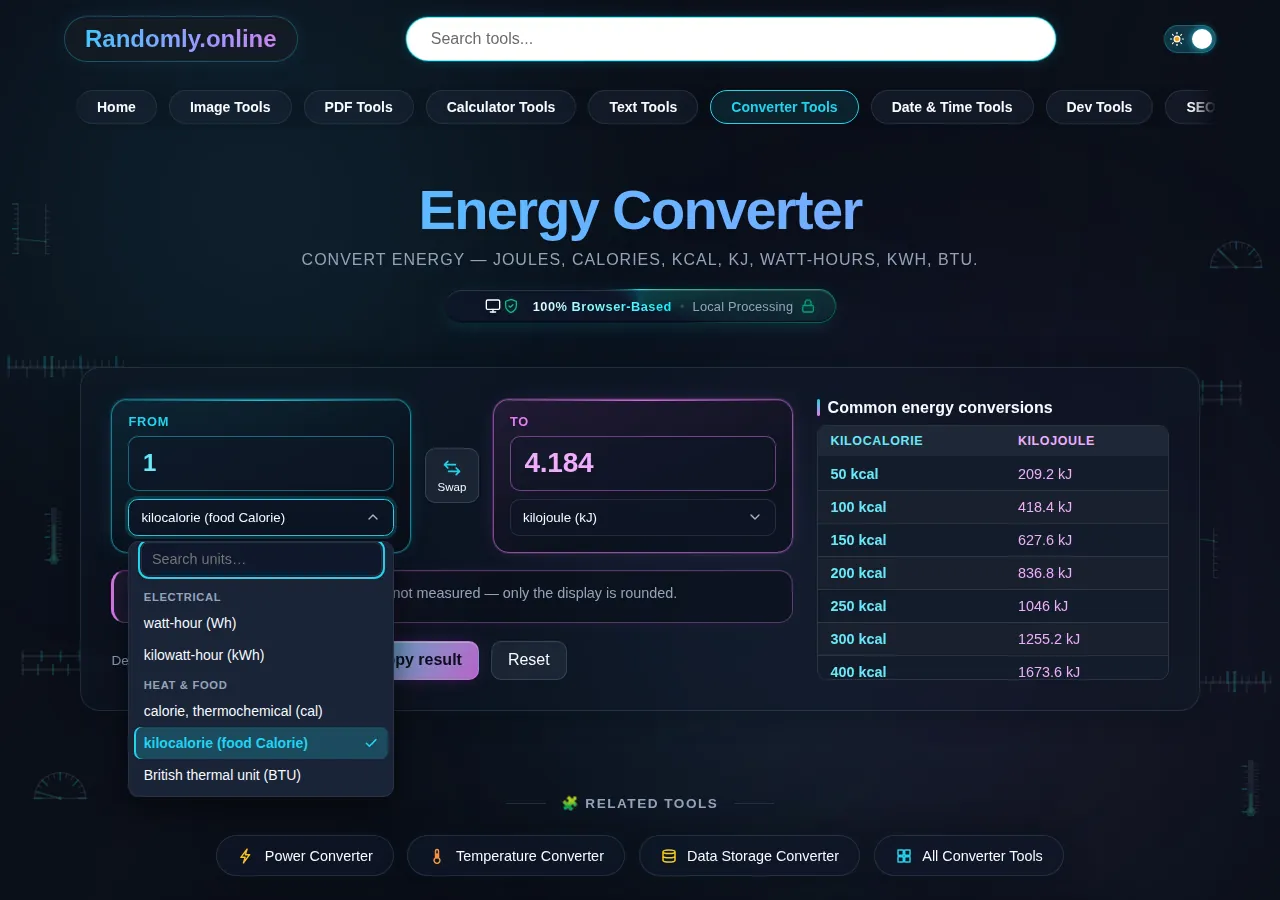
    The energy converter unit list open at the boundary between its electrical group and its heat and food group, with calorie, kilocalorie and British thermal unit below the heading.
    The unit list, grouped and searchable
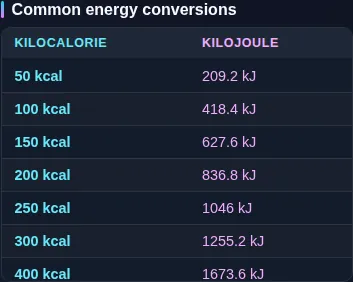
    The kilocalories to kilojoules reference table listing food energy values from 50 kcal to 2500 kcal beside their kilojoule readings.
    The reference table for the pair on screen
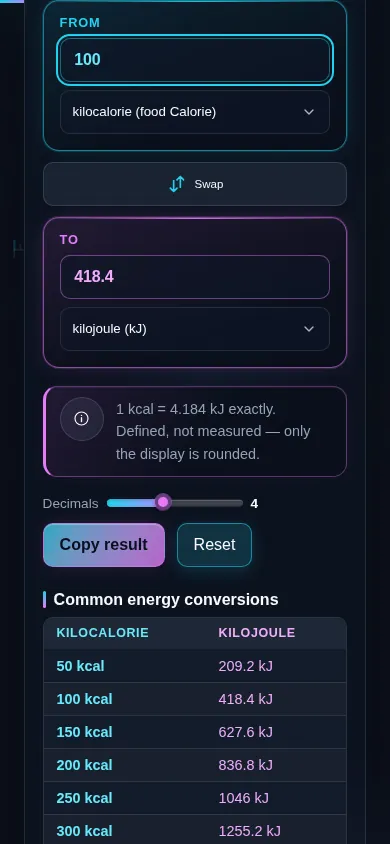
    The energy converter on a phone screen, the two panes stacked with the swap control between them.
    The same tool on a phone

    Frequently Asked Questions

    Is a calorie the same as a kcal?

    Not quite — and this trips up a lot of people. A kilocalorie (kcal) is 1000 small calories. But on food labels, the "calories" listed are actually kilocalories: 1 food Calorie (capital C) = 1 kcal = 1000 cal. So a "200-calorie" snack is 200 kcal. In science, a plain calorie is the small one (4.184 J); in nutrition, it means the kcal.

    ---

    How many joules are in a calorie?

    One (small, thermochemical) calorie is 4.184 joules. A kilocalorie — the "calorie" on food labels — is 1000 times that, so 4184 joules, or 4.184 kilojoules. For example, a 500 kcal meal is 500 × 4184 = 2,092,000 joules (2092 kJ). The tool shows the exact factor and labels which calorie it's using.

    ---

    Why do food labels say "calories" when they mean kilocalories?

    It's a long-standing convention. The "Calorie" used in nutrition (capital C) is defined as one kilocalorie, and over time the capital was dropped in everyday writing, so labels just say "calories". Scientifically it's imprecise, which is why many countries now also (or instead) label food in kilojoules — 1 kcal = 4.184 kJ. The tool converts between all of them clearly.

    ---

    How do I convert kJ to kcal for food energy?

    Divide kilojoules by 4.184. Since 1 kcal = 4.184 kJ, a food value in kJ divided by 4.184 gives kilocalories (the "calories" on a label). For example, 2000 kJ ÷ 4.184 = 478 kcal. To go the other way, multiply kcal by 4.184. Many labels show both, and the tool does the conversion instantly with the factor shown.

    ---

    How many joules are in a kWh?

    Exactly 3,600,000 joules (3.6 megajoules). A kilowatt-hour is 1000 watts sustained for one hour, and since a watt is one joule per second, that's 1000 × 3600 = 3,600,000 J. This is the unit on your electricity bill. So a 1 kWh appliance-hour equals 3.6 MJ, or about 860 kcal, or 3412 BTU. The tool converts kWh to any energy unit.

    ---

    How many joules are in a BTU?

    About 1055 joules. One British thermal unit (the IT definition this tool uses) is 1055.06 J — the energy to raise one pound of water by one degree Fahrenheit. So 1 kWh is about 3412 BTU. BTU is common in heating, air-conditioning, and appliance ratings. Note that slightly different BTU definitions exist; the tool uses the standard IT BTU and says so.

    ---

    How do I convert calories to kilojoules?

    Multiply by 4.184. For small calories, 1 cal = 4.184 J = 0.004184 kJ. For food calories (kilocalories), 1 kcal = 4.184 kJ — so a 250 kcal snack is 250 × 4.184 = 1046 kJ. Because "calorie" is ambiguous, make sure you know whether your figure is small calories or food kilocalories; the tool labels both.

    ---

    What's a kilowatt-hour, and why is it on my electricity bill?

    A kilowatt-hour (kWh) is the energy used by a 1000-watt appliance running for one hour — it's how electricity is metered and billed. In joules it's 3.6 million (3.6 MJ). So a 2000 W heater for one hour uses 2 kWh; a 60 W bulb for an hour uses 0.06 kWh. The tool converts kWh to joules, BTU, or calories to help compare energy use.

    ---

    Which calorie does the tool use, since they vary slightly?

    It uses the thermochemical calorie, defined as exactly 4.184 joules — the standard for nutrition and most everyday use. There are marginally different historical definitions (like the 15 °C calorie at 4.1855 J), but the difference is tiny and rarely matters. Stating the definition avoids ambiguity, and 4.184 J is the value behind every calorie result here.

    ---

    Is this converter exact, or does it round the answer?

    The math is exact — it uses defined factors (1 cal = 4.184 J, 1 kWh = 3,600,000 J, 1 BTU = 1055.06 J). Only the *displayed* value is rounded for readability, and you can add decimal places for more precision. The factor and unit shown with each result let you verify the figure yourself.

    ---

    What's the formula to convert energy units?

    Convert everything through joules. Multiply your value by its factor to joules (calorie → ×4.184, kcal → ×4184, Wh → ×3600, kWh → ×3,600,000, BTU → ×1055.06), then divide by the target unit's factor. For kcal to kJ this simplifies to value × 4.184. The tool applies this two-step method for any pair of units.

    ---

    Does the tool work offline, and does it upload my data?

    It works fully offline once the page has loaded, and it never uploads anything. All conversions are pure arithmetic using fixed factors, so the calculation happens on your own device — no server, no account, no tracking. That makes it dependable with no signal, and private by design, since there's nothing to send anywhere.

    Still have questions?

    If you can't find the answer you're looking for, feel free to contact our support team.

    Contact Us