Celsius to Fahrenheit

Convert Celsius to Fahrenheit instantly (and back).

100% Browser-Based Local Processing

degree Celsius (°C)

degree Fahrenheit (°F)

How this conversion works

The relation

Worked example

    4

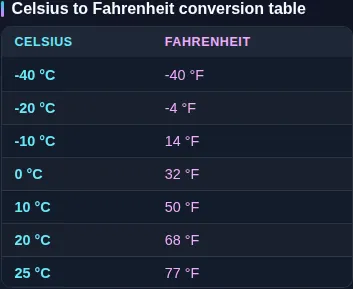
    Celsius to Fahrenheit conversion table

    CelsiusFahrenheit

    Privacy Focused

    🔒 Local Processing. The values you enter never leave your device.

    Instant Results

    🌐 Fully Client-Side. Runs instantly in your browser.

    No Signup

    ⚡ No accounts. No API keys. Just open and use.

    Browser Based

    🚀 No installs, no sign-ups, no conversion limits.

    What is a Celsius to Fahrenheit?

    > To convert Celsius to Fahrenheit, multiply by 9/5 (that's 1.8) and add 32: °F = °C × 9/5 + 32. So 20 °C × 1.8 = 36, plus 32 = 68 °F. To go back, subtract 32 and multiply by 5/9. This tool does both instantly and works offline. ---

    ### H2: Convert Celsius to Fahrenheit — with the formula, both ways

    Celsius-to-Fahrenheit is one of the most-searched conversions on the internet, usually for one of three reasons: cooking from a recipe that uses the other scale, checking whether a temperature is a fever, or making sense of a foreign weather forecast. The conversion isn't a single multiplier — the two scales start from different points — so the reliable way to do it is with the formula: °F = °C × 9/5 + 32.

    This page is a focused Celsius-to-Fahrenheit tool. Enter a value in Celsius and it shows the Fahrenheit instantly; enter Fahrenheit and it shows Celsius — the fields mirror each other, so it works both ways. Every result comes with the formula it used, so you can follow the math and trust the number rather than guessing.

    Because so much of the demand is about cooking, there's an oven-temperature chart below (with common settings and gas marks), and reference points for the temperatures people check most: water freezes at 0 °C = 32 °F, normal body temperature is 37 °C = 98.6 °F, and water boils at 100 °C = 212 °F. There's also the famous crossover where the two scales meet: −40 °C = −40 °F.

    You may have heard the quick trick "double it and add 30" — it's a handy rough estimate, but it drifts by a few degrees because the real multiplier is 1.8, not 2. For anything precise, use the full formula (which the tool does for you). And if you also need Kelvin, use the full Temperature Converter. Everything here runs on your own device, so there's nothing to upload and no connection needed once the page has loaded.
    ---

    How to use the Celsius to Fahrenheit

    Step 1: Enter the Celsius value. Type your temperature into the °C field

    Negatives and decimals are fine.

    Step 2: Read the Fahrenheit. The result appears instantly, with the formula used shown beside it

    Read the Fahrenheit. The result appears instantly, with the formula used shown beside it.

    Step 3: Or go the other way. Type into the °F field instead to convert Fahrenheit back to Celsius

    Or go the other way. Type into the °F field instead to convert Fahrenheit back to Celsius.

    Step 4: Check the formula. The exact relationship (°F = °C × 9/5 + 32) is displayed so you can see how it was reached

    Check the formula. The exact relationship (°F = °C × 9/5 + 32) is displayed so you can see how it was reached.

    Step 5: Copy or refine. Use Copy to grab the result, or adjust the decimal places for more precision

    Copy or refine. Use Copy to grab the result, or adjust the decimal places for more precision.

    Celsius to Fahrenheit in action

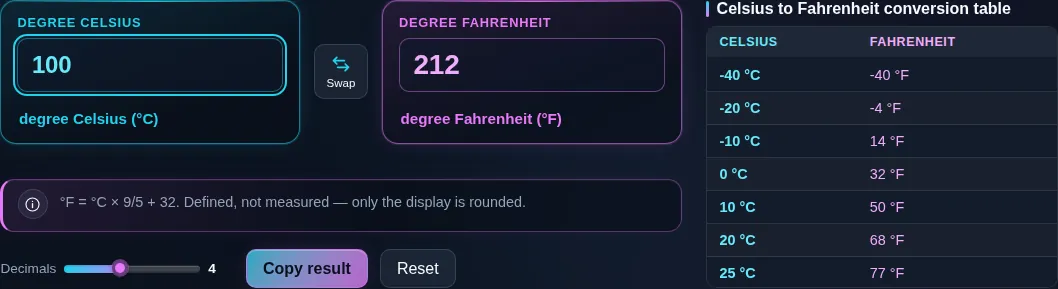
    The Celsius to Fahrenheit converter turning 100 degrees Celsius into 212 degrees Fahrenheit, with the formula printed underneath.
    Typing in either box, with the formula underneath
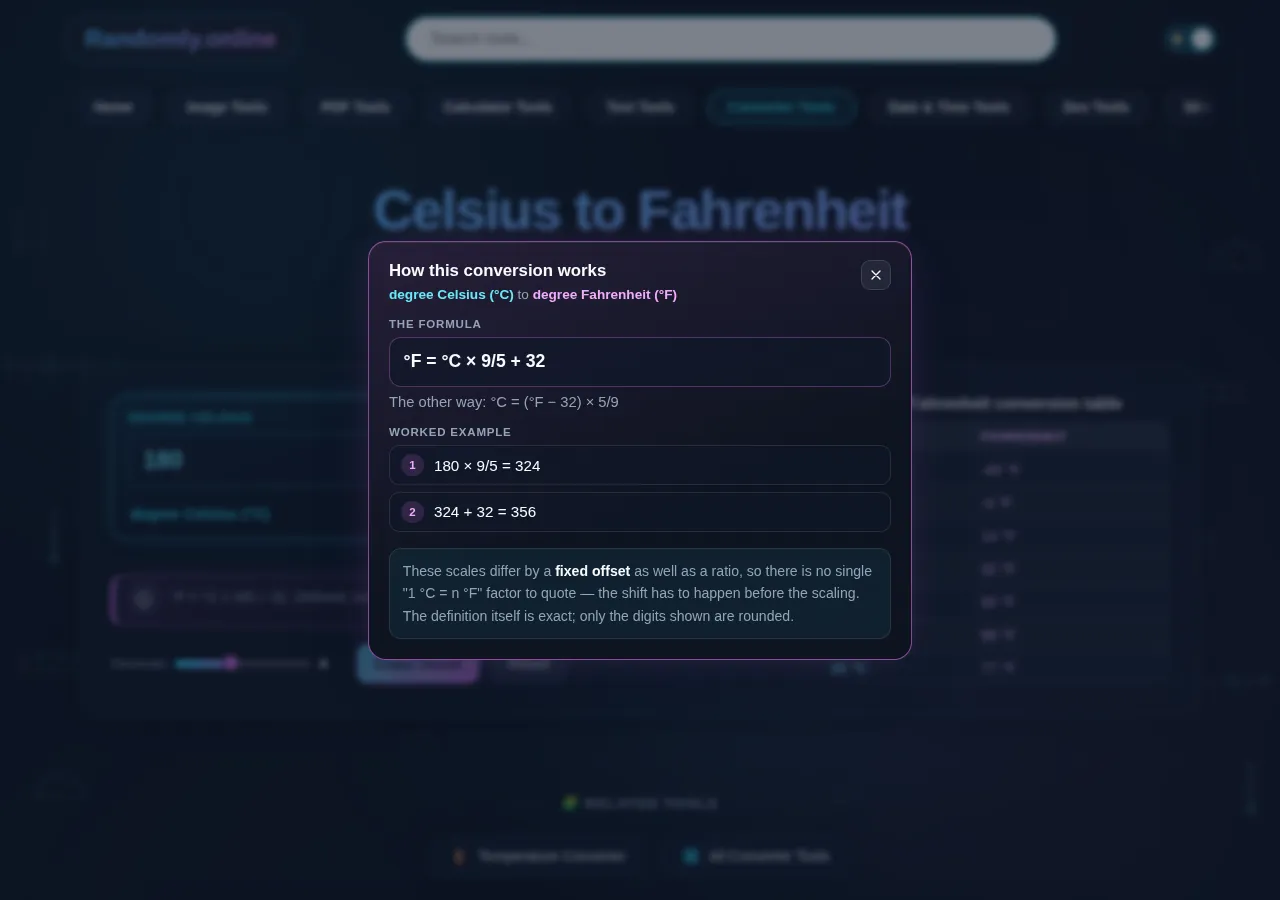
    The Celsius to Fahrenheit converter with its explanation panel open, listing the relation, the reverse relation and the numbered steps that turn the value on screen into the answer.
    The worked example, behind the info button
    The Celsius-to-Fahrenheit reference table listing common temperatures side by side beneath the converter.
    The reference table, ready to read
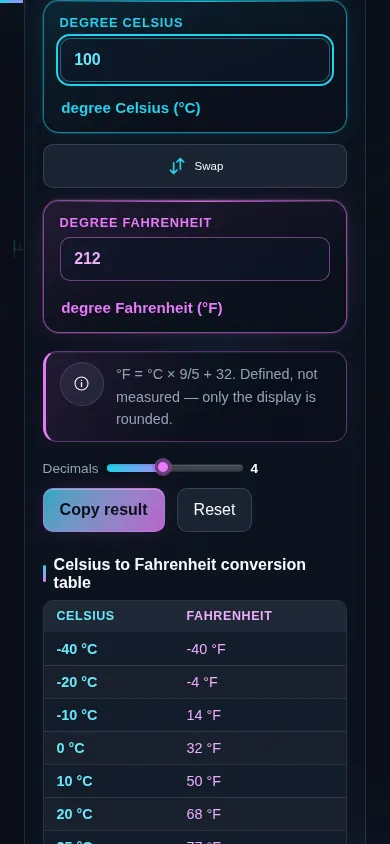
    The Celsius to Fahrenheit converter on a phone screen, the two scales stacked with the swap control between them.
    The same tool on a phone

    Frequently Asked Questions

    What's the formula to convert Celsius to Fahrenheit?

    °F = °C × 9/5 + 32. Multiply the Celsius value by 9/5 (which is 1.8), then add 32. For example, 25 °C × 1.8 = 45, plus 32 = 77 °F. The +32 matters because the two scales don't share a zero point. The tool shows this formula with every result so you can follow it.

    ---

    How do I convert Fahrenheit back to Celsius?

    °C = (°F − 32) × 5/9. Subtract 32 first, then multiply by 5/9 (about 0.5556). For example, (77 − 32) × 5/9 = 45 × 5/9 = 25 °C. Subtracting before multiplying is essential — do it in the wrong order and the answer is wrong. Type into the Fahrenheit field and the tool converts to Celsius automatically.

    ---

    What is 37 °C in Fahrenheit?

    98.6 °F, the standard figure for normal human body temperature. Using °F = °C × 9/5 + 32: 37 × 1.8 = 66.6, plus 32 = 98.6 °F. A reading of 38 °C (100.4 °F) or above is generally considered a fever. Enter any Celsius value and the tool gives the Fahrenheit with the formula shown.

    ---

    What is 180 °C in Fahrenheit?

    356 °F. That's a very common oven temperature: 180 × 1.8 = 324, plus 32 = 356 °F. Many recipes round it to a 350 °F oven setting, which is close enough for baking. The oven chart on this page lists the other common settings and their gas marks alongside the exact Fahrenheit figures.

    ---

    What is 100 °C in Fahrenheit?

    212 °F. That's the boiling point of water at sea level: 100 × 1.8 = 180, plus 32 = 212 °F. It pairs with water's freezing point of 0 °C = 32 °F. These two fixed points define the Celsius scale, and they're a quick way to sanity-check any conversion.

    ---

    Is there a quick way to estimate Celsius to Fahrenheit in my head?

    A popular shortcut is "double it and add 30" — so 20 °C ≈ 70 °F. It's fast and close, but not exact, because the real multiplier is 1.8, not 2. The true answer for 20 °C is 68 °F, so the trick runs a few degrees high, more so at higher temperatures. Use it for a rough sense, and the formula for accuracy.

    ---

    What are the common oven temperatures in Celsius and Fahrenheit?

    Useful ones: 160 °C = 320 °F (gas 3), 180 °C = 356 °F (gas 4, often set to 350 °F), 200 °C = 392 °F (gas 6, often 400 °F), and 220 °C = 428 °F (gas 7, often 425 °F). Recipes round to the nearest oven setting. The oven chart on this page has the full list with gas marks.

    ---

    What counts as a fever in Celsius and Fahrenheit?

    Normal body temperature is about 37 °C (98.6 °F). A fever is generally defined as 38 °C (100.4 °F) or higher, and a high fever is around 39.5–40 °C (103–104 °F). These are general guides — thresholds vary by person and measurement method. The tool converts any body-temperature reading between the two scales with the formula shown.

    ---

    Why is the formula ×9/5 + 32 and not just a multiplier?

    Because the two scales have different zero points. Length units share a zero (0 cm is 0 inches), so you multiply by one factor. But 0 °C is 32 °F, not 0 °F, so after scaling by 9/5 you must add the 32-degree offset. That's why a single multiplier can never convert temperature correctly on its own.

    ---

    Is centigrade the same as Celsius?

    Yes. "Centigrade" is the older name for the Celsius scale — both put water's freezing point at 0 and boiling point at 100. The name was officially changed to Celsius in 1948 to honour Anders Celsius and to avoid confusion with the "centigrade" angular unit. So "centigrade to Fahrenheit" and "Celsius to Fahrenheit" mean exactly the same conversion.

    ---

    Is this converter exact, or does it round the answer?

    The math is exact — it applies the precise formula °F = °C × 9/5 + 32. Only the *displayed* value is rounded for readability, and you can add decimal places if you need more precision. Because the formula is shown with each result, you can always check the figure by hand.

    ---

    Where can I also convert Kelvin?

    Use the full Temperature Converter. This page focuses on the Celsius-to-Fahrenheit pair, but the Temperature Converter handles all three scales — Celsius, Fahrenheit, and Kelvin — with the formula shown for each, an all-scales panel, and reference points for freezing, boiling, and absolute zero.

    Still have questions?

    If you can't find the answer you're looking for, feel free to contact our support team.

    Contact Us