Length Converter

Convert length between metric and imperial units — cm, m, km, inches, feet, yards, miles.

100% Browser-Based Local Processing

How this conversion works

The relation

Worked example

    4

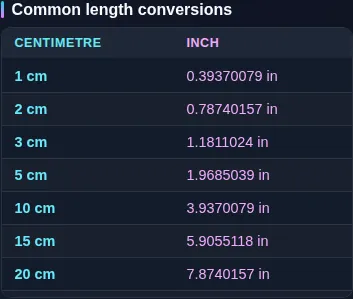
    Common length conversions

    CentimetresInches

    Privacy Focused

    🔒 Local Processing. The values you enter never leave your device.

    Instant Results

    🌐 Fully Client-Side. Runs instantly in your browser.

    No Signup

    ⚡ No accounts. No API keys. Just open and use.

    Browser Based

    🚀 No installs, no sign-ups, no conversion limits.

    What is a Length Converter?

    > Length Converter turns any distance between metric and imperial units — centimetres, metres, kilometres, inches, feet, yards, miles, and nautical miles. Enter a value, pick your units, and read the result with the exact factor shown (1 inch = 2.54 cm exactly). It runs in your browser and works offline. ---

    ### H2: Convert length between metric and imperial — with the math shown

    Length conversions come up constantly and rarely at a convenient moment: a furniture listing gives dimensions in inches when your room is measured in centimetres, a running route is in kilometres but your treadmill shows miles, or a school worksheet asks how many millimetres are in a metre. Most of the time you just want the number — and you want to trust it.

    This converter handles the nine units people actually use: metre, centimetre, millimetre, and kilometre on the metric side, and inch, foot, yard, mile, and nautical mile on the imperial and marine side. Type a value, choose what you're converting *from* and *to*, and the answer appears instantly. A swap button flips the direction, and the all-units table expands a single value into every unit at once, so "1 metre" becomes 100 cm, 1000 mm, 3.28084 ft, and 39.3701 in on one screen.

    What sets this tool apart is that it shows the exact conversion factor behind each result. An inch is 2.54 centimetres by international definition — not an approximation — and the tool states that relationship so you can verify the answer instead of trusting a black box. The same goes for a mile (1609.344 m exactly) and a nautical mile (1852 m exactly).

    Everything runs on your own device. The math uses fixed, defined conversion factors, so there's nothing to upload, no account to create, and no internet connection required once the page has loaded — handy on a plane, in a workshop, or anywhere with patchy signal. Values are rounded only for display; the exact figure is always available if you need more decimal places.
    ---

    How to use the Length Converter

    Step 1: Enter your value. Type the number you want to convert into the input box

    It accepts decimals and very large or very small values.

    Step 2: Pick the "from" unit. Choose the unit your number is currently in — for example, inches (in)

    Pick the "from" unit. Choose the unit your number is currently in — for example, inches (in).

    Step 3: Pick the "to" unit. Choose the unit you want the answer in — for example, centimetres (cm)

    The result updates instantly.

    Step 4: Read the result and the factor. The converted value appears alongside the exact relationship used (for example, 1 in = 2.54 cm), so you can verify it

    Read the result and the factor. The converted value appears alongside the exact relationship used (for example, 1 in = 2.54 cm), so you can verify it.

    Step 5: Copy, swap, or expand. Use Copy to grab the number, the swap button to reverse the direction, or open the all-units table to see your value in every unit at once

    Adjust the decimal places if you need more precision.

    Length Converter in action

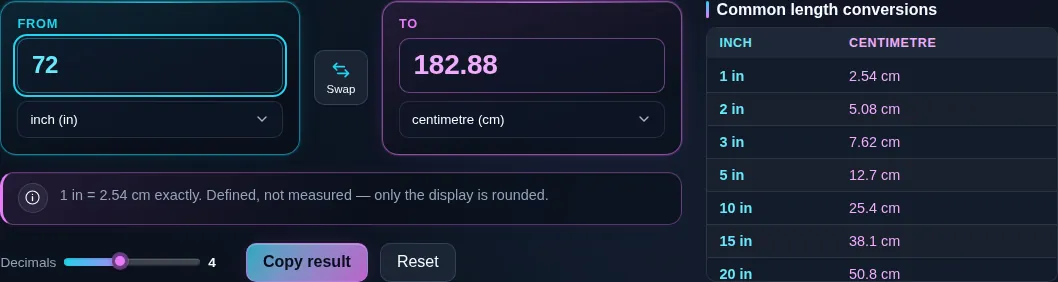
    Length converter turning 72 inches into 182.88 centimetres, with the note underneath reading that one inch is exactly 2.54 centimetres.
    Converting, with the exact factor underneath
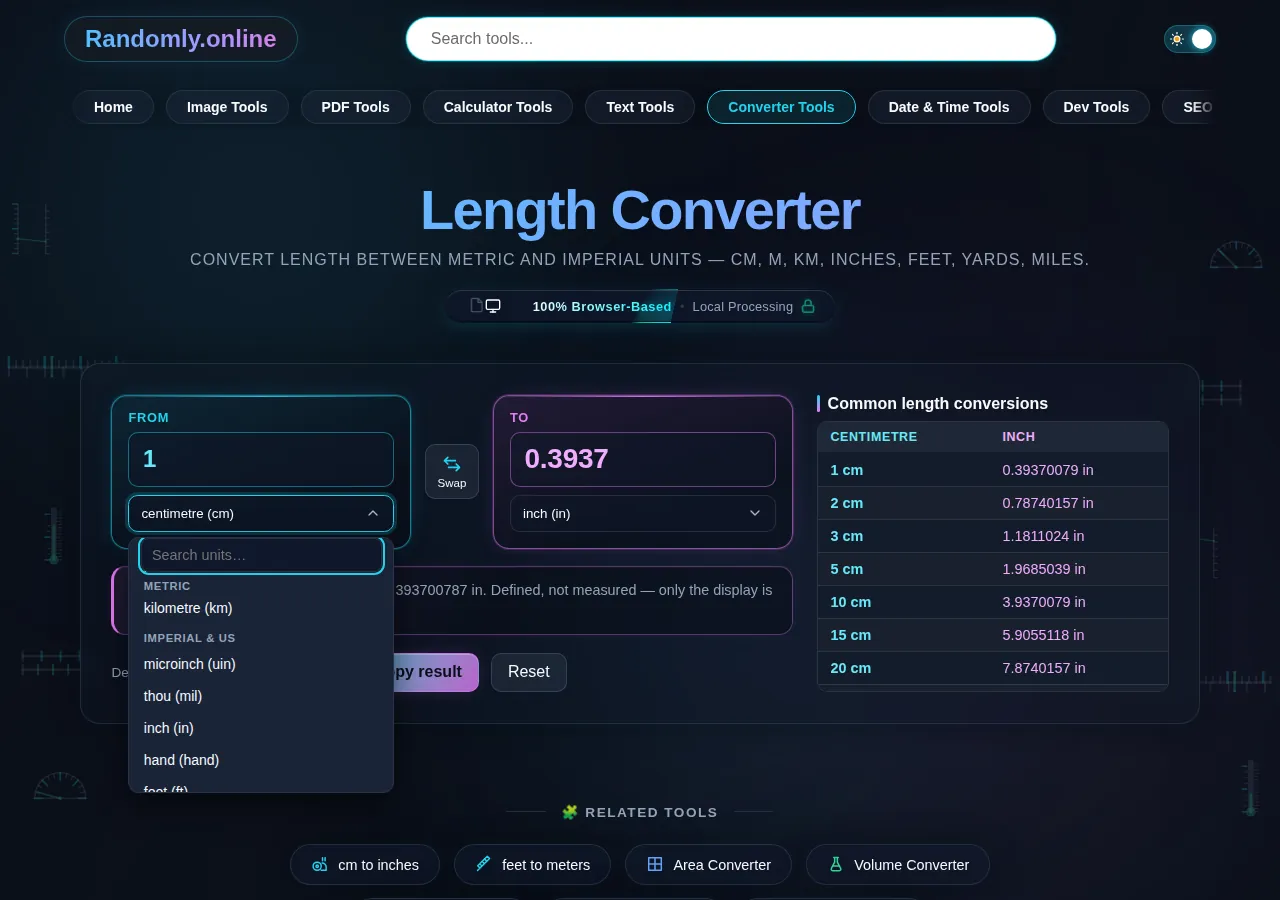
    The length converter unit list open at the boundary between its metric group and its imperial and US group, with the marine, typography, survey and astronomical groups further down the same list.
    The unit list, grouped and searchable
    The centimetres-to-inches reference table listing common values side by side beneath the converter.
    The reference table for the pair on screen
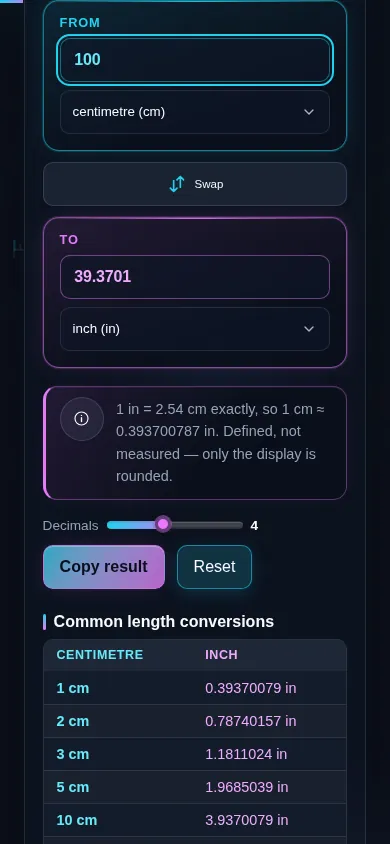
    The length converter on a phone screen, the two panes stacked with the swap control between them.
    The same tool on a phone

    Frequently Asked Questions

    How many centimeters are in an inch?

    Exactly 2.54. One inch equals 2.54 centimetres by international definition — it's a fixed, exact value, not a rounded approximation. So 10 inches is 25.4 cm, and to go the other way you divide by 2.54 (1 cm ≈ 0.3937 in). The converter uses this exact factor and shows it with every result.

    ---

    How do I convert meters to feet?

    Multiply metres by 3.280839895 to get feet, because one foot is 0.3048 metres exactly (so 1 m = 1 ÷ 0.3048 ≈ 3.28084 ft). For example, 5 metres × 3.28084 ≈ 16.404 feet. To reverse it, multiply feet by 0.3048 to get metres. The tool does this automatically and displays the factor it used.

    ---

    How many feet are in a mile?

    Exactly 5280. A statute mile is defined as 5280 feet, which works out to 1609.344 metres exactly. That's why a mile is 1.609 kilometres. If you're converting distances for running or driving, enter the value and the tool shows both the result and the underlying relationship (1 mi = 1609.344 m).

    ---

    What's the difference between a nautical mile and a regular mile?

    A nautical mile is 1852 metres exactly (about 1.15 statute miles), used in aviation and at sea because it maps neatly onto one minute of latitude. A regular, or statute, mile is 1609.344 metres. They are not interchangeable — always pick the right one in the tool. Selecting "mile" when you mean "nautical mile" introduces a 15% error.

    ---

    How many millimeters are in a centimeter?

    Exactly 10. One centimetre is 10 millimetres, and one metre is 1000 millimetres, because the metric system uses powers of ten. So 3.5 cm = 35 mm, and 250 mm = 25 cm. These conversions are exact by definition of the SI prefixes (centi = one hundredth, milli = one thousandth of a metre).

    ---

    Is this converter exact, or does it round the answer?

    The math is exact — it uses defined conversion factors (1 in = 2.54 cm, 1 mi = 1609.344 m, 1 nmi = 1852 m). Only the *displayed* value is rounded for readability, and you can increase the number of decimal places if you need more precision. The factor shown with each result lets you verify the figure yourself.

    ---

    What's the formula to convert between metric and imperial length?

    Convert everything through metres. Multiply your value by its factor to metres (inch → ×0.0254, foot → ×0.3048, yard → ×0.9144, mile → ×1609.344), then divide by the target unit's factor. For example, inches to centimetres: metres = inches × 0.0254, then cm = metres ÷ 0.01, which simplifies to inches × 2.54. The tool applies this two-step method for any pair.

    ---

    Does the tool work offline, and does it upload my data?

    It works fully offline once the page has loaded, and it never uploads anything. All conversions are pure arithmetic using fixed factors, so the calculation happens on your own device — no server, no account, no tracking. That makes it reliable on a plane or in a workshop with no signal, and private by design since there's nothing to send.

    ---

    What is the international foot versus the US survey foot?

    Nearly everyone uses the international foot, defined as exactly 0.3048 metres, and that's what this tool uses. The US survey foot is a slightly different legacy definition (about 2 parts per million longer) that was used in US land surveying and officially retired in 2023. The difference is negligible in daily life but matters over very long survey distances.

    ---

    How many kilometers are in a mile, and miles in a kilometer?

    One mile is 1.609344 kilometres, and one kilometre is about 0.621371 miles. So a 5K run is roughly 3.11 miles, and a 60 mph speed limit is about 96.6 km/h. These come from the exact definition of the mile as 1609.344 metres. Enter either value in the tool and it converts both ways with the factor shown.

    ---

    Which unit should I use — millimetres, centimetres, or metres?

    Match the unit to the scale. Use millimetres for small, precise measurements (screws, thicknesses), centimetres for everyday objects and body measurements, and metres for rooms, furniture, and distances. They're all exact multiples of each other, so you can switch freely — 1 m = 100 cm = 1000 mm — without losing any accuracy.

    ---

    Can I convert very large or very small values?

    Yes. The converter handles everything from microscopic measurements to astronomical distances, and accepts decimals. For extreme values it can display the result in scientific notation so the number stays readable. Because the underlying factors are exact, precision holds across the whole range — only the displayed rounding changes, and you control how many decimals to show.

    Still have questions?

    If you can't find the answer you're looking for, feel free to contact our support team.

    Contact Us