Power Converter

Convert power — watts, kW, horsepower, metric hp (PS), BTU/h.

100% Browser-Based Local Processing

How this conversion works

The relation

Worked example

    4

    Common power conversions

    HorsepowerKilowatts

    Privacy Focused

    🔒 Local Processing. The values you enter never leave your device.

    Instant Results

    🌐 Fully Client-Side. Runs instantly in your browser.

    No Signup

    ⚡ No accounts. No API keys. Just open and use.

    Browser Based

    🚀 No installs, no sign-ups, no conversion limits.

    What is a Power Converter?

    > Power Converter turns any power between watts, kilowatts, megawatts, horsepower, metric horsepower (PS), and BTU per hour. Enter a value, pick your units, and read the result with the exact factor shown (1 hp = 745.7 W; 1 PS = 735.5 W; 1 kW ≈ 1.341 hp). It works offline. ---

    ### H2: Convert power — watts, kilowatts, horsepower, and BTU/h

    Power is the rate at which energy is used or produced, and it's measured differently across fields. Electrical and general use go by watts (W), kilowatts (kW), and megawatts (MW); engines are rated in horsepower; and heating and air-conditioning use BTU per hour (BTU/h). This converter covers all of them, so a car's kW figure becomes horsepower, or an air-conditioner's BTU/h becomes kilowatts, in one step. Every result shows the exact factor, with a swap button and an all-units table.

    The most important thing to get right is that there are two different "horsepowers". The mechanical (or imperial) horsepower used in the US and UK is 745.7 watts. The metric horsepower — written PS (German *Pferdestärke*), cv, or ch — used in European car specs is 735.5 watts, about 1.4% smaller. So a "100 PS" European car is about 98.6 mechanical hp, not 100. This tool labels both clearly, so you can pick the right one instead of silently mixing them.

    The exact relationships: one kilowatt is about 1.341 mechanical hp, or 1.360 metric PS; one mechanical horsepower is 745.7 W; and one BTU/h is about 0.293 W. For air-conditioning, the "ton of cooling" equals 12,000 BTU/h, which is about 3.517 kW — handy when comparing an AC unit's BTU rating to its electrical draw.

    One clarification worth making: power is not the same as energy. Power (watts) is the rate; energy (joules or kilowatt-hours) is the total amount used over time. A 2000-watt heater running for an hour *uses* 2 kWh of energy. If you need to convert amounts of energy rather than power, use the Energy Converter. Everything here runs on your own device, offline, with nothing uploaded.
    ---

    How to use the Power Converter

    Step 1: Enter your value. Type the power you want to convert into the input box

    Decimals are fine.

    Step 2: Pick the "from" unit. Choose the unit your number is currently in — for example, kilowatts (kW)

    Pick the "from" unit. Choose the unit your number is currently in — for example, kilowatts (kW).

    Step 3: Pick the "to" unit. Choose the unit you want the answer in — for example, mechanical horsepower (hp)

    The result updates instantly.

    Step 4: Read the result and the factor. The converted value appears with the exact relationship used (for example, 1 hp = 745.7 W), so you can verify it

    Read the result and the factor. The converted value appears with the exact relationship used (for example, 1 hp = 745.7 W), so you can verify it.

    Step 5: Copy, swap, or expand. Use Copy to grab the number, the swap button to reverse the direction, or open the all-units table to see your value in every unit at once

    Adjust the decimal places for more precision.

    Power Converter in action

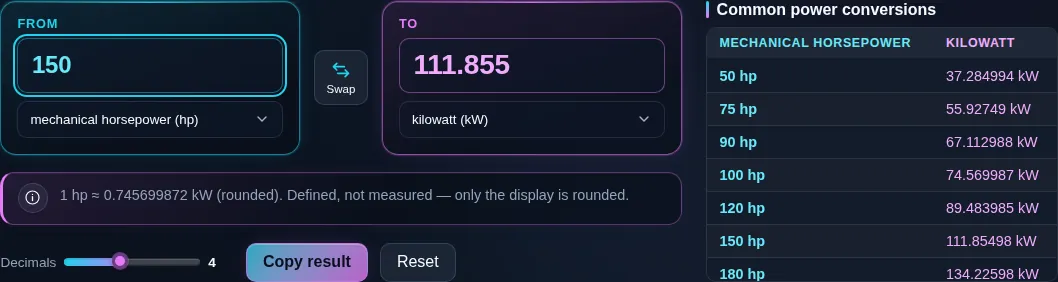
    Power converter turning 150 mechanical horsepower into 111.855 kilowatts, with the note underneath reading that one horsepower is about 0.745699872 kilowatts.
    Converting horsepower to kilowatts, with the exact factor underneath
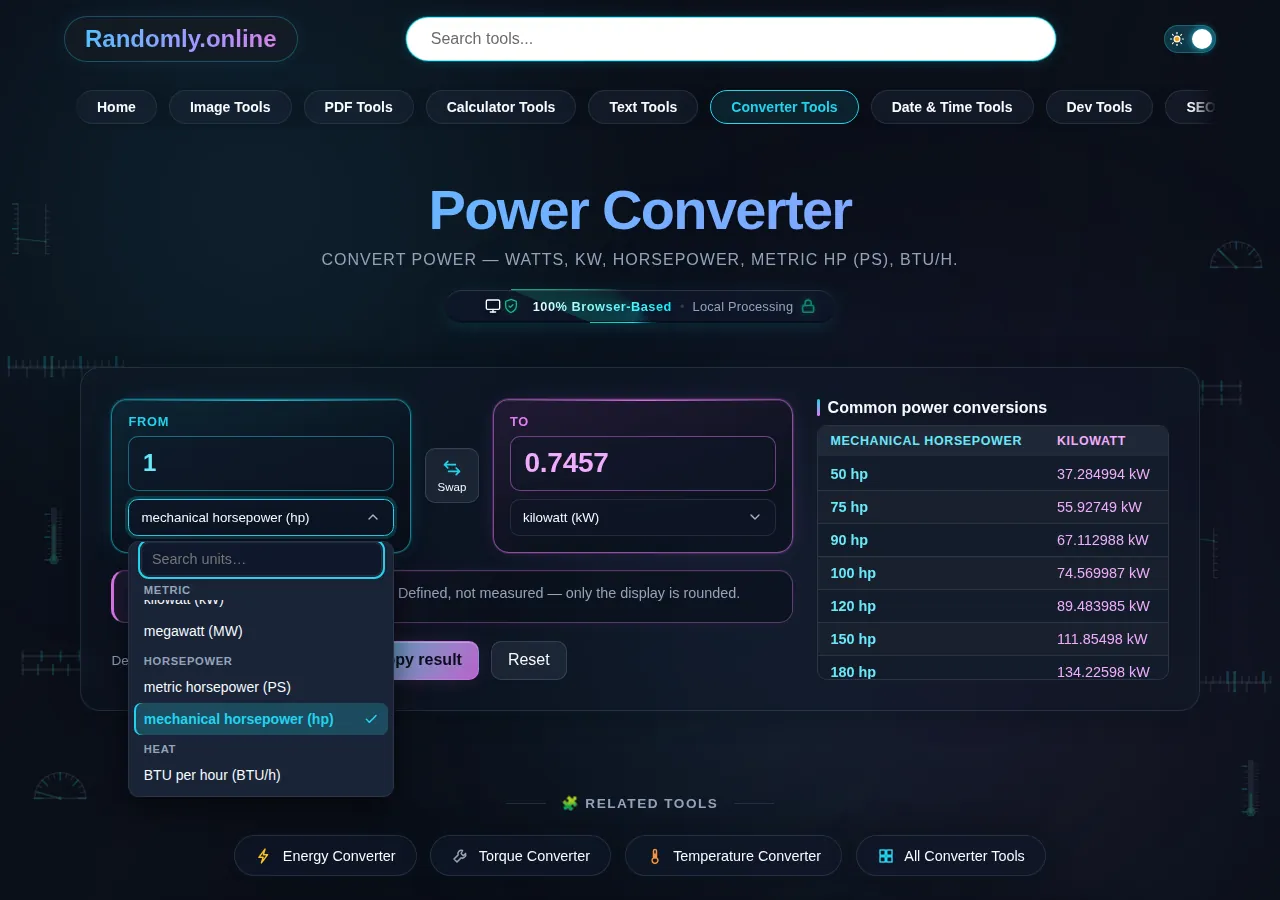
    The power converter unit list open at the boundary between its metric group and its horsepower group, with metric horsepower and mechanical horsepower below the heading.
    The unit list, grouped and searchable
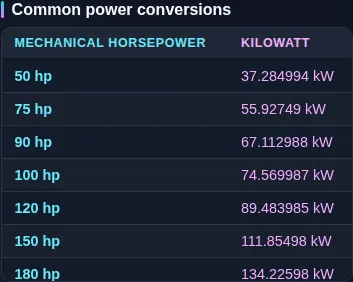
    The horsepower to kilowatts reference table listing engine outputs from 50 hp to 600 hp beside their kilowatt readings.
    The reference table for the pair on screen
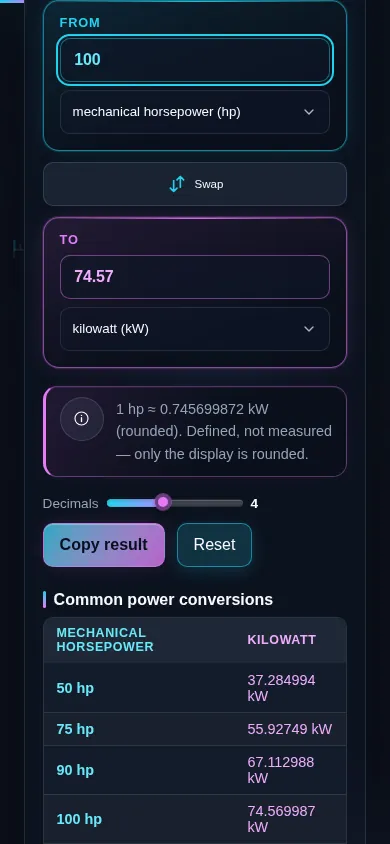
    The power converter on a phone screen, the two panes stacked with the swap control between them.
    The same tool on a phone

    Frequently Asked Questions

    How many watts are in a horsepower?

    One mechanical (imperial) horsepower is 745.7 watts — the definition used in the US and UK. Metric horsepower (PS), used in European car specs, is slightly less at 735.5 watts. So the answer is about 746 W for hp, or 735 W for PS. The tool shows the exact factor and labels which horsepower it's using.

    ---

    How do I convert hp to kW and back?

    Multiply mechanical horsepower by 0.7457 to get kilowatts, or multiply kW by 1.341 to get hp. For example, 200 hp × 0.7457 = 149.1 kW, and 100 kW × 1.341 = 134.1 hp. For metric PS, use 0.7355 kW per PS instead. The tool applies the exact factor for whichever horsepower you pick and shows it with the result.

    ---

    How many kW is 100 hp?

    About 74.6 kW for mechanical horsepower (100 × 0.7457). If the figure is metric PS instead, 100 PS is about 73.5 kW. That's why a car quoted as "100 PS" isn't quite the same as one quoted as "100 hp". Enter the value and pick the horsepower type in the tool for the exact conversion.

    ---

    What's the difference between mechanical hp and metric hp (PS)?

    They're two definitions of horsepower. Mechanical (imperial) hp is 745.7 W, used in the US and UK. Metric hp — written PS, cv, or ch — is 735.5 W, used across Europe and Asia. Metric PS is about 1.4% smaller, so "100 PS" equals about 98.6 mechanical hp. They look interchangeable but aren't, which is why the tool labels each one.

    ---

    What is PS (or cv) in car specs?

    PS stands for *Pferdestärke*, German for "horse strength" — it's metric horsepower, equal to 735.5 watts. French specs call the same unit cv or ch (*cheval*). European and Asian manufacturers quote engine output in PS, while US and UK figures use mechanical hp (745.7 W). The tool converts PS to watts, kW, or mechanical hp so you can compare specs fairly.

    ---

    Is BHP the same as HP?

    Effectively yes, for conversion purposes. BHP (brake horsepower) is horsepower measured at the engine's output shaft with a brake dynamometer — it describes *how* the power is measured, not a different unit. A BHP figure is mechanical horsepower (745.7 W each), so you convert it the same way. Just watch whether a European "hp" figure is actually metric PS.

    ---

    How do I convert BTU/h to watts or kW?

    Multiply BTU per hour by 0.293 to get watts, or divide by 3412 to get kilowatts. For example, a 9000 BTU/h air-conditioner is about 2637 W, or 2.64 kW. To go the other way, multiply kW by 3412 to get BTU/h. The tool handles these HVAC conversions directly, with the factor shown.

    ---

    What is a "ton" of cooling in kW?

    One ton of cooling is 12,000 BTU/h, which is about 3.517 kilowatts. It's an air-conditioning rating based on the cooling effect of melting a ton of ice in a day — nothing to do with weight. So a "2-ton" AC unit provides about 24,000 BTU/h, or roughly 7 kW of cooling. The tool converts between BTU/h, tons, and kW.

    ---

    What's the difference between power and energy?

    Power is the *rate* of energy use, measured in watts (joules per second). Energy is the *total amount*, measured in joules or kilowatt-hours. A 2000-watt heater has a power of 2 kW; run it for an hour and it *uses* 2 kWh of energy. This tool converts power units; for energy amounts (kWh, joules, calories), use the Energy Converter.

    ---

    Is this converter exact, or does it round the answer?

    The math is exact — it uses defined factors (1 mechanical hp = 745.699872 W, 1 metric PS = 735.49875 W, 1 BTU/h = 0.29307107 W). Only the *displayed* value is rounded for readability, and you can add decimal places for more precision. The factor and horsepower type shown with each result let you verify the figure yourself.

    ---

    What's the formula to convert power units?

    Convert everything through watts. Multiply your value by its factor to watts (mechanical hp → ×745.7, metric PS → ×735.5, kW → ×1000, BTU/h → ×0.293), then divide by the target unit's factor. For hp to kW it's value × 745.7 ÷ 1000, which is value × 0.7457. The tool applies this two-step method for any pair of units.

    ---

    Does the tool work offline, and does it upload my data?

    It works fully offline once the page has loaded, and it never uploads anything. All conversions are pure arithmetic using fixed factors, so the calculation happens on your own device — no server, no account, no tracking. That makes it dependable in a workshop with no signal, and private by design, since there's nothing to send anywhere.

    Still have questions?

    If you can't find the answer you're looking for, feel free to contact our support team.

    Contact Us