Speed Converter

Convert speed between mph, km/h, m/s, knots, and ft/s.

100% Browser-Based Local Processing

How this conversion works

The relation

Worked example

    4

    Common speed conversions

    km/hmph

    Privacy Focused

    🔒 Local Processing. The values you enter never leave your device.

    Instant Results

    🌐 Fully Client-Side. Runs instantly in your browser.

    No Signup

    ⚡ No accounts. No API keys. Just open and use.

    Browser Based

    🚀 No installs, no sign-ups, no conversion limits.

    What is a Speed Converter?

    > Speed Converter turns any speed between km/h, mph, metres per second, knots, and feet per second. Enter a value, pick your units, and read the result with the exact factor shown — 1 mph = 1.609344 km/h, 1 knot = 1.852 km/h, and 1 m/s = 3.6 km/h. It runs in your browser and works offline. ---

    ### H2: Convert speed between mph, km/h, m/s, and knots — with the math shown

    Speed comes in more flavours than people expect. Cars use miles per hour or kilometres per hour depending on the country; physics uses metres per second; boats and aircraft use knots; and a falling-object problem might be in feet per second. When you cross between them — reading a foreign speed limit, checking a wind forecast, or solving a homework question — you want a number you can trust.

    This converter handles the five units that actually come up: kilometres per hour (km/h), miles per hour (mph), metres per second (m/s), knots (kn), and feet per second (ft/s). Type a value, choose what you're converting *from* and *to*, and the answer appears instantly. A swap button reverses the direction, and the all-units table expands one value into every unit at once, so "100 km/h" becomes 62.14 mph, 27.78 m/s, 53.996 knots, and 91.13 ft/s on a single screen.

    The tool shows the exact factor behind each result. A mile per hour is 1.609344 km/h by definition, a knot is exactly 1.852 km/h (one nautical mile per hour), and a metre per second is exactly 3.6 km/h — the tool states the relationship so you can verify the answer.

    One honest note on Mach: the speed of sound isn't a fixed number. It's about 1235 km/h (767 mph) at sea level and 15 °C, but it drops as air gets colder and thinner with altitude — so "Mach 1" changes with conditions. If the tool offers Mach, treat it as an approximation, not an exact factor like the others. Everything runs on your own device using fixed factors, so nothing is uploaded and no connection is needed once the page has loaded.
    ---

    How to use the Speed Converter

    Step 1: Enter your value. Type the speed you want to convert into the input box

    Decimals are fine.

    Step 2: Pick the "from" unit. Choose the unit your number is currently in — for example, miles per hour (mph)

    Pick the "from" unit. Choose the unit your number is currently in — for example, miles per hour (mph).

    Step 3: Pick the "to" unit. Choose the unit you want the answer in — for example, kilometres per hour (km/h)

    The result updates instantly.

    Step 4: Read the result and the factor. The converted value appears with the exact relationship used (for example, 1 mph = 1.609344 km/h), so you can verify it

    Read the result and the factor. The converted value appears with the exact relationship used (for example, 1 mph = 1.609344 km/h), so you can verify it.

    Step 5: Copy, swap, or expand. Use Copy to grab the number, the swap button to reverse the direction, or open the all-units table to see your value in every unit at once

    Adjust the decimal places for more precision.

    Speed Converter in action

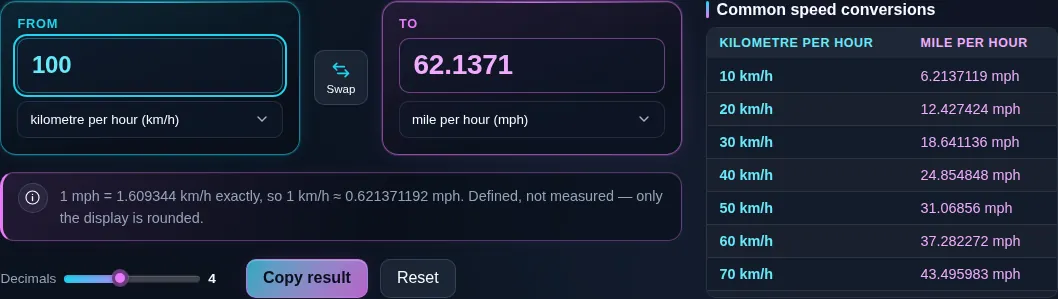
    Speed converter turning 100 kilometres per hour into 62.1371 miles per hour, with the note underneath reading that one mile per hour is exactly 1.609344 kilometres per hour.
    Converting, with the exact factor underneath
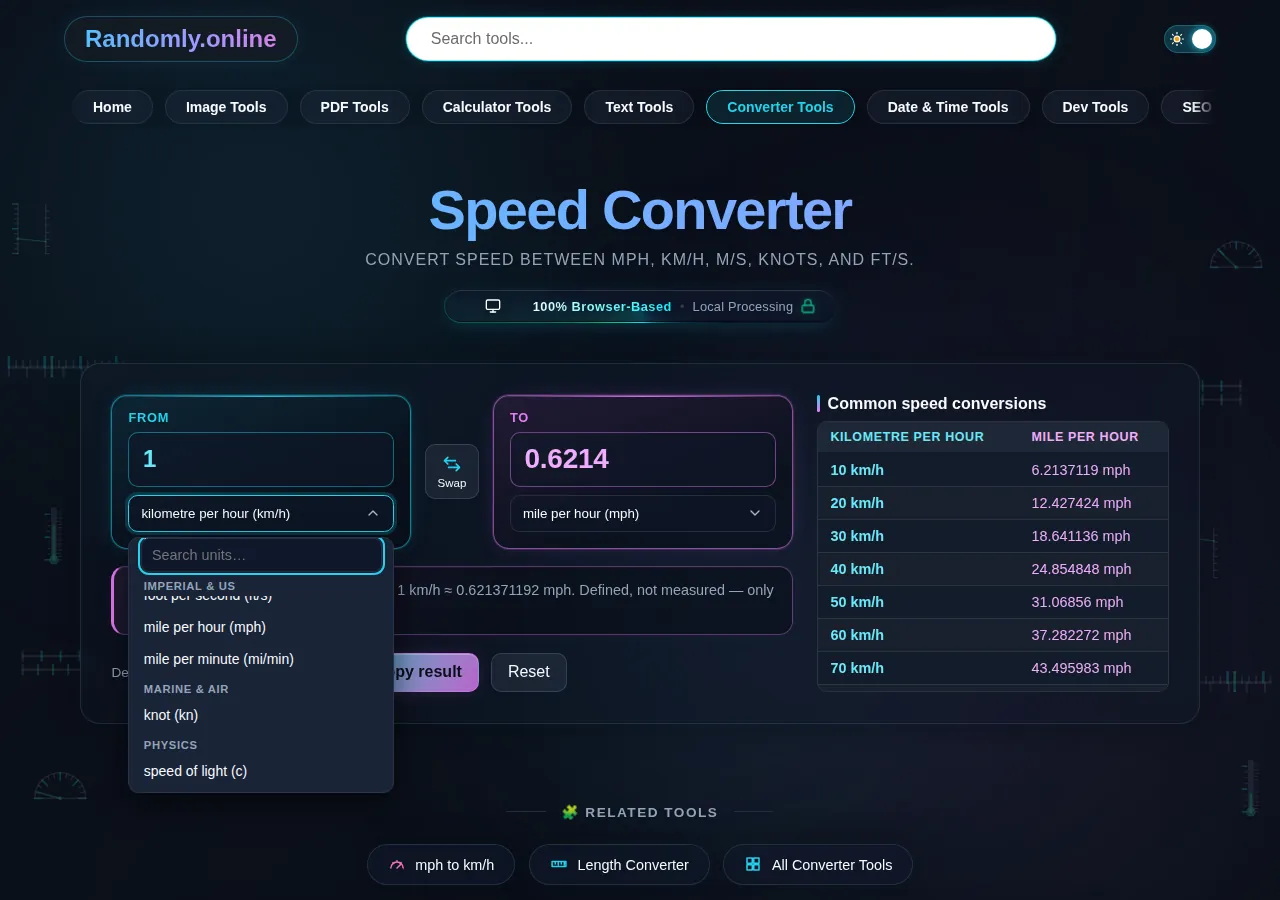
    The speed converter unit list open at its marine and air group, showing the knot listed apart from the imperial and US units above it.
    The unit list, grouped and searchable
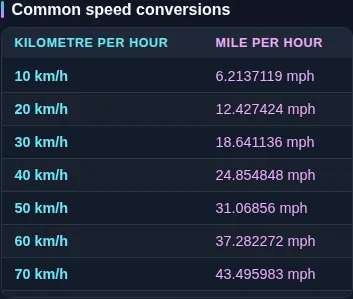
    The kilometres per hour to miles per hour reference table listing common road speeds side by side beneath the converter.
    The reference table for the pair on screen
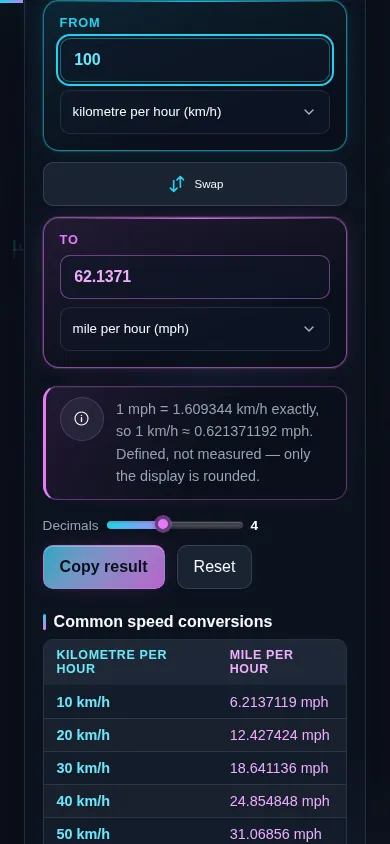
    The speed converter on a phone screen, the two panes stacked with the swap control between them.
    The same tool on a phone

    Frequently Asked Questions

    How many km/h is 60 mph?

    96.56 km/h. Multiply mph by 1.609344 to get km/h, so 60 × 1.609344 = 96.56 km/h. Common ones: 30 mph ≈ 48.3 km/h, 70 mph ≈ 112.7 km/h, and 100 mph ≈ 160.9 km/h. Enter any value and the tool shows the result plus the exact factor it used.

    ---

    How do I convert mph to km/h and back?

    To go from mph to km/h, multiply by 1.609344 (because one mile is 1.609344 km). To go the other way, multiply km/h by 0.621371, or divide by 1.609344. For example, 50 mph = 80.47 km/h, and 120 km/h = 74.56 mph. The tool applies the exact factor automatically and displays it with the result.

    ---

    How fast is one knot in mph and km/h?

    One knot is exactly 1.852 km/h, which is about 1.15078 mph. A knot is one nautical mile per hour, and a nautical mile is 1852 metres by definition. So 20 knots is 37.04 km/h or about 23.02 mph — a typical brisk sailing wind. The tool converts knots to any other speed unit with the factor shown.

    ---

    What exactly is a knot?

    A knot is a unit of speed equal to one nautical mile per hour. Because a nautical mile is 1852 metres (based on one minute of latitude), a knot is exactly 1.852 km/h or about 1.151 mph. It's used in sailing, aviation, and meteorology. The name comes from old ships timing knots on a rope paid out behind the boat.

    ---

    How do I convert metres per second to km/h?

    Multiply by 3.6. One metre per second is exactly 3.6 km/h, because there are 3600 seconds in an hour and 1000 metres in a kilometre (3600 ÷ 1000 = 3.6). So 10 m/s = 36 km/h. To reverse it, divide km/h by 3.6. It's one of the cleanest conversions there is, and the tool shows the factor.

    ---

    How fast is Mach 1?

    It depends on conditions. Mach 1 is the speed of sound, which is about 1235 km/h (767 mph, or 343 m/s) at sea level and 15 °C — but it drops as air gets colder and thinner with altitude, to roughly 1062 km/h high up. So Mach isn't a fixed conversion factor like the others; any figure is an approximation tied to temperature and altitude.

    ---

    Is a knot faster than a mile per hour?

    Per unit, yes. One knot equals about 1.151 mph, so "20 knots" is faster than "20 mph". This is because a nautical mile (1852 m) is longer than a statute mile (1609 m). It's a per-unit comparison, though — a specific speed is the same however you label it, once converted correctly.

    ---

    What's the formula to convert speed units?

    Convert everything through metres per second. Multiply your value by its factor to m/s (km/h → ÷3.6, mph → ×0.44704, knot → ×0.514444, ft/s → ×0.3048), then divide by the target unit's factor. For mph to km/h this simplifies to value × 1.609344. The tool applies this two-step method for any pair of units.

    ---

    Which unit is used for wind speed?

    It varies by context. Marine and aviation forecasts use knots; general weather reports use mph (US, UK) or km/h (most of the world); and scientific data often uses metres per second. The tool converts between all of them, so a "25-knot wind" becomes 46.3 km/h or 28.8 mph — useful when a forecast doesn't match the units you think in.

    ---

    Is this converter exact, or does it round the answer?

    The math is exact — it uses defined factors (1 mph = 1.609344 km/h, 1 knot = 1.852 km/h, 1 ft/s = 0.3048 m/s). Only the *displayed* value is rounded for readability, and you can add decimal places for more precision. The factor shown with each result lets you verify the figure yourself. Mach is the one exception, since it isn't a fixed factor.

    ---

    How do I convert running or cycling pace to speed?

    Pace (like minutes per kilometre) is the inverse of speed. To convert, divide 60 by your pace in minutes per km to get km/h — so a 5-minute-per-km pace is 60 ÷ 5 = 12 km/h. For minutes per mile, divide 60 by the pace to get mph. This converter handles the speed units once you've turned pace into a speed.

    ---

    Does the tool work offline, and does it upload my data?

    It works fully offline once the page has loaded, and it never uploads anything. All conversions are pure arithmetic using fixed factors, so the calculation happens on your own device — no server, no account, no tracking. That makes it dependable on the road or at sea with no signal, and private by design, since there's nothing to send.

    Still have questions?

    If you can't find the answer you're looking for, feel free to contact our support team.

    Contact Us