Fuel Economy Converter

Convert fuel economy — MPG (US & UK), L/100km, km/L.

100% Browser-Based Local Processing

How this conversion works

The relation

Worked example

    4

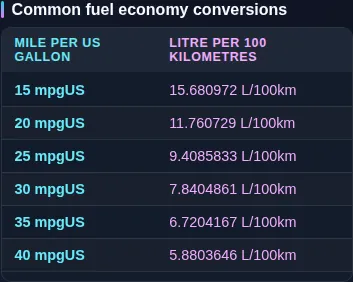
    Common fuel economy conversions

    US MPGL/100km

    Privacy Focused

    🔒 Local Processing. The values you enter never leave your device.

    Instant Results

    🌐 Fully Client-Side. Runs instantly in your browser.

    No Signup

    ⚡ No accounts. No API keys. Just open and use.

    Browser Based

    🚀 No installs, no sign-ups, no conversion limits.

    What is a Fuel Economy Converter?

    > Fuel Economy Converter switches between MPG (US and UK), L/100km, and km/L. MPG and L/100km are *inverse*: L/100km = 112903/480 ÷ US MPG, which is 235.215 rounded, so higher MPG means lower L/100km. And US MPG isn't UK MPG — the gallons differ. Enter a value, pick your units, and it works offline. ---

    ### H2: Convert fuel economy — MPG, L/100km, and km/L (the honest way)

    Comparing fuel economy across countries is deceptively tricky, and two traps catch almost everyone. This converter is built to handle both honestly, across four units: miles per US gallon, miles per UK (imperial) gallon, litres per 100 km (L/100km), and kilometres per litre (km/L).

    Trap one: MPG and L/100km run in opposite directions. MPG and km/L measure *fuel economy* — distance per unit of fuel, so higher is better. L/100km measures *fuel consumption* — fuel per fixed distance, so lower is better. They're reciprocals, not a simple scaling: to convert, you use L/100km = 235.215 ÷ US MPG. So a 40 US MPG car is about 5.88 L/100km, and a very efficient 60 MPG car is about 3.92 L/100km. Because it's an inverse, the same *gap* in MPG means different things at different levels — going 20→30 MPG saves far more fuel than 50→60 MPG, even though both are a 10-MPG jump. The tool shows the formula so this stays clear.

    Trap two: a US gallon is not a UK gallon. The US gallon is 3.785 litres; the imperial (UK) gallon is 4.546 litres — about 20% bigger. So the *same car* scores roughly 20% higher in UK MPG than US MPG: 30 US MPG is about 36 UK MPG. Quoting "40 MPG" without saying which gallon is genuinely ambiguous, so the tool labels US and UK MPG separately and never mixes them.

    The fourth unit, km/L, is common in much of Asia and Latin America and converts cleanly: 1 US MPG is about 0.425 km/L. One more honest note: you can't just average two MPG figures to get combined economy — MPG averages non-linearly (the correct method is a harmonic mean). This tool converts single values. Everything runs on your own device, offline, with nothing uploaded.
    ---

    How to use the Fuel Economy Converter

    Step 1: Enter your value. Type the economy or consumption figure into the input box

    Decimals are fine.

    Step 2: Pick the "from" unit. Choose your starting unit — and if it's MPG, make sure you've selected US or UK

    Pick the "from" unit. Choose your starting unit — and if it's MPG, make sure you've selected US or UK.

    Step 3: Pick the "to" unit. Choose the unit you want the answer in — again minding US vs UK MPG

    The result updates instantly.

    Step 4: Read the result and the relation. The converted value appears with the relation used — L/100km = 112903/480 ÷ US MPG — so you can check it

    That fraction is the exact one; every other converter rounds it to 235.215 and then calls it a constant.

    Step 5: Copy, swap, or expand. Use Copy to grab the number, the swap button to reverse the direction, or open the all-units table to see your value across all four units

    Adjust the decimal places for more precision.

    Fuel Economy Converter in action

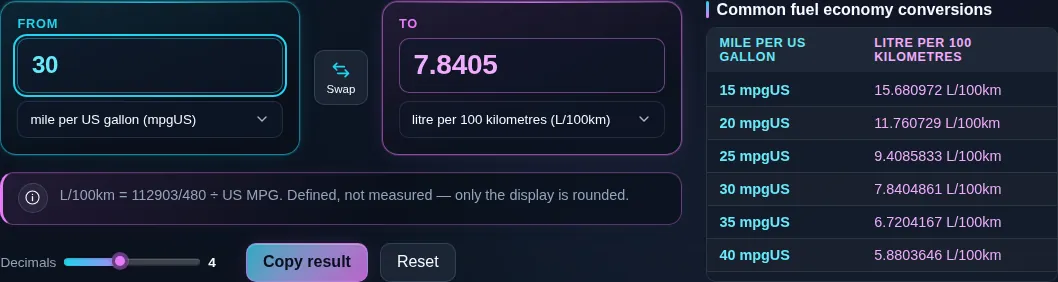
    Fuel economy converter turning 30 US MPG into 7.8405 litres per 100 km, with the note underneath reading that L/100km equals 112903/480 divided by US MPG.
    Converting, with the exact ratio stated underneath
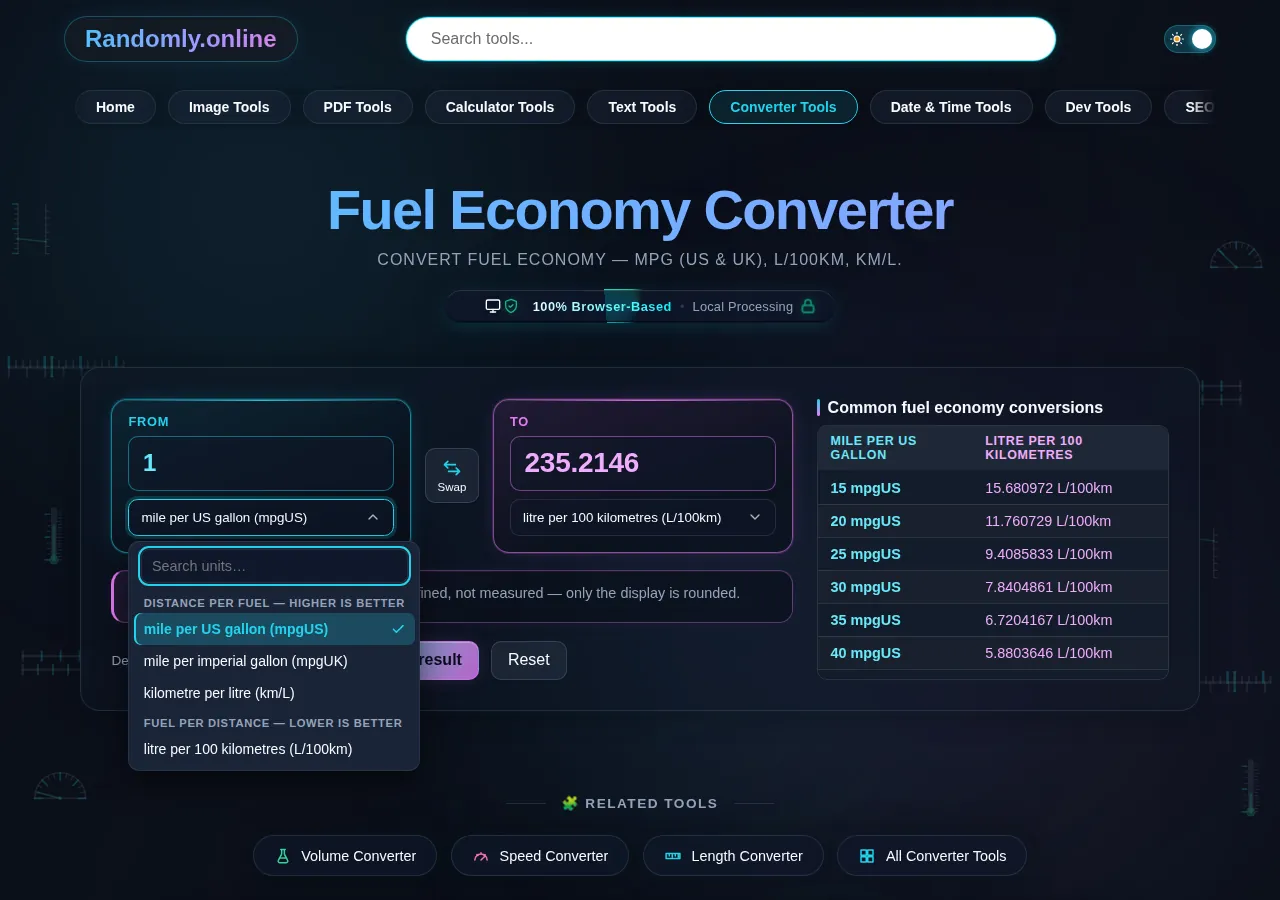
    The open unit list showing all four units under two headings, distance per fuel where higher is better holding US MPG, UK MPG and km/L, and fuel per distance where lower is better holding L/100km.
    The unit list, grouped by which way is better
    The fuel economy table listing US MPG from 15 to 80 against litres per 100 km, beneath the converter.
    A table of ordinary economy figures, ready to read
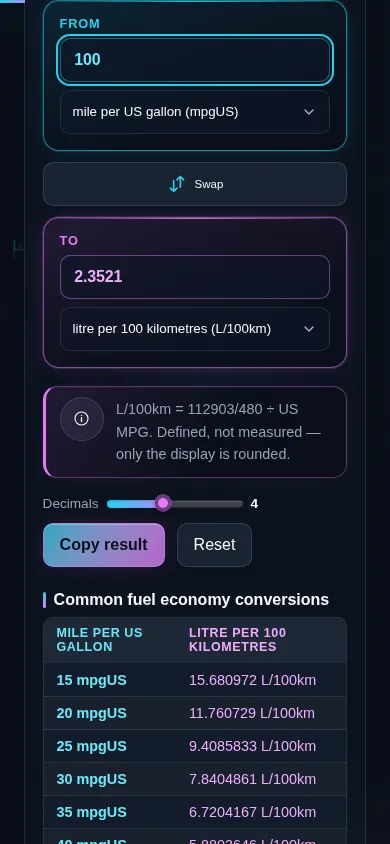
    The fuel economy converter on a phone screen, the two panes stacked with the swap control between them.
    The same tool on a phone

    Frequently Asked Questions

    How do I convert MPG to L/100km?

    Divide, don't multiply — the two units are inverses. L/100km = 112903/480 ÷ US MPG, and 112903/480 is 235.215 if you want it as a decimal. So 40 US MPG is about 5.88 L/100km. For UK MPG the constant is 56826125/201168, or 282.481, because the imperial gallon is bigger. The tool prints the fraction rather than the decimal, since neither one terminates and rounding it would make the constant itself an approximation.

    ---

    What is 40 MPG in L/100km?

    For 40 US MPG, about 5.88 L/100km (235.215 ÷ 40). But if that "40 MPG" is a UK figure, it's 282.481 ÷ 40 ≈ 7.06 L/100km — noticeably different, because a UK gallon is larger. This is exactly why you must know whether an MPG number is US or UK. The tool labels both so the answer is unambiguous.

    ---

    Why are MPG and L/100km inversely related?

    Because they measure opposite things. MPG is *distance per fuel* (miles per gallon) — more is better. L/100km is *fuel per distance* (litres per 100 km) — less is better. When one goes up the other goes down, so you convert by division (L/100km = 112903/480 ÷ US MPG), not by a fixed multiplier. That's also why there is no "1 MPG = n L/100km" factor to quote: such a figure would be right at 1 MPG and wrong at every other value. And it is why a small MPG change at high economy barely moves the L/100km figure.

    ---

    Is US MPG different from UK (imperial) MPG?

    Yes — by about 20%. A US gallon is 3.785 litres, while a UK (imperial) gallon is 4.546 litres, so the same car travels further on a UK gallon and scores higher UK MPG. For example, 30 US MPG equals about 36 UK MPG. They share the name "MPG" but aren't interchangeable, which is why the tool keeps US and UK MPG separate.

    ---

    How do I convert US MPG to UK MPG and back?

    Multiply US MPG by 1.201 to get UK MPG, because a UK gallon is 1.201 times a US gallon. To go the other way, multiply UK MPG by 0.8327. So 25 US MPG is about 30 UK MPG, and 60 UK MPG is about 50 US MPG. The tool does this exactly, using the true gallon sizes rather than a rough ratio.

    ---

    Which is better — higher MPG or lower L/100km?

    Both describe better economy — they just count opposite ways. A higher MPG means the car goes further on the same fuel. A lower L/100km means it uses less fuel over the same distance. So a 50 MPG car (about 4.7 L/100km) is more efficient than a 30 MPG car (about 7.84 L/100km). When comparing, make sure you're reading the right direction for each unit.

    ---

    How do I convert km/L to L/100km and MPG?

    For km/L to L/100km, divide 100 by the km/L figure (they're inverses): L/100km = 100 ÷ km/L. For km/L to US MPG, multiply km/L by about 2.352. So 15 km/L is 100 ÷ 15 ≈ 6.67 L/100km, or about 35.3 US MPG. The tool converts km/L to all the other units with the formula shown.

    ---

    What is 5 L/100km in MPG?

    About 47 US MPG, or 56.5 UK MPG. Because the relationship is inverse, you divide: US MPG = 235.215 ÷ 5 ≈ 47.04, and UK MPG = 282.481 ÷ 5 ≈ 56.5. A figure of 5 L/100km is quite economical — typical of an efficient small car or hybrid. The tool converts any L/100km value to both MPG standards and km/L.

    ---

    Can I average two MPG figures for combined economy?

    No — averaging MPG directly gives the wrong answer, because MPG is a reciprocal measure. If a car does 20 MPG in town and 40 MPG on the highway over equal distances, the true combined figure isn't 30 MPG; it's the harmonic mean, about 26.7 MPG. This is easier in L/100km, which *can* be averaged. This tool converts single values, not trip averages.

    ---

    Is this converter exact, or does it round the answer?

    The arithmetic is exact. It runs on the defined gallon sizes — a US gallon is 3.785411784 L and an imperial one 4.54609 L — and the defined mile, 1.609344 km. What the familiar 235.215 and 282.481 are is those exact ratios rounded: written properly they are 112903/480 and 56826125/201168, and neither terminates as a decimal. This is the one quantity on the site where no pair terminates in either direction, so the tool prints the fraction and rounds only the answer on screen.

    ---

    What's the formula for each conversion?

    L/100km = 112903/480 ÷ US MPG, or 56826125/201168 ÷ UK MPG — 235.215 and 282.481 as decimals, both rounded. km/L = US MPG × 0.42514 (or UK MPG × 0.35401). US MPG = UK MPG × 0.8327. km/L to L/100km = 100 ÷ km/L, and that 100 is exact. Every one comes from the gallon and mile definitions, and the tool prints the relation it used with each result.

    ---

    Does the tool work offline, and does it upload my data?

    It works fully offline once the page has loaded, and it never uploads anything. All conversions are pure arithmetic using fixed factors, so the calculation happens on your own device — no server, no account, no tracking. That makes it dependable on the road with no signal, and private by design, since there's nothing to send anywhere.

    Still have questions?

    If you can't find the answer you're looking for, feel free to contact our support team.

    Contact Us