Acceleration Converter

Convert acceleration — m/s², ft/s², g-force, and Gal.

100% Browser-Based Local Processing

How this conversion works

The relation

Worked example

    4

    Common acceleration conversions

    m/s2g

    Privacy Focused

    🔒 Local Processing. The values you enter never leave your device.

    Instant Results

    🌐 Fully Client-Side. Runs instantly in your browser.

    No Signup

    ⚡ No accounts. No API keys. Just open and use.

    Browser Based

    🚀 No installs, no sign-ups, no conversion limits.

    What is a Acceleration Converter?

    > Acceleration Converter turns any acceleration between metres per second squared, feet per second squared, g-force, and Gal. Enter a value, pick your units, and read the result with the exact factor shown. The key anchor: 1 g = 9.80665 m/s² (standard gravity), or 32.174 ft/s². Works offline. ---

    ### H2: Convert acceleration — m/s², ft/s², and g-force

    Acceleration is how quickly velocity changes, and it's measured in a few different units. Science uses metres per second squared (m/s²); imperial contexts use feet per second squared (ft/s²); everyday and automotive/aerospace talk uses g-force (g), expressing acceleration as a multiple of gravity; and geophysics uses the galileo (Gal), equal to one centimetre per second squared. This converter handles all four, so a value in g becomes m/s², or an imperial ft/s² becomes metric, in one step. Every result shows the exact factor, with a swap button and an all-units table.

    The anchor that makes acceleration intuitive is standard gravity: 1 g = 9.80665 m/s² exactly (about 32.174 ft/s²). This is the acceleration an object gains in free fall near Earth's surface. Expressing accelerations in "g" gives an instant feel for them: gentle car braking is around 0.3 g, hard emergency braking about 1 g, a roller-coaster loop can hit 4 g, and a fighter pilot in a tight turn might pull 9 g. The reference strip on this page lists these so you can sanity-check a conversion.

    A couple of honest clarifications. First, the "g" here is g-force / standard gravity, not grams — same letter, completely different quantity. Second, the value of gravity actually varies slightly with location (roughly 9.78 to 9.83 m/s² between the equator and poles, and with altitude), but the "g" unit always uses the fixed standard of 9.80665 m/s², which keeps the conversion exact.

    One more distinction: acceleration is the *rate* velocity changes, not a "0–60 time". Working out an acceleration from a 0–60 figure needs the change in velocity divided by the time — a separate calculation. This tool converts *acceleration units*. Everything runs on your own device, offline, with nothing uploaded.
    ---

    How to use the Acceleration Converter

    Step 1: Enter your value. Type the acceleration you want to convert into the input box

    Decimals are fine.

    Step 2: Pick the "from" unit. Choose the unit your number is currently in — for example, g-force (g)

    Pick the "from" unit. Choose the unit your number is currently in — for example, g-force (g).

    Step 3: Pick the "to" unit. Choose the unit you want the answer in — for example, metres per second squared (m/s²)

    The result updates instantly.

    Step 4: Read the result and the factor. The converted value appears with the exact relationship used (for example, 1 g = 9.80665 m/s²), so you can verify it

    Read the result and the factor. The converted value appears with the exact relationship used (for example, 1 g = 9.80665 m/s²), so you can verify it.

    Step 5: Copy, swap, or expand. Use Copy to grab the number, the swap button to reverse the direction, or open the all-units table to see your value in every unit at once

    Adjust the decimal places for more precision.

    Acceleration Converter in action

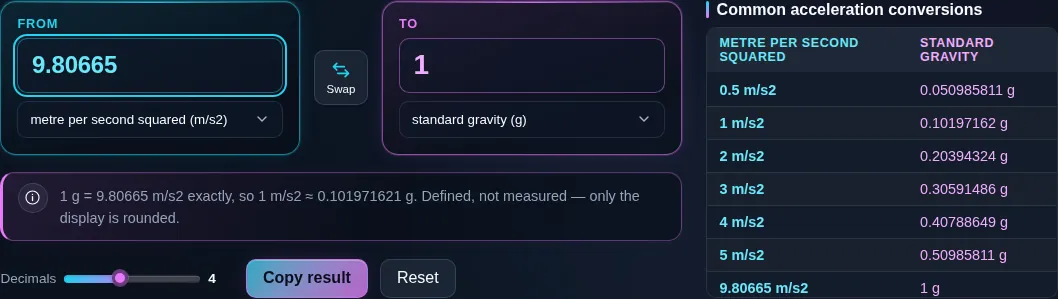
    Acceleration converter turning 9.80665 metres per second squared into exactly 1 g, with the note underneath reading that standard gravity is 9.80665 metres per second squared exactly.
    Converting metres per second squared to g, with the exact factor underneath
    The acceleration converter unit list showing metre per second squared and galileo under its metric heading, foot per second squared under imperial and US, and standard gravity under reference.
    The unit list, grouped and searchable
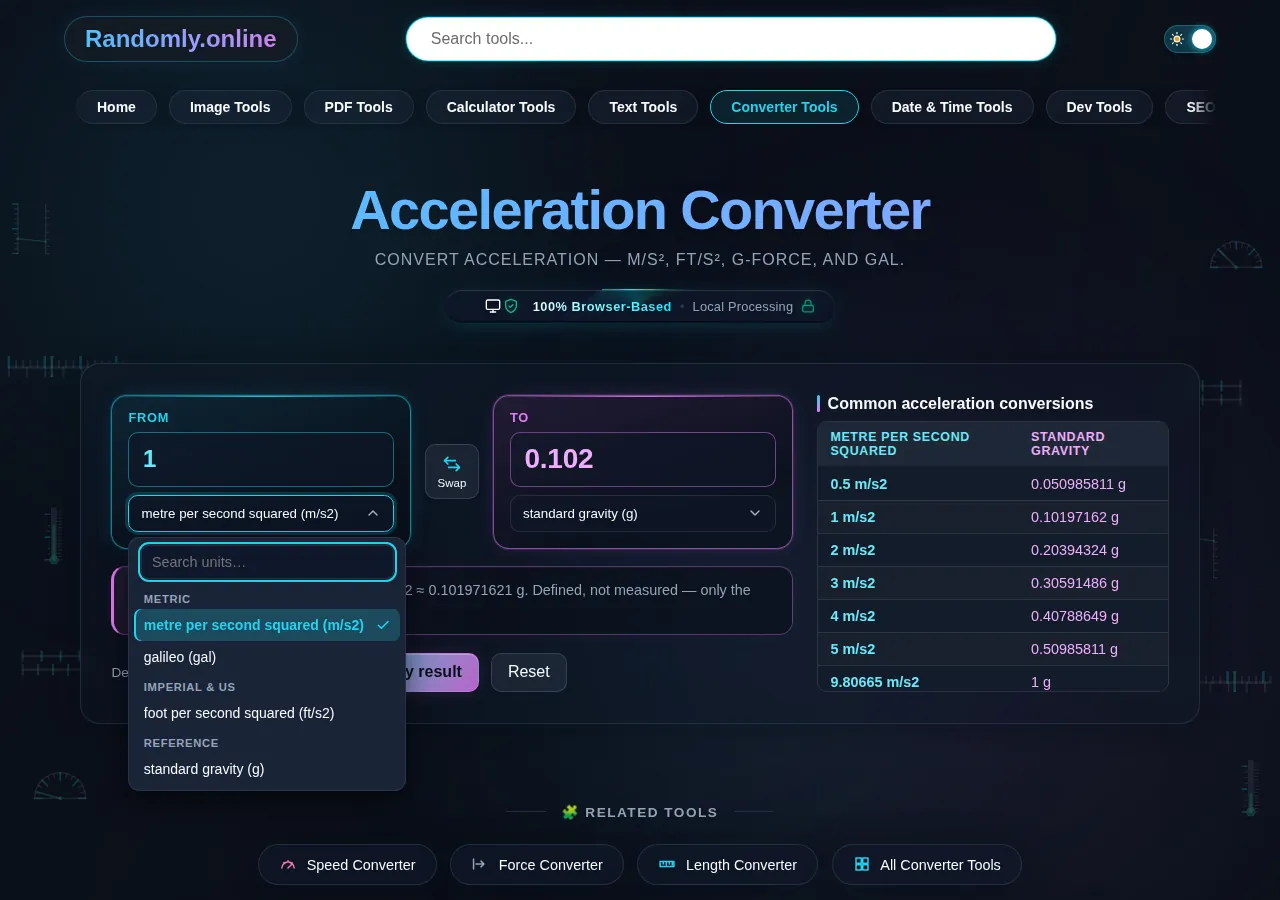
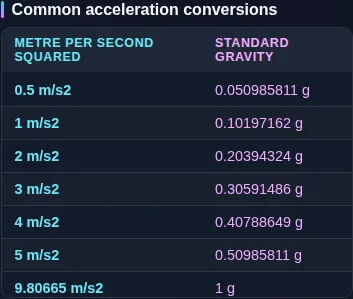
    The metres per second squared to g reference table listing values from 0.5 to 100 beside their readings in g.
    The reference table for the pair on screen
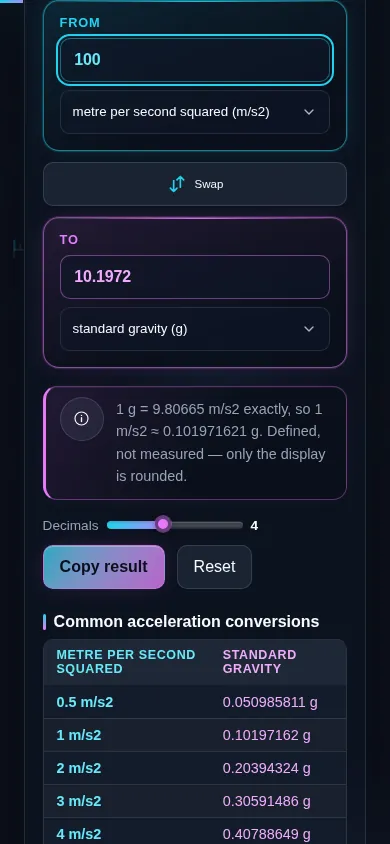
    The acceleration converter on a phone screen, the two panes stacked with the swap control between them.
    The same tool on a phone

    Frequently Asked Questions

    How many m/s² is 1 g?

    Exactly 9.80665 metres per second squared. That's the definition of standard gravity (g₀) — the acceleration of an object in free fall near Earth's surface. So 2 g is 19.61 m/s², and 4 g is about 39.23 m/s². For quick estimates, "1 g ≈ 9.81 m/s²" is fine. The tool shows this exact factor with every result.

    ---

    What is g-force?

    G-force expresses an acceleration as a multiple of standard gravity (9.80665 m/s²). "1 g" is the acceleration you feel from gravity at rest, and higher g-values mean stronger acceleration — a 4 g turn pushes on you four times as hard as gravity. It's popular in cars, aviation, and theme parks because it gives an instant, intuitive sense of the forces involved.

    ---

    How do I convert g to m/s² and back?

    Multiply g-force by 9.80665 to get m/s², or divide m/s² by 9.80665 to get g. For example, 3 g × 9.80665 = 29.42 m/s², and 20 m/s² ÷ 9.80665 = 2.04 g. The tool applies this exact factor automatically and displays it, so you don't have to remember which way it goes.

    ---

    How many ft/s² are in a g?

    One g is about 32.174 feet per second squared. This is the imperial form of standard gravity — 9.80665 m/s² divided by 0.3048 metres per foot gives 32.174 ft/s². It's the classic "32 ft/s²" figure from physics textbooks. So 2 g is about 64.35 ft/s². The tool converts between g, ft/s², and m/s² with the factor shown.

    ---

    Is "g" the same as gravity?

    Essentially, yes — the "g" unit is standard gravity, the acceleration gravity produces near Earth's surface (9.80665 m/s²). When you express an acceleration in g, you're comparing it to that gravitational acceleration. Strictly, gravity's actual strength varies a little by location, but the "g" *unit* is fixed at the standard value, which is what makes it a consistent reference.

    ---

    Is "g" (g-force) the same as grams?

    No — they just share a letter. g as used here is g-force / standard gravity, a unit of acceleration (9.80665 m/s²). Grams (also abbreviated g) are a unit of mass. They're completely different quantities, and context tells them apart: an accelerometer or a roller-coaster spec means g-force, while a kitchen scale means grams. This tool deals only with acceleration.

    ---

    How do I convert ft/s² to m/s²?

    Multiply feet per second squared by 0.3048 — the same factor as feet to metres, because acceleration just adds "per second squared". So 10 ft/s² × 0.3048 = 3.048 m/s². To reverse it, divide m/s² by 0.3048 (or multiply by 3.28084). The tool applies this exact factor and shows it with the result.

    ---

    Does gravity's value vary by location?

    Yes, a little. Earth's gravitational acceleration ranges from about 9.78 m/s² near the equator to 9.83 m/s² near the poles, and it drops slightly with altitude. However, the standard gravity used to define the "g" unit is fixed at exactly 9.80665 m/s², an internationally agreed average. That's why the conversion here is exact, even though your local gravity might differ by a fraction of a percent.

    ---

    What are some real-world g-force examples?

    A few for scale: gentle car braking is around 0.3 g (about 2.9 m/s²), a hard emergency stop is roughly 1 g (9.81 m/s²), a roller-coaster loop can reach 4 g (about 39 m/s²), and a fighter pilot in a tight turn may pull 9 g (about 88 m/s²). The reference strip on this page lists these so you can sanity-check any conversion.

    ---

    Is acceleration the same as a 0–60 time?

    No — but they're related. Acceleration is the *rate* velocity changes (velocity ÷ time), while a "0–60 mph time" is how long a car takes to reach 60 mph. To get an average acceleration from it, divide the change in speed by the time. This tool converts *acceleration units* (m/s², g, and so on); working out acceleration from a 0–60 figure is a separate step.

    ---

    Is this converter exact, or does it round the answer?

    The math is exact — it uses defined factors (1 g = 9.80665 m/s², 1 ft/s² = 0.3048 m/s², 1 Gal = 0.01 m/s²). Only the *displayed* value is rounded for readability, and you can add decimal places for more precision. The factor shown with each result lets you verify the figure yourself.

    ---

    Does the tool work offline, and does it upload my data?

    It works fully offline once the page has loaded, and it never uploads anything. All conversions are pure arithmetic using fixed factors, so the calculation happens on your own device — no server, no account, no tracking. That makes it dependable with no signal, and private by design, since there's nothing to send anywhere.

    Still have questions?

    If you can't find the answer you're looking for, feel free to contact our support team.

    Contact Us