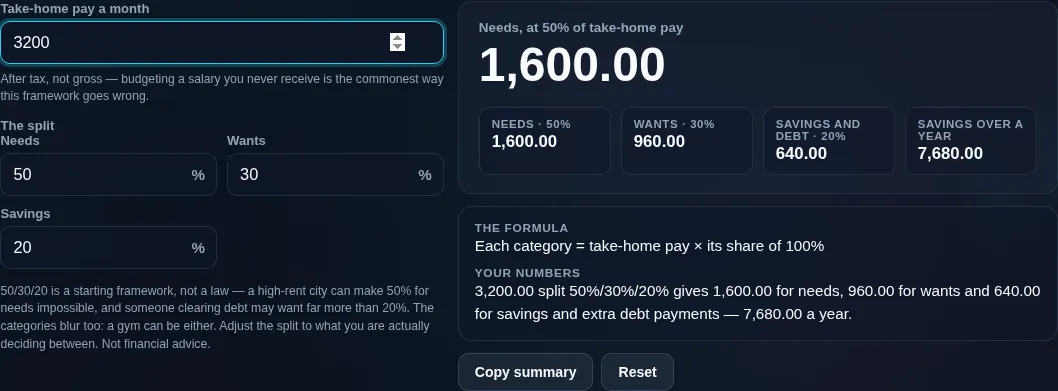
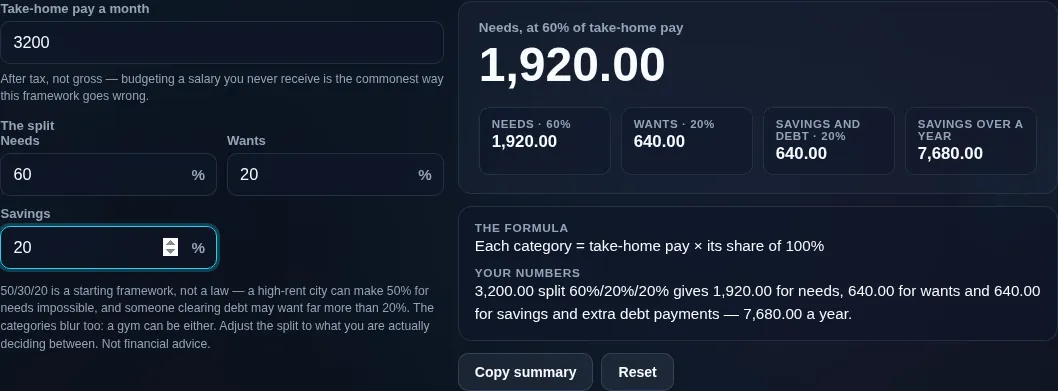
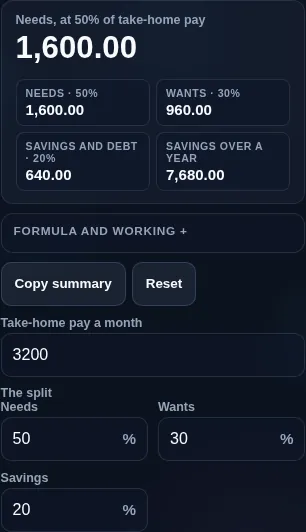
Two honesty points make this more useful than a rigid formula. First, use your net (after-tax) income, not your gross salary — budgeting from gross overstates what you actually have and is a very common mistake. If you're not sure of your take-home figure, work it out with the Take-Home Pay Calculator. Second, 50/30/20 is a guideline, not a law. In a high-cost city, needs can easily exceed 50%; aggressive savers push well past 20%; people repaying heavy debt may temporarily shrink wants. That's why the tool lets you adjust the percentages (to 70/20/10, 60/30/10, or anything that sums to 100%) to fit your real life.
It's a planning framework to bring clarity, not financial advice — and categories can blur (a gym membership might be a need or a want for you). Everything runs in your browser: your income and spending are never uploaded, unlike budgeting apps that ask to connect your bank. For where the savings should go first, see the Emergency Fund Calculator.
- Starting a budget. Get instant target amounts from your take-home pay.
- Checking your spending. Compare your actual needs/wants/savings against the targets.
- After a pay change. Re-split a new salary in seconds.
- Setting a savings rate. See what 20% (or more) actually means in money.
- Simplifying finances. Skip spreadsheets and bank-linked apps for a quick, private plan.
Realistic example. Take-home pay of $4,000/month with the standard split: $2,000 for needs, $1,200 for wants, and $800 for savings and extra debt repayment. If your rent, groceries, and bills already come to $2,400, your needs are 60% — a signal to trim wants, boost income, or accept a different split.
Advanced tip. If you carry high-interest debt, treat aggressive payoff as part of the 20% (or more) — clearing 20% interest is a guaranteed "return" no investment matches.
Common mistake to avoid. Don't budget from your gross salary. Tax and deductions come out first, so always start from take-home pay.
Related. Work out net pay with the Take-Home Pay Calculator; size your safety net with the Emergency Fund Calculator.
What this budget is — and isn't
- A guideline, not a rule. 50/30/20 is a helpful starting point, not a mandate; adjust it to your income, cost of living, debt, and goals.
- Use net income. Budget from take-home pay, not gross — otherwise you'll plan around money you don't have.
- Categories can blur. Whether something is a need or a want is personal; the split is a framework, not a rulebook.
- Not financial advice. It's an educational planning aid.
- Your data stays private. All maths runs on your device — no bank connection, no account, nothing uploaded.