Emergency Fund Calculator

Work out your emergency fund target (months of essential expenses) and how long it takes to save it.

100% Browser-Based Local Processing

Rent or mortgage, utilities, food, transport, insurance, minimum debt payments — what you would still have to pay with no income coming in. Not your normal monthly spending.

mo

Three to six months is a starting point, not a rule — variable income, a single income or dependents usually argue for more. An emergency fund's job is availability rather than return, so it belongs somewhere accessible and safe, not invested. Not financial advice.

Target fund

14,400.00

Still to save 11,400.00
Time to get there 2 yr 5 mo
Covered right now 1.3 months
Formula and working

The formula

Target = essential monthly expenses × months of cover

Your numbers

2,400.00 × 6 = 14,400.00. You have 3,000.00, so 11,400.00 to go at 400.00 a month — 29 months.

An estimate, not financial advice. Figures are indicative, and the assumptions behind them are stated on the tool itself. Tax rules, rates and fees vary by country and change over time — check against your provider or a qualified adviser before acting on a number.

Privacy Focused

🔒 Local Processing. Your salary and balances never leave your device.

Instant Results

🌐 Fully Client-Side. Runs instantly in your browser.

No Signup

⚡ No accounts. No API keys. Just open and use.

Browser Based

🚀 No installs, no sign-ups, no bank account linking.

What is a Emergency Fund Calculator?

An Emergency Fund Calculator works out how much cash you should keep for emergencies: target = monthly essential expenses × months of cover. Most guidance suggests 3–6 months, so $2,500 of essentials × 6 = a $15,000 fund. It also shows how long it takes to save, and it's a guideline, not a rule.

An emergency fund is easy-to-reach cash that covers you when life goes wrong: a job loss, a medical bill, a car or boiler repair. This calculator estimates the target — how big your fund should be — and the timeline to save it, using a simple, transparent rule: target = your monthly essential expenses × the number of months of cover you want.

Enter your monthly essential expenses (or itemize them — housing, utilities, food, transport, insurance, minimum debt payments), choose how many months of cover you want, and add your current savings and how much you save each month. The tool shows your target fund, the gap still to go, how many months you're currently covered for, and how long at your saving rate it takes to reach the goal.

How to use the emergency fund calculator

Step 1: Enter your monthly essential expenses. Just the essentials you'd still pay in an emergency (or itemize them)

Enter your monthly essential expenses. Just the essentials you'd still pay in an emergency (or itemize them).

Step 2: Choose months of cover. Start with 3–6, and raise it if your income is less stable

Choose months of cover. Start with 3–6, and raise it if your income is less stable.

Step 3: Enter your current savings. What you've already set aside for emergencies

Enter your current savings. What you've already set aside for emergencies.

Step 4: Enter your monthly saving. How much you can put toward the fund each month

Enter your monthly saving. How much you can put toward the fund each month.

Step 5: Read your target and timeline. See the target fund, the gap, your current coverage, and how long it takes to get there

Copy if needed.

Emergency Fund Calculator in action

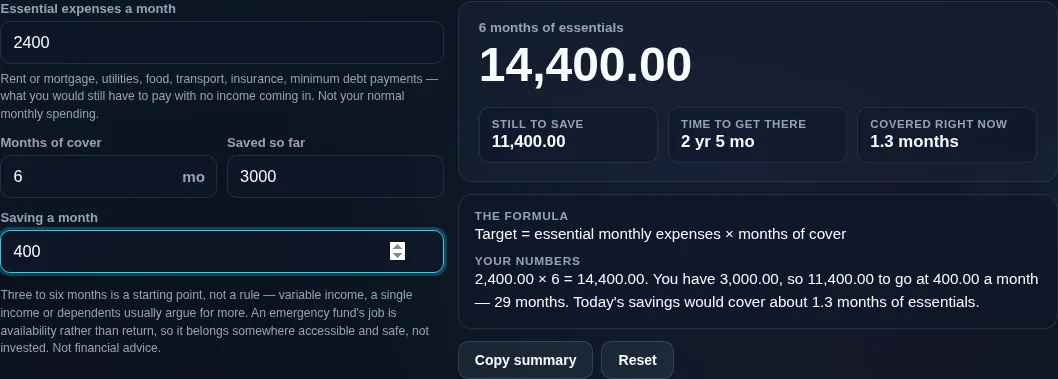
Emergency fund calculator: 2,400 of essential monthly expenses over 6 months is a 14,400.00 target, with 11,400.00 still to save and 2 yr 5 mo to get there at 400 a month
Target + timeline result
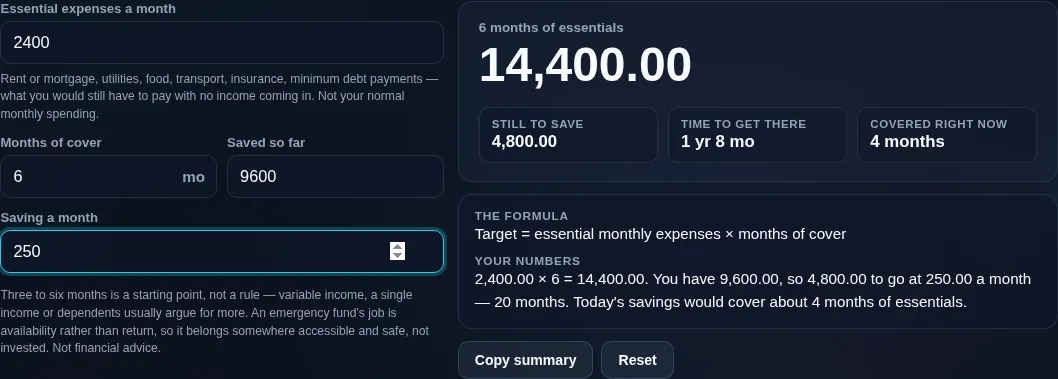
The same target with 9,600 already saved, showing 4 months of essentials covered right now and 1 yr 8 mo left at 250 a month
Current-coverage indicator
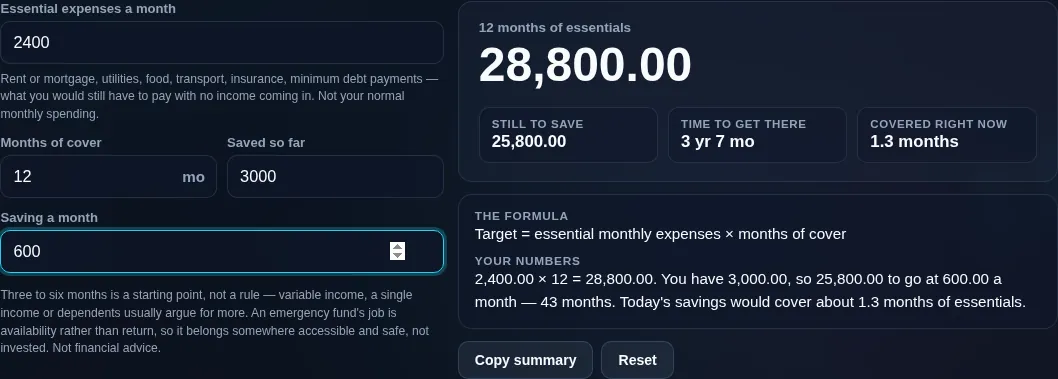
The same expenses with the cover raised to 12 months, moving the target to 28,800.00 and the timeline to 3 yr 7 mo
Adjustable months of cover
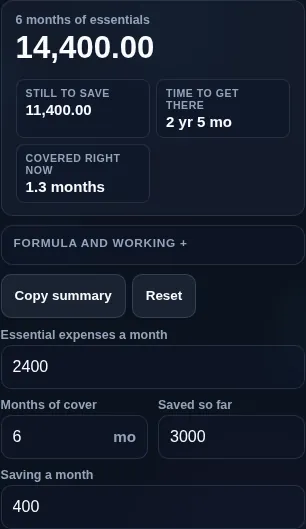
Emergency fund calculator running in a phone browser, with the expense inputs and the target stacked
Mobile browser

When an emergency fund calculator helps

Three honesty points shape how you should use it. First, "3–6 months" is a guideline, not a rule. The right size depends on your situation: someone with a stable salaried job and no dependents might be fine at the lower end, while a freelancer, a single-income household, or anyone with irregular pay often wants 6–12 months or more. The months input is adjustable for exactly this reason.

Second, base it on essential expenses, not your total spending. In a real emergency you'd cut discretionary costs, so padding the target with dining out and subscriptions inflates it — an emergency budget is leaner than normal life.

Third, keep an emergency fund liquid and safe — in an accessible savings account, not locked away or invested in volatile assets. Its job is to be *available the moment you need it*, not to earn high returns; a market dip shouldn't shrink your safety net just when you rely on it.

This is educational, not financial advice, and it runs entirely in your browser — nothing uploaded. To free up money to save, use the Budget Calculator.

  • Setting a target. Turn your expenses into a concrete savings goal.
  • Checking your buffer. See how many months you're currently covered for.
  • Making a plan. Find how long it takes to reach the target at your saving rate.
  • Adjusting for risk. Model more months if your income is irregular.
  • Prioritizing. Decide how much of your budget's savings to aim here first.

Realistic example. Essential expenses of $2,500/month with a 6-month target = a $15,000 fund. If you have $3,000 saved (1.2 months of coverage) and save $500/month, you'll reach the target in (15,000 − 3,000) ÷ 500 = 24 months.

Advanced tip. Build a small starter buffer first (say one month, or a fixed amount) before tackling other goals — even a little cash prevents small emergencies becoming debt — then grow toward the full target.

Common mistake to avoid. Don't invest your emergency fund in volatile assets chasing returns. If it falls right when you need it, it isn't doing its job — keep it liquid and safe.

Related. Free up saving with the Budget Calculator; see the bigger picture with the Net Worth Calculator.

How to size and hold your fund

  • 3–6 months is a guideline. Freelancers, single-income households, and irregular earners often want 6–12+ months; the months input is adjustable.
  • Use essential expenses. An emergency budget is leaner than normal spending — don't inflate the target with discretionary costs.
  • Keep it liquid and safe. An accessible savings account, not a locked or volatile investment — availability matters more than returns.
  • It's for genuine emergencies. Job loss, urgent repairs, medical costs — not planned purchases.
  • Not financial advice. It's an educational planning aid. Your figures stay on your device and are never uploaded.
Frequently Asked Questions

How much should I have in an emergency fund?

A common guideline is three to six months of essential expenses, so if your essentials are $2,500 a month, that's $7,500–$15,000. But the right amount depends on your situation — job stability, income variability, and dependents can push it higher. This calculator lets you set the number of months and shows your target and how long it takes to reach.

---

How is the emergency fund target calculated?

Target = monthly essential expenses × months of cover. You take the amount you'd need to cover each month in an emergency and multiply by how many months you want to be protected. For example, $3,000 of essentials × 6 months = an $18,000 target. The tool shows this, plus the gap to your current savings and a timeline to close it.

---

How many months of expenses should I save?

Three to six months suits many people, but it's a starting guideline, not a rule. If you have a stable salaried job, no dependents, and other resources, the lower end may be fine. If you're a freelancer, single-income household, or have irregular pay or dependents, six to twelve months (or more) is safer. Adjust the months in the tool to match your risk.

---

Should I use total spending or just essentials?

Just essentials. In a real emergency — especially a job loss — you'd cut discretionary spending like dining out, subscriptions, and travel, so your fund only needs to cover the necessities: housing, utilities, food, transport, insurance, and minimum debt payments. Sizing the fund to your full lifestyle spending inflates the target and makes it harder to reach without adding much real protection.

---

How long will it take me to build it?

That depends on the gap to your target and how much you save each month: months to goal = (target − current savings) ÷ monthly saving. For example, an $18,000 target with $3,000 saved and $500/month takes (18,000 − 3,000) ÷ 500 = 30 months. Saving more each month, or starting with a smaller target, shortens the timeline — the tool shows it instantly.

---

Where should I keep my emergency fund?

Somewhere safe and easy to access quickly — typically a separate high-yield or instant-access savings account. The priority is availability: you need the money at short notice, in full, without penalties or market risk. Keeping it separate from your everyday account also reduces the temptation to dip into it, while still letting you reach it in an actual emergency.

---

Should I invest my emergency fund?

Generally, no. An emergency fund's job is to be there in full the moment you need it, so it shouldn't be exposed to market swings — if it drops right when you lose your job, it's failed its purpose. Keep it in cash or cash-like savings. Once your emergency fund is fully built, *additional* savings can go into investments for longer-term goals.

---

Do freelancers or single-income households need more?

Usually yes. If your income is irregular (freelance, commission, seasonal) or your household relies on a single earner, a shock hits harder and can last longer, so a bigger buffer — often six to twelve months or more — makes sense. The same applies if you have dependents or work in an unstable industry. Set a higher number of months in the calculator to reflect this.

---

What counts as an emergency?

A genuine, unexpected, and necessary expense — job loss, an urgent medical bill, an essential car or home repair, or a sudden drop in income. It's not for planned purchases, holidays, or predictable costs, which belong in a budget or a separate savings goal. Keeping the fund strictly for real emergencies is what keeps it available when a true crisis hits.

---

What if I can only save a little each month?

Start anyway — even a small, consistent amount builds a meaningful buffer over time and beats having nothing. Aim first for a modest starter fund (say one month of essentials, or a fixed amount) to handle small shocks, then keep going toward the full target. The calculator shows how even a small monthly saving steadily closes the gap.

---

Is this financial advice?

No. This calculator is an educational planning aid to help you size and plan an emergency fund. It isn't financial advice and doesn't account for your full circumstances. For personalized guidance on savings, debt, or investing priorities, consider a qualified financial professional.

---

Is my data uploaded, and does it work offline?

No upload, and yes it works offline. Every calculation runs entirely in your browser, so your expense and savings figures are never sent to a server, there's no account, and no tracking. Once the page has loaded it keeps working with no connection — a private way to plan your safety net without sharing your numbers.

Still have questions?

If you can't find the answer you're looking for, feel free to contact our support team.

Contact Us