Dividend Reinvestment (DRIP) Calculator

See how reinvested dividends compound over time, and compare DRIP vs taking cash.

100% Browser-Based Local Processing
%
%
%

Yield and growth are assumptions you are supplying, not forecasts — dividends get cut and share prices fall. Figures are nominal, so inflation is not removed, and tax is not modelled: in a taxable account a reinvested dividend is usually still taxed in the year it is paid. Fractional shares are assumed. Not investment advice.

Value with dividends reinvested

85,912.00

If dividends were taken as cash 67,384.00
What reinvesting added 18,528.00
Dividends reinvested 24,110.00
Income in the final year 3,240.00
Formula and working

The formula

Each period: dividend = shares × price × (yield ÷ frequency), reinvested at the current price; the price then grows

Your numbers

Waiting for your numbers.

An estimate, not financial advice. Figures are indicative, and the assumptions behind them are stated on the tool itself. Tax rules, rates and fees vary by country and change over time — check against your provider or a qualified adviser before acting on a number.

Privacy Focused

🔒 Local Processing. Your salary and balances never leave your device.

Instant Results

🌐 Fully Client-Side. Runs instantly in your browser.

No Signup

⚡ No accounts. No API keys. Just open and use.

Browser Based

🚀 No installs, no sign-ups, no bank account linking.

What is a Dividend Reinvestment (DRIP) Calculator?

A Dividend Reinvestment (DRIP) Calculator projects an investment's growth when dividends are used to buy more shares instead of taken as cash. Those extra shares pay their own dividends, which buy more shares — a compounding snowball. Enter your investment, yield, and growth to estimate it. Returns are assumed, not guaranteed.

A dividend reinvestment plan (DRIP) automatically uses the dividends an investment pays to buy more shares of that investment, rather than sending you the cash. Over time this compounds powerfully: more shares pay more dividends, which buy still more shares — a snowball that can dwarf the price growth alone. This calculator projects that growth and shows the mechanics, so the number isn't a black box.

Enter your initial investment, the dividend yield, an expected share-price growth rate, and the number of years (plus dividend frequency, an optional annual dividend-growth rate, and any regular contributions). Each period, the tool works out the dividend, reinvests it to buy more shares, and grows the share price — then it shows the final value, the total dividends reinvested, how your share count grew, and a direct DRIP-versus-taking-cash comparison so you can see exactly what reinvestment adds.

How to use the DRIP calculator

Step 1: Enter your investment. The starting amount (or shares × price)

Enter your investment. The starting amount (or shares × price).

Step 2: Enter the dividend yield. The annual dividend as a percent of price

Enter the dividend yield. The annual dividend as a percent of price.

Step 3: Enter expected price growth and years. A realistic share-appreciation assumption and your horizon

Enter expected price growth and years. A realistic share-appreciation assumption and your horizon.

Step 4: Optional: add dividend growth, frequency, or contributions. For a more detailed projection

Optional: add dividend growth, frequency, or contributions. For a more detailed projection.

Step 5: Read the results. See the final value with reinvestment, total dividends reinvested, share-count growth, and the DRIP-vs-cash comparison

Copy if needed.

Dividend Reinvestment (DRIP) Calculator in action

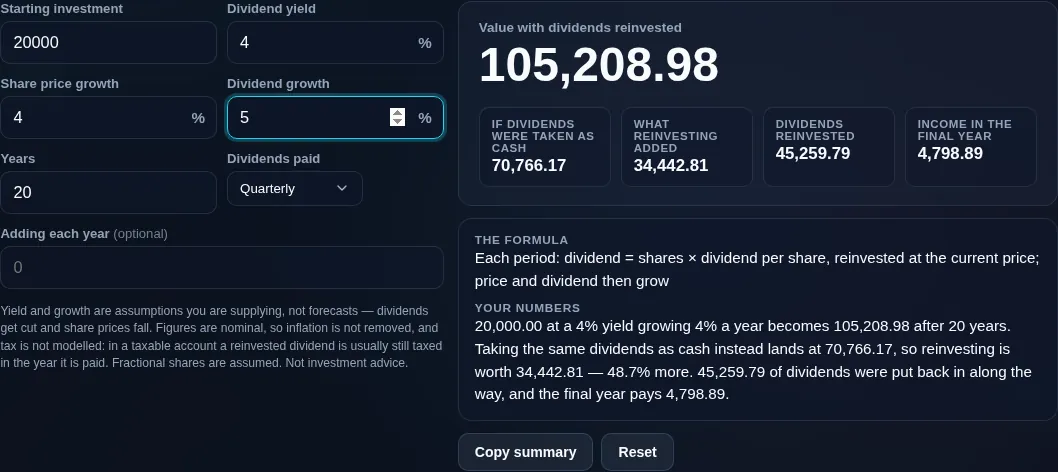
DRIP calculator projecting a reinvested holding, with the dividends reinvested shown separately from the growth of the shares themselves
Final value + reinvested dividends + mechanics
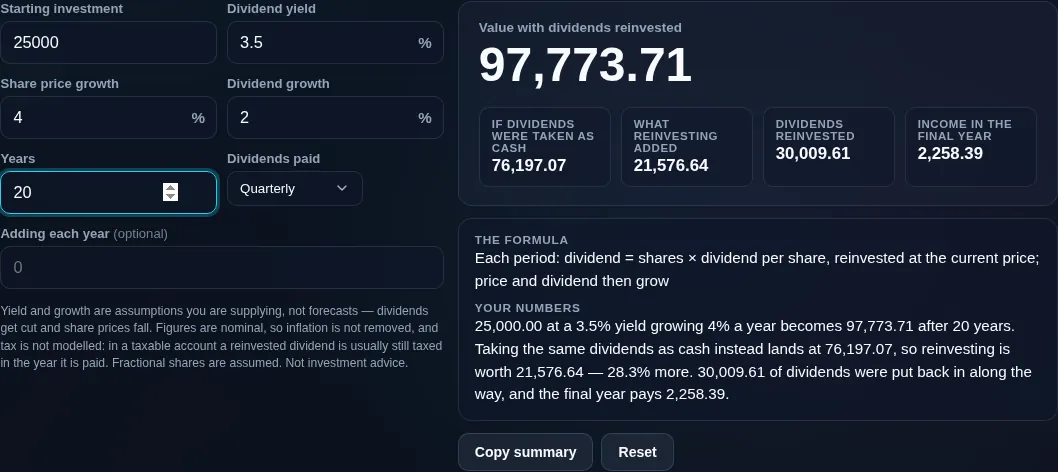
DRIP calculator comparing reinvesting dividends against banking them as cash on the same price and dividend path, so the gap is the decision and nothing else
DRIP vs cash-dividends comparison
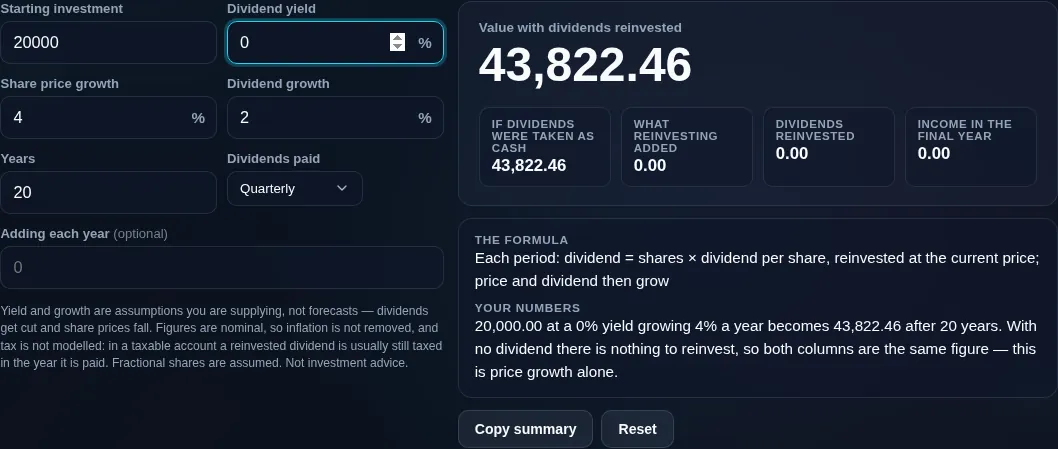
DRIP calculator on a zero-yield holding, where reinvesting and taking cash give the same result and the tool says so instead of printing a meaningless edge
A zero-yield holding, where reinvesting and taking cash land on the same number
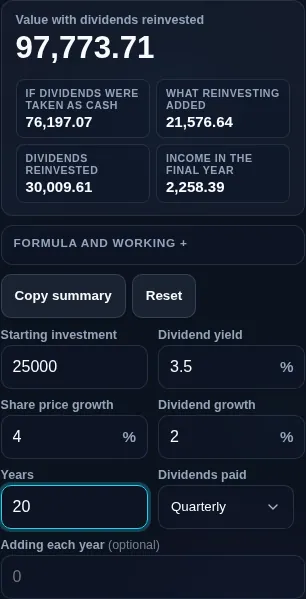
DRIP calculator running in a phone browser with the assumption fields stacked
Mobile browser

When a DRIP calculator helps

The honest framing matters. The yield and growth rates you enter are assumptions, not guarantees — dividends can be cut and share prices fall, so the projection is one possible path, and this is not investment advice. The figures are nominal (inflation isn't removed), and — a point many DRIP tools skip — reinvested dividends are usually still taxable in a regular taxable account, even though you never received the cash; only tax-sheltered accounts avoid this. The model also assumes a constant yield and growth and fractional shares, which real investments and plans don't always match.

Used with those caveats in mind, it's a great way to see why long-term dividend investors care so much about reinvestment. For a plain lump-sum projection without dividends, see the Compound Interest Calculator; for regular investing towards a target, the Savings Goal Calculator. Everything runs privately in your browser — nothing uploaded.

  • Dividend investing. See the long-run value of reinvesting versus taking income.
  • The snowball. Watch share count and dividends compound over decades.
  • Dividend growth. Model companies that raise their dividend each year.
  • Yield on cost. Understand how reinvestment lifts income relative to your original cost.
  • Planning income. Decide when to switch from reinvesting to taking cash.

Realistic example. $10,000 invested at a 4% yield with 5% annual price growth for 25 years, reinvesting quarterly: the reinvested dividends buy a growing pile of extra shares, so the final value can be substantially higher than price growth alone would give — and far more than if you'd spent the dividends as cash. The comparison view shows the gap.

Advanced tip. Reinvesting matters most over long horizons and with dividend-*growth* stocks, where a rising payout on a rising share count compounds twice over.

Common mistake to avoid. Don't assume reinvested dividends are tax-free. In a taxable account they're generally taxed in the year paid, even though you didn't pocket the cash.

Related. For annualized return on an investment, use the ROI Calculator.

What this estimate does and doesn't include

  • Not investment advice. It's an educational projection, not a recommendation.
  • Yield and growth are assumptions. Dividends can be cut and prices fall; past performance doesn't predict the future.
  • Reinvested dividends are usually taxable. In a taxable account you typically owe tax the year they're paid, even reinvested — only sheltered accounts avoid this.
  • Figures are nominal. Inflation isn't removed, so real spending power is lower.
  • Simplified model. It assumes constant yield and growth and fractional shares; real investments vary.
  • Your data stays private. All maths runs on your device; nothing is uploaded.
Frequently Asked Questions

What is dividend reinvestment (a DRIP), and how does this work?

A dividend reinvestment plan (DRIP) uses the dividends an investment pays to buy more shares of it, instead of paying you cash. This calculator projects the result: it reinvests each dividend to grow your share count, grows the share price by your assumed rate, and shows the final value, total dividends reinvested, and how it compares to taking the dividends as cash.

---

How does reinvesting dividends compound?

Each dividend buys more shares, and those extra shares pay their own dividends next time, which buy still more shares — so both your share count and your dividend income grow on themselves. Combined with any share-price appreciation, this "snowball" can add up to far more over decades than taking the dividends as cash, which is the whole point of a DRIP.

---

Is it better to reinvest dividends or take the cash?

For long-term growth, reinvesting usually wins, because it compounds your share count and income. Taking cash makes sense when you need the income to spend, or when you'd rather deploy it elsewhere. Many investors reinvest during their accumulation years, then switch to taking dividends as cash in retirement. The comparison view shows the long-run difference so you can decide.

---

Are reinvested dividends taxed?

Usually, yes — in a regular taxable account, dividends are generally taxable in the year they're paid, even if you reinvested them and never saw the cash. This is a common surprise. Only tax-sheltered accounts (like an IRA, ISA, or their equivalents) let dividends reinvest without immediate tax. Rules vary by country, so check yours; this tool shows pre-tax figures.

---

How much can reinvested dividends grow over time?

It depends on the yield, share-price growth, dividend growth, and how long you reinvest — and small differences compound into large ones over decades. Over 20–30 years, reinvested dividends can account for a big share of total returns, often rivaling or exceeding price appreciation for high-yield holdings. Enter your assumptions to see your own figure and the gap versus taking cash.

---

What is dividend yield, and what's a realistic assumption?

Dividend yield is the annual dividend as a percentage of the share price — a $2 dividend on a $50 share is a 4% yield. Realistic yields vary a lot: broad market indexes often yield a couple of percent, while some sectors yield more (sometimes because the price has fallen, a warning sign). Use a figure that fits your actual holdings, and remember a very high yield can signal risk.

---

What is "yield on cost"?

Yield on cost is the current annual dividend divided by what you originally paid, rather than the current price. Because reinvestment and dividend growth raise your income while your original cost stays fixed, yield on cost climbs over time — so a stock bought years ago at a 3% yield might now pay 8% or more on that original cost. It shows the long-run payoff of holding and reinvesting.

---

What if the company cuts or raises its dividend?

Both change the outcome a lot. A dividend cut reduces the income available to reinvest (and often signals trouble), slowing or reversing the snowball. A dividend increase does the opposite — the tool's dividend-growth option models companies that raise their payout each year, which compounds especially well. Neither is guaranteed, so treat your yield and growth inputs as assumptions, not promises.

---

Does the result account for inflation and taxes?

No, by default. The figures are nominal, so they don't subtract inflation, and they're pre-tax, so they don't deduct any tax on dividends (which, in a taxable account, usually applies even to reinvested dividends). Your real, after-tax outcome will be lower. For a real-terms view, use a lower (inflation-adjusted) growth assumption, and check your local dividend tax rules.

---

Do I need whole shares to reinvest?

This calculator assumes fractional shares, so every dividend is fully reinvested. Many real DRIPs also allow fractional shares, but some brokers or plans only buy whole shares and hold the leftover cash until it's enough for another share. That makes real reinvestment slightly less smooth than the model, though the long-run difference is usually small.

---

Is the projection guaranteed, and is this financial advice?

No to both. The result depends on assumptions — yield, price growth, and dividend growth — that won't play out exactly, and dividend investing carries real risk, including dividend cuts and price falls. This tool is educational, to illustrate the power of reinvestment. It isn't investment advice; for guidance suited to your situation, consult a qualified professional.

---

Is my data uploaded, and does it work offline?

No upload, and yes it works offline. All the projection maths runs in your browser, so the figures you enter are never sent to a server, there's no account, and no tracking. Once the page has loaded it keeps working with no connection — a private way to model dividend reinvestment without handing your numbers to a service.

Still have questions?

If you can't find the answer you're looking for, feel free to contact our support team.

Contact Us