Discount Calculator

Calculate the sale price and how much you save from a discount, plus reverse 'percent off'.

100% Browser-Based Local Processing
What are you working out?
%
%
%

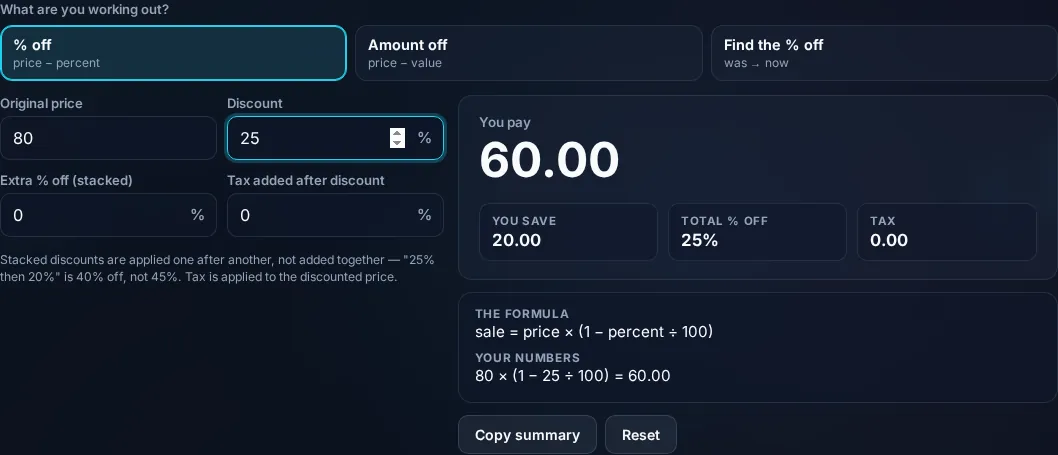
Stacked discounts are applied one after another, not added together — "25% then 20%" is 40% off, not 45%. Tax is applied to the discounted price.

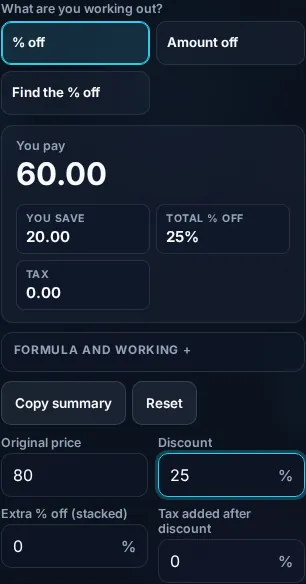
You pay

60.00

You save 20.00
Total % off 25%
Tax 0.00
Formula and working

The formula

sale = price × (1 − percent ÷ 100)

Your numbers

80 × (1 − 25 ÷ 100) = 60.00

Privacy Focused

🔒 Local Processing. Your numbers never leave your device.

Instant Results

🌐 Fully Client-Side. Runs instantly in your browser.

No Signup

⚡ No accounts. No API keys. Just open and use.

Browser Based

🚀 No installs, no sign-ups, no server round-trip.

What is a Discount Calculator?

A Discount Calculator finds the sale price and how much you save when an item is discounted. Enter the original price and the percent off, and it shows the final price and the amount saved — sale price = original × (1 − discount% ÷ 100). It can also work backwards to find the percentage off from an original and sale price, all in your browser.

Spotting whether a '30% off' deal is as good as it sounds — and what you'll actually pay — is quick math you shouldn't have to do in the aisle. A discount calculator gives the sale price and your savings instantly.

This one also works in reverse (find the % off from two prices), handles stacked discounts correctly, and shows the formula. It runs entirely in your browser.
How to calculate a discount

Step 1: Enter the original price and the discount (a percentage or an amount off)

Enter the original price and the discount (a percentage or an amount off).

Step 2: Read the sale price and how much you save

Read the sale price and how much you save.

Step 3: Use reverse mode to find the percentage off from an original and a sale price

Use reverse mode to find the percentage off from an original and a sale price.

Discount Calculator in action

Discount Calculator showing the sale price and savings in the browser.
Sale price + saved
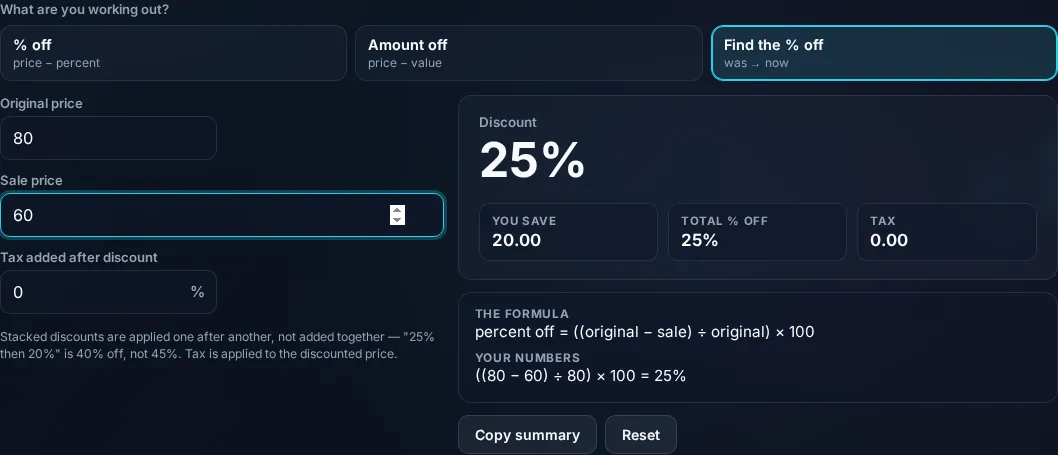
Reverse discount finding the percentage off from two prices.
Reverse / stacked
Calculating a discount on a phone, no app installed.
Mobile (stacked)

Sale price, savings, and the stacked-discount trap

A percentage discount gives a sale price of original × (1 − discount ÷ 100): 30% off $50 is 50 × 0.70 = $35, a saving of $15. An amount-off discount simply subtracts. The reverse calculation finds the discount from two prices: percent off = (1 − sale ÷ original) × 100. One genuinely useful thing the calculator gets right is stacked discounts: an 'extra 20% off an already 30%-off price' is not 50% off — the discounts multiply, not add. The price is original × 0.70 × 0.80 = original × 0.56, i.e. 44% off, not 50%. Confusing this is how '70% off!' signs feel bigger than they are. The tool can also apply sales tax after the discount, which is the usual order, so you see the true checkout price. Everything is simple arithmetic shown step by step so you can trust and reuse it, and it all runs locally in your browser. For general percentages see the Percentage Calculator; for tax specifically, the Sales Tax Calculator.

Frequently Asked Questions

How do I calculate a discount?

Multiply the original price by (1 − discount ÷ 100) to get the sale price, and subtract that from the original for the savings. 30% off $50 is 50 × 0.70 = $35, saving $15. Enter the price and the percent off and the calculator shows both, with the formula.

How do I find the sale price after a percent off?

Sale price = original × (1 − percent ÷ 100). So 25% off $80 is 80 × 0.75 = $60. The calculator computes this instantly and also shows the amount saved ($20 here), so you know exactly what you'll pay and how much you're saving.

How do I find what percentage off something is?

Use the reverse calculation: percent off = (1 − sale price ÷ original price) × 100. If something dropped from $80 to $60, that's (1 − 60 ÷ 80) × 100 = 25% off. Switch the calculator to reverse mode, enter both prices, and it gives the discount percentage.

How do stacked discounts work?

They multiply, not add. An extra 20% off an already 30%-off price is original × 0.70 × 0.80 = 0.56 of the original — that's 44% off in total, not 50%. The calculator handles stacked percentages correctly so you see the real combined discount, which is always less than simply adding the percentages.

Is tax applied before or after the discount?

Usually after: the discount is taken off the price first, then sales tax is added to the discounted amount. The calculator can apply tax after the discount so you get the true checkout total. Order matters because applying tax first would give a slightly different figure.

Can it work with an amount off instead of a percentage?

Yes. If the deal is a fixed amount off (e.g. $15 off) rather than a percentage, enter that amount and the calculator subtracts it from the original price to give the sale price, and can express it as an equivalent percentage if you want to compare deals.

Is it free, and do I need to sign up?

Yes, it's completely free with no account, no trial, and no limit on how many times you use it. It runs entirely in your browser, so there's no sign-in wall — just open the page and calculate.

Is my data private?

Yes. Everything is calculated in your browser — the numbers you enter are never sent to a server, and nothing is stored once you close the tab. That keeps any personal figures (salary, loan, health) on your own device.

Does it work on mobile?

Yes. It runs in your phone's browser with nothing to install, so you can calculate on Android or iOS. The layout adapts to small screens, so entering numbers and reading the result is easy on the go.

Does it work offline?

Once the page has loaded, the calculation runs entirely on your device, so it keeps working without a connection. You only need to be online to open the page the first time — which is also why nothing you enter is uploaded.

Can I copy or share the result?

Yes. You can copy the result to your clipboard with one click, and many results can be shared. Because everything is calculated locally, copying is instant with no upload step.

How accurate is it, and is this professional advice?

The math is accurate for the inputs you give, and the formula is shown so you can verify it. But results are estimates for general use, not professional advice — finance calculators use simplified assumptions and ignore fees and rate changes, and health calculators are general estimates, not medical advice. For important decisions, consult a qualified professional.

Still have questions?

If you can't find the answer you're looking for, feel free to contact our support team.

Contact Us