Time Converter

Convert time durations — seconds, minutes, hours, days, weeks, months, years.

100% Browser-Based Local Processing

How this conversion works

The relation

Worked example

    4

    Common time conversions

    HoursMinutes

    Privacy Focused

    🔒 Local Processing. The values you enter never leave your device.

    Instant Results

    🌐 Fully Client-Side. Runs instantly in your browser.

    No Signup

    ⚡ No accounts. No API keys. Just open and use.

    Browser Based

    🚀 No installs, no sign-ups, no conversion limits.

    What is a Time Converter?

    > Time Converter turns a duration between units — milliseconds, seconds, minutes, hours, days, weeks, months, and years. Enter a value, pick your units, and read the result with the exact factor shown (1 day = 86,400 seconds; 1 hour = 3600 seconds). Months and years use a stated average. It works offline. ---

    ### H2: Convert time durations — seconds, minutes, hours, days, and more

    This converter turns a length of time from one unit into another: how many seconds are in a day, how many hours in a week, how many minutes in a year. It covers the eight units people use most — millisecond, second, minute, hour, day, week, month, and year — with a swap button and an all-units table that shows every unit at once. Every result comes with the exact factor it used, so you can verify it.

    For the shorter units, the conversions are exact and fixed: a minute is 60 seconds, an hour is 3600 seconds, a day is 86,400 seconds, and a week is 604,800 seconds. These never change, so the tool converts them precisely.

    Months and years are the honest exception. A month isn't a fixed length — it's 28 to 31 days — and a year is 365 or 366 days depending on leap years. So for those two units the tool uses a clearly stated average: a year of 365 days and a month of about 30.44 days (365 ÷ 12). That's ideal for "roughly how long" questions, but it isn't a calendar calculation. If you need the exact number of days between two real dates, use the Date Difference Calculator.

    One more clarification: this is a duration converter, not a clock or time-zone tool. If you're trying to find out what time it is in another city, or convert a meeting time across zones, use the Time Zone Converter instead. Everything here runs on your own device using fixed factors, so there's nothing to upload and no connection needed once the page has loaded.
    ---

    How to use the Time Converter

    Step 1: Enter your value. Type the duration you want to convert into the input box

    Decimals are fine.

    Step 2: Pick the "from" unit. Choose the unit your number is currently in — for example, hours (h)

    Pick the "from" unit. Choose the unit your number is currently in — for example, hours (h).

    Step 3: Pick the "to" unit. Choose the unit you want the answer in — for example, seconds (s)

    The result updates instantly.

    Step 4: Read the result and the factor. The converted value appears with the exact relationship used (for example, 1 h = 3600 s), so you can verify it

    Read the result and the factor. The converted value appears with the exact relationship used (for example, 1 h = 3600 s), so you can verify it.

    Step 5: Copy, swap, or expand. Use Copy to grab the number, the swap button to reverse the direction, or open the all-units table to see your value in every unit at once

    Adjust the decimal places for more precision.

    Time Converter in action

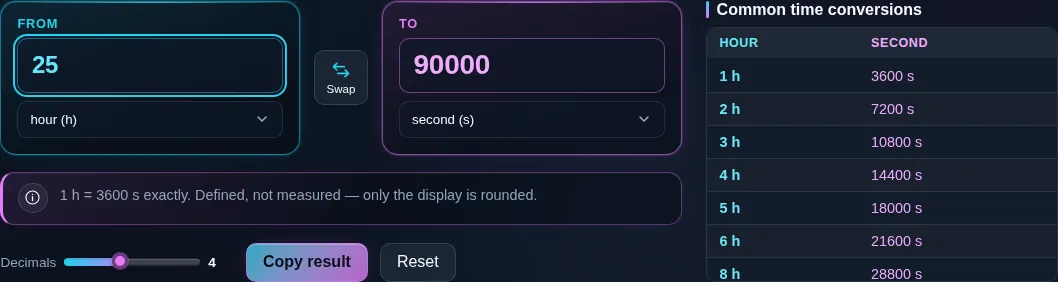
    Time converter turning 25 hours into 90000 seconds, with the note underneath reading that one hour is exactly 3600 seconds.
    Converting, with the exact factor underneath
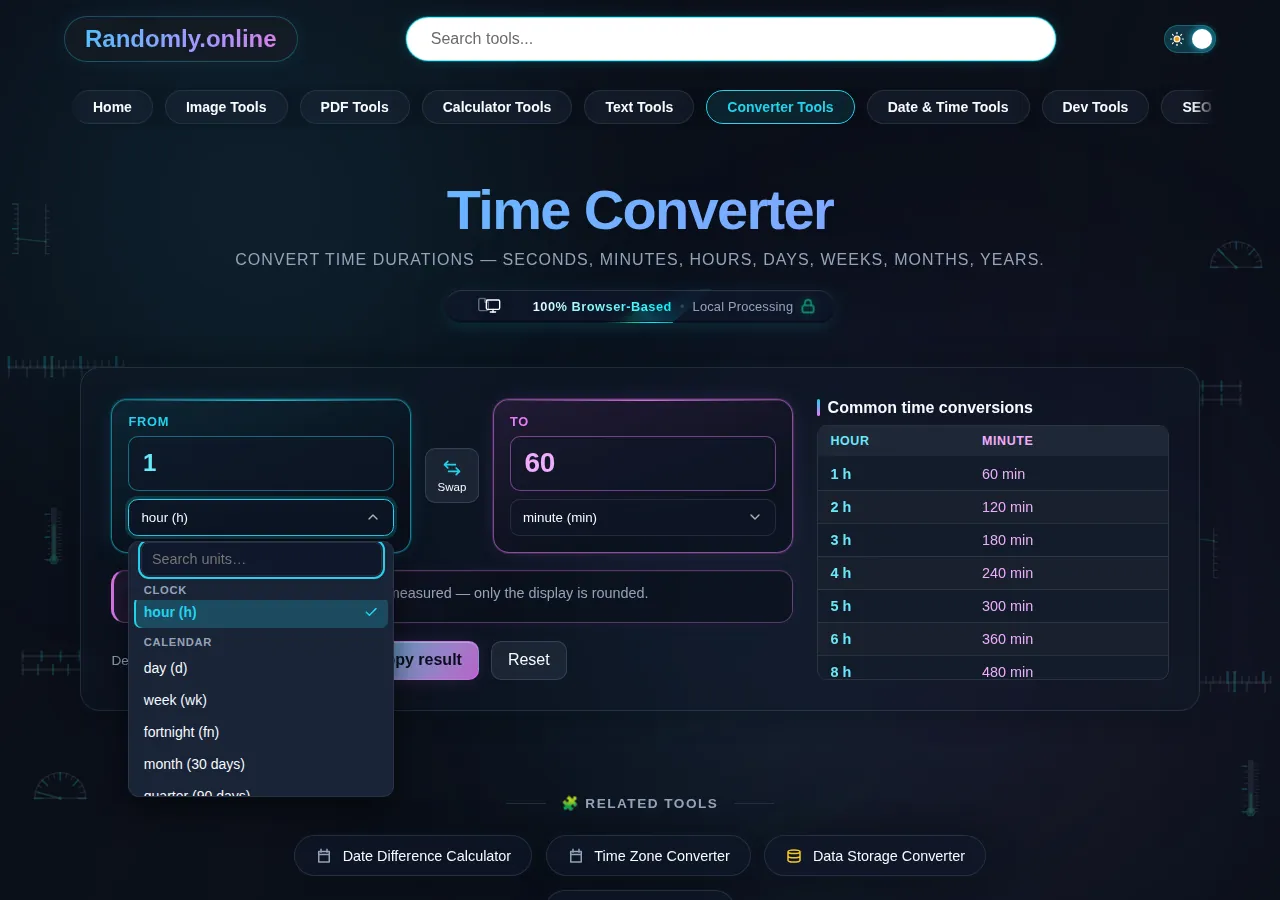
    The time converter unit list open at its calendar group, where the entries name a month as 30 days and a year as 365 days rather than leaving the length unsaid.
    The unit list, with the calendar units named by their length
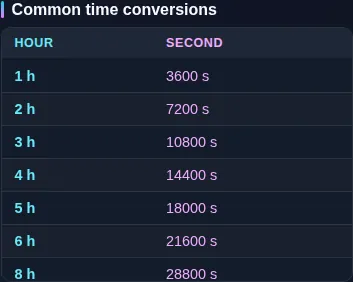
    The hours to seconds reference table listing common values side by side beneath the converter.
    The reference table for the pair on screen
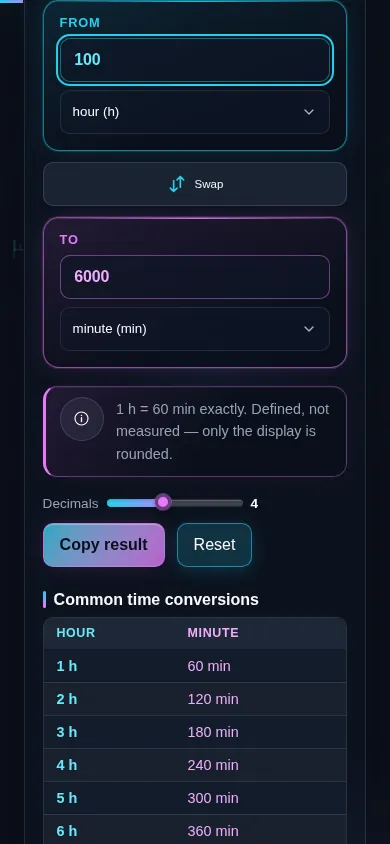
    The time converter on a phone screen, the two panes stacked with the swap control between them.
    The same tool on a phone

    Frequently Asked Questions

    How many seconds are in a day?

    Exactly 86,400 seconds. A day is 24 hours, each hour is 60 minutes, and each minute is 60 seconds: 24 × 60 × 60 = 86,400. So half a day is 43,200 seconds. This is an exact, fixed conversion — unlike months and years, which vary — and the tool shows the factor with every result.

    ---

    How many seconds are in an hour?

    Exactly 3600 seconds. An hour is 60 minutes, and each minute is 60 seconds, so 60 × 60 = 3600. That's why timers and code often count in multiples of 3600 for hours. Two hours is 7200 seconds, and a quarter-hour is 900. Enter any value and the tool converts hours to seconds, or any other unit, with the factor shown.

    ---

    How many minutes are in a day?

    Exactly 1440 minutes. A day is 24 hours, and each hour is 60 minutes: 24 × 60 = 1440. So half a day is 720 minutes, and a week is 10,080 minutes (1440 × 7). These are exact, fixed relationships. The all-units table on the tool shows a day in seconds, minutes, hours, and weeks together.

    ---

    How many hours are in a week?

    Exactly 168 hours. A week is 7 days, and each day is 24 hours: 7 × 24 = 168. So a fortnight (two weeks) is 336 hours. This is handy for scheduling and time-budgeting — 168 hours is the total time everyone has in a week. The tool converts weeks to hours, days, minutes, or seconds instantly.

    ---

    How many seconds are in a year?

    About 31,536,000 seconds for a common 365-day year (365 × 86,400). A leap year of 366 days has 31,622,400 seconds. Because year length varies, this tool uses a stated average — a 365-day year by default — so treat the figure as a close approximation. For precise spans between real dates, use a date calculator instead.

    ---

    How many weeks are in a year?

    About 52.14 weeks. A 365-day year divided by 7 days gives 52.14, which is why a year is "52 weeks and a day" (or two days in a leap year). So it's not a whole number of weeks. The tool uses a 365-day average for the year; the exact figure depends on the specific year and whether it's a leap year.

    ---

    How does the tool handle months and years, since they vary?

    It uses a clearly stated average. A month isn't a fixed length (28–31 days) and a year is 365 or 366 days, so the tool assumes a 365-day year and a month of about 30.44 days (365 ÷ 12). That's ideal for rough "how long" conversions, but it isn't a calendar calculation. For the exact number of days between two real dates, use the Date Difference Calculator.

    ---

    Is this a time-zone converter or a clock?

    No — this is a duration converter. It answers "how long is X in another unit", like seconds to hours. It does not tell you what time it is somewhere, or convert a clock time between cities. For that, use the Time Zone Converter, and for the gap between two dates, the Date Difference Calculator.

    ---

    How do I convert seconds into minutes, hours, and seconds (HH:MM:SS)?

    Divide by the largest unit and keep the remainder. For 3725 seconds: 3725 ÷ 3600 = 1 hour, remainder 125 seconds; 125 ÷ 60 = 2 minutes, remainder 5 seconds — so 01:02:05. The converter gives you each unit's value, and the all-units table shows the total in hours, minutes, and seconds at once so you can read off the breakdown.

    ---

    Is this converter exact, or does it round the answer?

    For seconds, minutes, hours, days, and weeks the math is exact (1 day = 86,400 s, 1 week = 604,800 s). Only the *displayed* value is rounded for readability. Months and years are the exception: they use a stated average because their real length varies. The factor shown with each result tells you exactly what was used.

    ---

    What's the formula to convert time units?

    Convert everything through seconds. Multiply your value by its factor to seconds (minute → ×60, hour → ×3600, day → ×86,400, week → ×604,800), then divide by the target unit's factor. For hours to days it's value × 3600 ÷ 86,400, which simplifies to value ÷ 24. Months and years use averaged factors. The tool applies this for any pair.

    ---

    Does the tool work offline, and does it upload my data?

    It works fully offline once the page has loaded, and it never uploads anything. All conversions are pure arithmetic using fixed factors, so the calculation happens on your own device — no server, no account, no tracking. That makes it dependable with no signal, and private by design, since there's nothing to send anywhere.

    Still have questions?

    If you can't find the answer you're looking for, feel free to contact our support team.

    Contact Us