Pressure Converter

Convert pressure — psi, bar, kPa, atm, mmHg, millibar.

100% Browser-Based Local Processing

How this conversion works

The relation

Worked example

    4

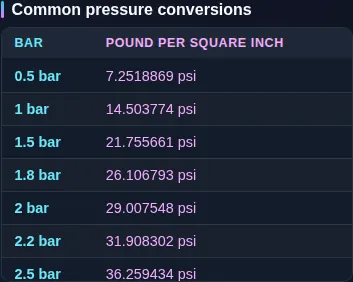
    Common pressure conversions

    Barpsi

    Privacy Focused

    🔒 Local Processing. The values you enter never leave your device.

    Instant Results

    🌐 Fully Client-Side. Runs instantly in your browser.

    No Signup

    ⚡ No accounts. No API keys. Just open and use.

    Browser Based

    🚀 No installs, no sign-ups, no conversion limits.

    What is a Pressure Converter?

    > Pressure Converter turns any pressure between pascals, kilopascals, bar, psi, atmospheres, mmHg, and millibars. Enter a value, pick your units, and read the result with the exact factor shown (1 bar = 100,000 Pa = 14.5038 psi; 1 atm = 101,325 Pa). Note: tyre and most gauge readings sit above atmospheric. Works offline. ---

    ### H2: Convert pressure — tyre, weather, and scientific units

    Pressure is measured in a surprising range of units depending on the field. Tyres use psi, bar, or kPa; weather forecasts use hectopascals (hPa) or millibars (mbar); blood pressure and vacuums use mmHg; and science uses the pascal (Pa) and the atmosphere (atm). This converter covers all seven, so a tyre spec in bar becomes psi, or a barometric reading in hPa becomes mmHg, in one step. Every result shows the exact factor it used, with a swap button and an all-units table.

    The fixed relationships behind it: one bar is exactly 100,000 pascals, one standard atmosphere is 101,325 Pa, one psi is about 6894.76 Pa, and one millimetre of mercury (mmHg, also called a torr) is about 133.322 Pa. In everyday terms, one bar is about 14.50 psi, and one atmosphere is about 14.70 psi or 760 mmHg or 1013.25 mbar.

    There's one important thing this tool is honest about: gauge versus absolute pressure. Most everyday readings — tyre pressure, turbo boost, many industrial gauges — are gauge pressure, meaning they're measured *above* the surrounding air. Absolute pressure includes the roughly 14.7 psi (101.325 kPa) that the atmosphere already presses with. So a "32 psi" tyre is 32 psi *gauge*, which is about 46.7 psi *absolute*. This converter changes the *units* of a value; it doesn't add or remove the atmosphere for you — so keep track of whether your number is gauge or absolute.

    A couple of quick equivalences worth knowing: mmHg and torr are used interchangeably (they're equal for all practical purposes), and hPa and millibar are exactly the same unit (1 hPa = 1 mbar), which is why weather maps mix the two. Everything here runs on your own device, offline, with nothing uploaded.

    ---

    How to use the Pressure Converter

    Step 1: Enter your value. Type the pressure you want to convert into the input box

    Decimals are fine.

    Step 2: Pick the "from" unit. Choose the unit your number is currently in — for example, bar

    Pick the "from" unit. Choose the unit your number is currently in — for example, bar.

    Step 3: Pick the "to" unit. Choose the unit you want the answer in — for example, psi

    The result updates instantly.

    Step 4: Read the result and the factor. The converted value appears with the exact relationship used (for example, 1 bar = 14.5038 psi), so you can verify it

    Read the result and the factor. The converted value appears with the exact relationship used (for example, 1 bar = 14.5038 psi), so you can verify it.

    Step 5: Copy, swap, or expand. Use Copy to grab the number, the swap button to reverse the direction, or open the all-units table to see your value in every unit at once

    Adjust the decimal places for more precision.

    Pressure Converter in action

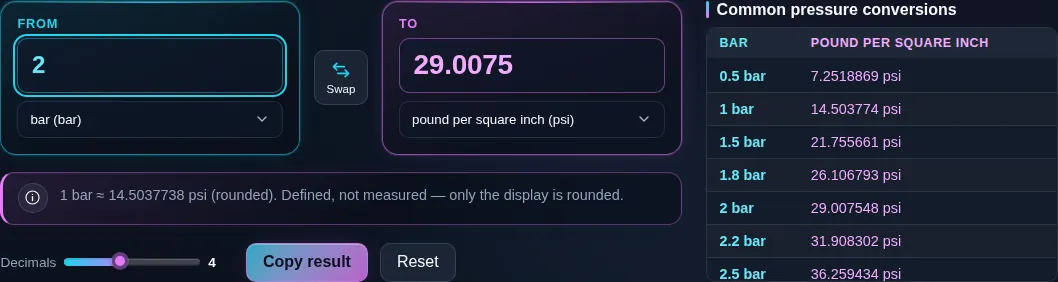
    Pressure converter turning 2 bar into 29.0075 psi, with the note underneath reading that one bar is about 14.5037738 psi.
    Converting bar to psi, with the exact factor underneath
    The pressure converter unit list open at the boundary between its metric group and its atmospheric group, with standard atmosphere, millimetre of mercury and torr among the units below the heading.
    The unit list, grouped and searchable
    The bar to psi reference table listing tyre pressures from 0.5 bar to 8 bar beside their psi readings.
    The reference table for the pair on screen
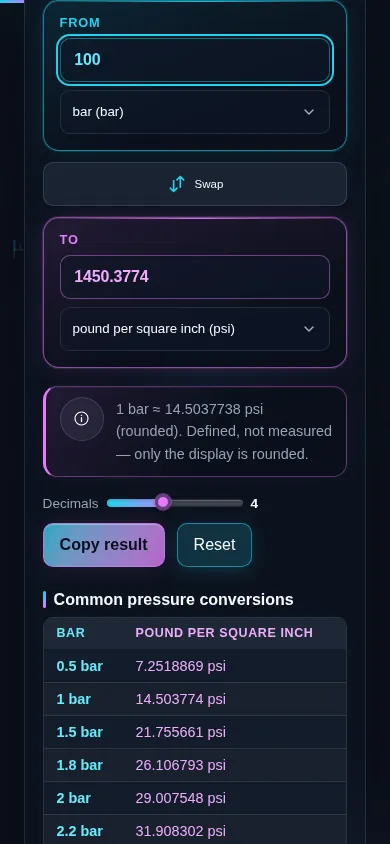
    The pressure converter on a phone screen, the two panes stacked with the swap control between them.
    The same tool on a phone

    Frequently Asked Questions

    How many psi are in a bar?

    One bar is 14.5038 psi. This comes from the exact definitions: 1 bar is 100,000 pascals, and 1 psi is 6894.76 pascals, so 100,000 ÷ 6894.76 = 14.5038. For quick estimates, "1 bar ≈ 14.5 psi" is close enough. So a 2-bar tyre is about 29 psi. The tool shows this exact factor with every result.

    ---

    How do I convert psi to bar and back?

    To go from psi to bar, divide by 14.5038 (or multiply by 0.0689476). To go from bar to psi, multiply by 14.5038. For example, 35 psi ÷ 14.5038 = 2.41 bar, and 2.5 bar × 14.5038 = 36.3 psi. The tool applies the exact factor automatically and displays it, so you don't have to remember which way it goes.

    ---

    What is 32 psi in bar and kPa?

    32 psi is about 2.21 bar, or 220.6 kPa. Divide psi by 14.5038 for bar (32 ÷ 14.5038 = 2.206), and multiply psi by 6.895 for kPa (32 × 6.895 = 220.6). This is a common tyre pressure, and all three are gauge readings, so no atmosphere adjustment is needed. The tool converts any tyre spec across psi, bar, and kPa instantly.

    ---

    What's the difference between gauge and absolute pressure?

    Gauge pressure is measured relative to the surrounding air — it reads zero when open to the atmosphere. Absolute pressure is measured relative to a perfect vacuum, so it includes the roughly 14.7 psi (101.325 kPa) the atmosphere already exerts. Absolute = gauge + atmospheric. A "0 psi" gauge is actually about 14.7 psi absolute. This tool converts units; it doesn't switch between gauge and absolute.

    ---

    Is tyre pressure gauge or absolute?

    Gauge. The pressure on a tyre placard and on a tyre gauge is gauge pressure — the amount above the surrounding air. So a "32 psi" tyre holds about 32 psi more than the atmosphere, which is roughly 46.7 psi in absolute terms. Everyday tyre and boost figures are always gauge, which is why the converter treats them as plain magnitudes and leaves the gauge/absolute reference to you.

    ---

    How many mmHg are in one atmosphere?

    Exactly 760 mmHg (by the historical definition of the standard atmosphere). One standard atmosphere is 101,325 pascals, 1013.25 millibars, or about 14.696 psi. That's why blood-pressure and barometric readings around sea level hover near 760 mmHg. The tool converts atmospheres to mmHg, and to any other pressure unit, with the factor shown.

    ---

    Are mmHg and torr the same?

    For all practical purposes, yes. One torr is defined as 1/760 of a standard atmosphere (133.322 Pa), and one millimetre of mercury is essentially the same value (133.322 Pa), so they're used interchangeably in labs, medicine, and vacuum work. Any tiny difference is far below normal measurement precision. The tool treats mmHg and torr as equal.

    ---

    Are hectopascals and millibars the same (in weather)?

    Yes, exactly. One hectopascal (hPa) equals one millibar (mbar) — both are 100 pascals. Meteorologists switched from millibars to hectopascals decades ago, but the numbers are identical, so a "1013 hPa" reading and a "1013 mbar" reading are the same pressure. That's why weather maps and apps use the two terms interchangeably.

    ---

    What is standard atmospheric pressure?

    Standard atmospheric pressure is defined as 101,325 pascals — equal to 1 atmosphere, 1013.25 millibars (or hPa), 760 mmHg, or about 14.696 psi. It's the average air pressure at sea level and the reference point for the "atmosphere" unit. Actual local pressure varies with weather and altitude, but this fixed value is what conversions to and from "atm" are based on.

    ---

    Is this converter exact, or does it round the answer?

    The math is exact — it uses defined factors (1 bar = 100,000 Pa, 1 atm = 101,325 Pa, 1 psi = 6894.757 Pa, 1 mmHg = 133.322 Pa). Only the *displayed* value is rounded for readability, and you can add decimal places for more precision. The factor shown with each result lets you verify the figure yourself.

    ---

    What's the formula to convert pressure units?

    Convert everything through pascals. Multiply your value by its factor to pascals (bar → ×100,000, psi → ×6894.76, atm → ×101,325, mmHg → ×133.322, mbar → ×100), then divide by the target unit's factor. For bar to psi it's value × 100,000 ÷ 6894.76, which simplifies to value × 14.5038. The tool applies this two-step method for any pair.

    ---

    Does the tool work offline, and does it upload my data?

    It works fully offline once the page has loaded, and it never uploads anything. All conversions are pure arithmetic using fixed factors, so the calculation happens on your own device — no server, no account, no tracking. That makes it dependable in a garage or workshop with no signal, and private by design, since there's nothing to send anywhere.

    Still have questions?

    If you can't find the answer you're looking for, feel free to contact our support team.

    Contact Us