Force Converter

Convert force — newtons, kilonewtons, kgf, pound-force, dyne.

100% Browser-Based Local Processing

How this conversion works

The relation

Worked example

    4

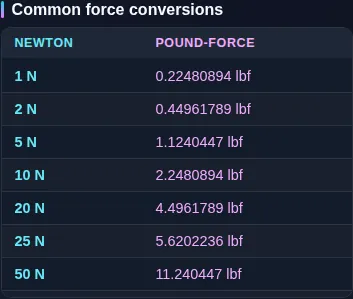
    Common force conversions

    NewtonsPound-force

    Privacy Focused

    🔒 Local Processing. The values you enter never leave your device.

    Instant Results

    🌐 Fully Client-Side. Runs instantly in your browser.

    No Signup

    ⚡ No accounts. No API keys. Just open and use.

    Browser Based

    🚀 No installs, no sign-ups, no conversion limits.

    What is a Force Converter?

    > Force Converter turns any force between newtons, kilonewtons, kilogram-force, pound-force, and dyne. Enter a value, pick your units, and read the result with the exact factor shown (1 kgf = 9.80665 N; 1 lbf = 4.44822 N). Note: kgf and lbf are forces, not masses. It works offline. ---

    ### H2: Convert force — newtons, kilogram-force, and pound-force

    Force is measured in the newton (N) in the SI system, but engineering and everyday specs still use gravitational units: kilogram-force (kgf), pound-force (lbf), the kilonewton (kN) for larger loads, and the old CGS dyne. This converter handles all five, so a load rated in kgf becomes newtons, or a thrust in pound-force becomes kilonewtons, in one step. Every result shows the exact factor, with a swap button and an all-units table.

    The exact relationships: one kilogram-force is 9.80665 newtons, one pound-force is 4.44822 newtons, one kilonewton is 1000 newtons, and one dyne is a hundred-thousandth of a newton (0.00001 N).

    The single most important thing to understand is that kilogram-force and pound-force are units of force, not mass — even though they share names with the kilogram and pound. A kilogram-force is defined as the force gravity exerts on a one-kilogram mass at standard gravity (g₀ = 9.80665 m/s²). So "1 kgf" is the *weight* of 1 kg on Earth, which is 9.80665 N — a force. This is why the numbers line up on Earth's surface and people treat kg and kgf as the same, but they're different quantities: kilograms measure mass, kilograms-force measure force.

    Because kgf and lbf are pinned to standard gravity, they're conventions: real gravity varies by about half a percent across the Earth, but these units always use the fixed g₀ = 9.80665 m/s². If what you actually have is a mass in kilograms or pounds (not a force), convert it with the Weight Converter instead — weight as a force in newtons belongs here.

    Everything runs on your own device using fixed factors, so there's nothing to upload and no connection needed once the page has loaded.
    ---

    How to use the Force Converter

    Step 1: Enter your value. Type the force you want to convert into the input box

    Decimals are fine.

    Step 2: Pick the "from" unit. Choose the unit your number is currently in — for example, kilogram-force (kgf)

    Pick the "from" unit. Choose the unit your number is currently in — for example, kilogram-force (kgf).

    Step 3: Pick the "to" unit. Choose the unit you want the answer in — for example, newtons (N)

    The result updates instantly.

    Step 4: Read the result and the factor. The converted value appears with the exact relationship used (for example, 1 kgf = 9.80665 N), so you can verify it

    Read the result and the factor. The converted value appears with the exact relationship used (for example, 1 kgf = 9.80665 N), so you can verify it.

    Step 5: Copy, swap, or expand. Use Copy to grab the number, the swap button to reverse the direction, or open the all-units table to see your value in every unit at once

    Adjust the decimal places for more precision.

    Force Converter in action

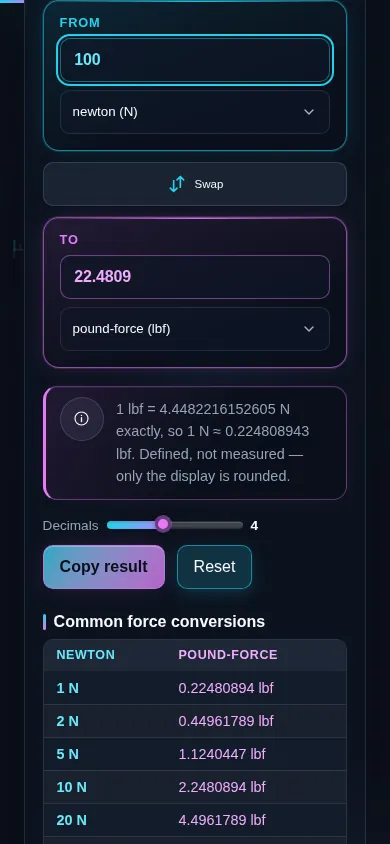
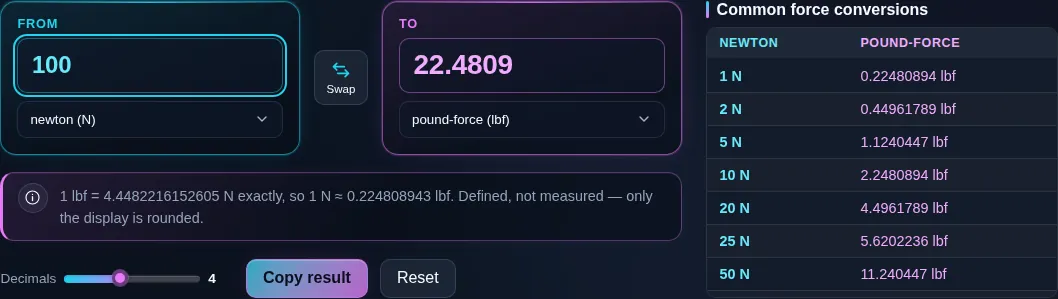
    Force converter turning 100 newtons into 22.4809 pound-force, with the note underneath reading that one pound-force is exactly 4.4482216152605 newtons.
    Converting newtons to pound-force, with the exact factor underneath
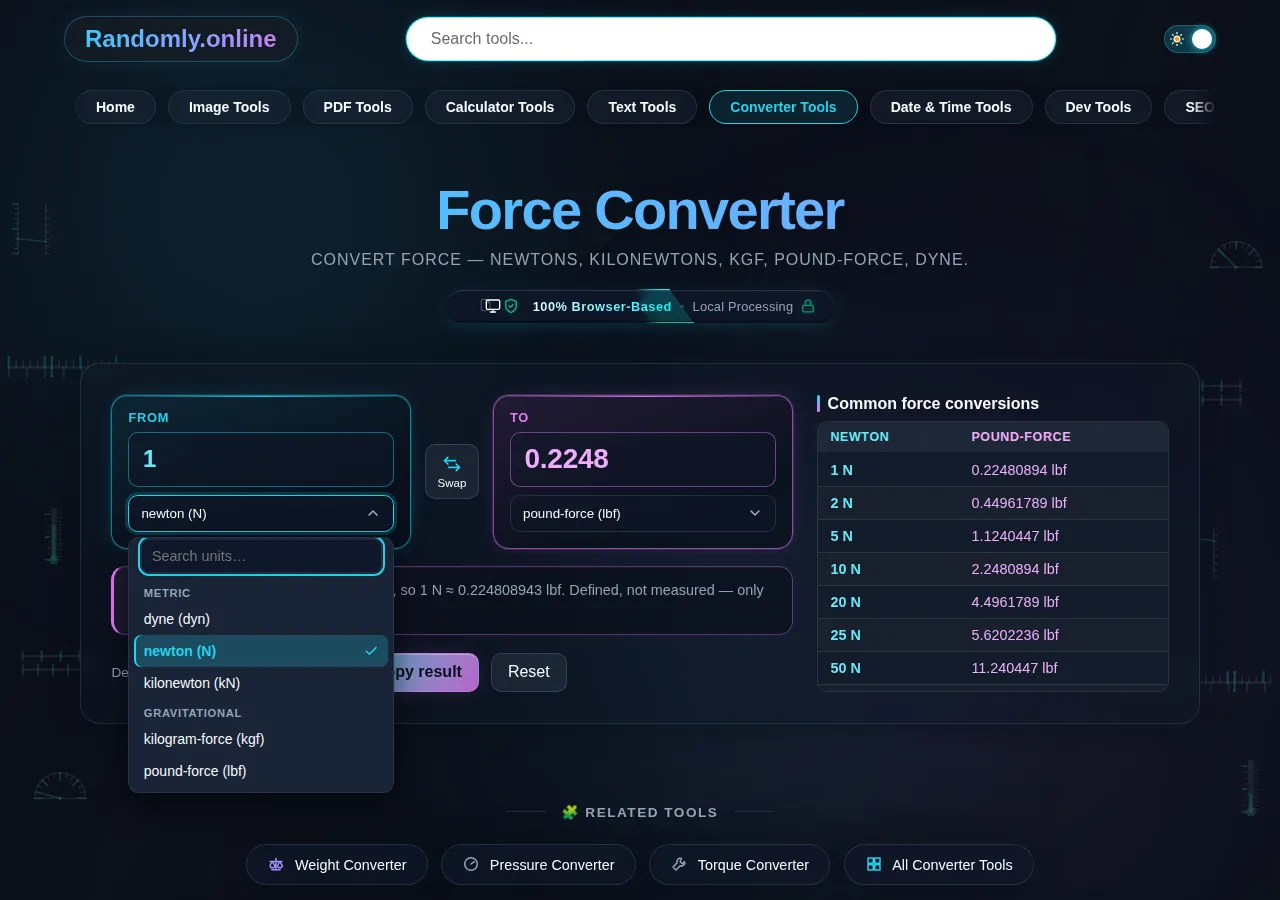
    The force converter unit list open at the boundary between its metric group of dyne, newton and kilonewton and its gravitational group of kilogram-force and pound-force.
    The unit list, grouped and searchable
    The newtons to pound-force reference table listing values from 1 N to 5000 N beside their pound-force readings.
    The reference table for the pair on screen
    The force converter on a phone screen, the two panes stacked with the swap control between them.
    The same tool on a phone

    Frequently Asked Questions

    How many newtons are in a kilogram-force?

    Exactly 9.80665 newtons. A kilogram-force (kgf) is defined as the force gravity exerts on a one-kilogram mass at standard gravity (9.80665 m/s²). So 1 kgf = 9.80665 N, and for quick work "1 kgf ≈ 9.81 N". A 10 kgf load is 98.07 N. The tool shows this exact factor with every result.

    ---

    How do I convert newtons to kgf and back?

    Divide newtons by 9.80665 to get kilogram-force, or multiply kgf by 9.80665 to get newtons. For example, 200 N ÷ 9.80665 = 20.39 kgf, and 5 kgf × 9.80665 = 49.03 N. The tool applies this exact factor automatically and displays it, so you don't have to remember which way it goes.

    ---

    How many newtons are in a pound-force?

    One pound-force is 4.44822 newtons. Like kgf, a pound-force is defined as the force of gravity on a one-pound mass at standard gravity. So 10 lbf is 44.48 N. To reverse it, divide newtons by 4.44822 to get pound-force. The tool shows the exact factor with each result.

    ---

    Is a kilogram-force the same as a kilogram?

    No — they measure different things. A kilogram (kg) is a unit of mass. A kilogram-force (kgf) is a unit of force — the weight of a 1 kg mass at standard gravity, equal to 9.80665 N. The numbers align on Earth's surface, which is why they're often confused, but mass and force are distinct quantities. This tool converts forces; for mass, use the Weight Converter.

    ---

    What's the difference between force and mass?

    Mass is the amount of matter in an object (measured in kilograms); force is a push or pull, including weight (measured in newtons). Weight is the force of gravity on a mass: force = mass × gravitational acceleration. So a 1 kg mass has a weight of about 9.81 N on Earth. Force units like kgf and lbf describe that weight, not the mass itself.

    ---

    Is weight a force?

    Yes. Weight is the force of gravity acting on an object's mass, so it's correctly measured in newtons (or in gravitational units like kgf and lbf). It equals mass times gravitational acceleration (about 9.81 m/s² on Earth). This is why a mass "weighs" less on the Moon — the mass is unchanged, but the gravitational force is weaker. This converter handles weight expressed as a force.

    ---

    What is standard gravity, and why does it matter here?

    Standard gravity (g₀) is a defined value of 9.80665 m/s² — the conventional strength of Earth's gravity used to define kilogram-force and pound-force. Real gravity varies by about half a percent depending on location and altitude, but kgf and lbf always use this fixed figure. That's what makes the conversions exact: 1 kgf is always 9.80665 N, regardless of where you actually are.

    ---

    How do I convert pound-force to newtons?

    Multiply pound-force by 4.44822 to get newtons. Because a pound-force is the weight of a one-pound mass at standard gravity, 1 lbf = 4.44822 N. So 25 lbf × 4.44822 = 111.2 N. To go the other way, divide newtons by 4.44822. The tool does this automatically and shows the factor with the result.

    ---

    What is a dyne?

    A dyne is the unit of force in the older CGS (centimetre-gram-second) system. It's very small: one dyne is 0.00001 newtons (1 × 10⁻⁵ N), the force needed to accelerate one gram at one centimetre per second squared. So one newton is 100,000 dynes. It still appears in some physics and older engineering contexts, and the tool converts it alongside the SI units.

    ---

    Is this converter exact, or does it round the answer?

    The math is exact — it uses defined factors (1 kgf = 9.80665 N, 1 lbf = 4.4482216 N, 1 dyne = 0.00001 N). Only the *displayed* value is rounded for readability, and you can add decimal places for more precision. The factor shown with each result lets you verify the figure yourself.

    ---

    What's the formula to convert force units?

    Convert everything through newtons. Multiply your value by its factor to newtons (kgf → ×9.80665, lbf → ×4.44822, kN → ×1000, dyne → ×0.00001), then divide by the target unit's factor. For kgf to pound-force it's value × 9.80665 ÷ 4.44822, which is value × 2.20462. The tool applies this two-step method for any pair of units.

    ---

    Does the tool work offline, and does it upload my data?

    It works fully offline once the page has loaded, and it never uploads anything. All conversions are pure arithmetic using fixed factors, so the calculation happens on your own device — no server, no account, no tracking. That makes it dependable with no signal, and private by design, since there's nothing to send anywhere.

    Still have questions?

    If you can't find the answer you're looking for, feel free to contact our support team.

    Contact Us