Magnetic Field Converter

Convert magnetic field units: tesla, gauss, millitesla, microtesla, milligauss.

100% Browser-Based Local Processing

How this conversion works

The relation

Worked example

    4

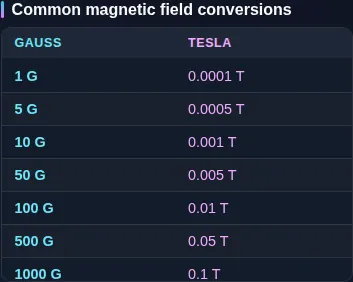
    Common magnetic field conversions

    GaussTesla

    Privacy Focused

    🔒 Local Processing. The values you enter never leave your device.

    Instant Results

    🌐 Fully Client-Side. Runs instantly in your browser.

    No Signup

    ⚡ No accounts. No API keys. Just open and use.

    Browser Based

    🚀 No installs, no sign-ups, no conversion limits.

    What is a Magnetic Field Converter?

    Magnetic Field Converter turns any magnetic flux density between tesla, gauss, and their prefixed forms. One tesla is 10,000 gauss, exactly, by definition. Enter a value, pick your units, and the result appears with that factor shown. It runs on your device and works offline.

    Two unit systems split this measurement, and almost every conversion people need is a bridge between them. The SI unit is the tesla (T), used in physics papers, MRI specifications, and safety standards. The older CGS unit is the gauss (G), still standard among magnet manufacturers, geophysicists, and anyone holding a gaussmeter. The relationship is fixed: 1 T = 10,000 G. That is a definition rather than a measurement, because the gauss was defined as one ten-thousandth of a tesla, so the number never drifts and never needs a tolerance.

    Most real fields are far smaller than a tesla, which is why the prefixed units matter more than the base ones. Earth's magnetic field runs about 25 to 65 microtesla depending on latitude, or 0.25 to 0.65 gauss. A fridge magnet is around 5 millitesla, so 50 gauss. A clinical MRI scanner runs at 1.5 or 3 tesla, which is 15,000 or 30,000 gauss. Domestic EMF meters report in milligauss, while the exposure standards they get compared against are written in microtesla — and 1 mG is 0.1 µT, so a 200 µT reference level is 2,000 mG.

    The unit list runs from femtotesla to kilogauss for a reason. Magnetoencephalography reads brain signals near 10 femtotesla, twelve orders of magnitude below an MRI bore. One converter has to span all of it.

    One thing this tool will not do: convert oersted or amperes per metre. Those measure magnetic field strength, written H, while tesla and gauss measure flux density, written B. The two are related by B = µ₀·µr·H, so the answer depends on what the field is passing through. In a vacuum one oersted corresponds to one gauss, which is exactly why the mistake is so common. Put iron in the path and the ratio changes by a factor of thousands. Everything here is local, offline, and uploaded nowhere.
    How to use the Magnetic Field Converter

    Step 1: Enter your value. Type the field strength into the input box

    Decimals are fine, and so is

    Step 2: Pick the "from" unit. Choose the unit your number is already in — gauss, for example

    Pick the "from" unit. Choose the unit your number is already in — gauss, for example.

    Step 3: Pick the "to" unit. Choose what you want back, such as tesla

    The result updates as you

    Step 4: Read the result and the factor. The converted value appears with the relationship used

    Read the result and the factor. The converted value appears with the relationship used

    Step 5: Copy, swap, or expand. Copy takes the number, the swap button reverses the

    Copy, swap, or expand. Copy takes the number, the swap button reverses the

    Magnetic Field Converter in action

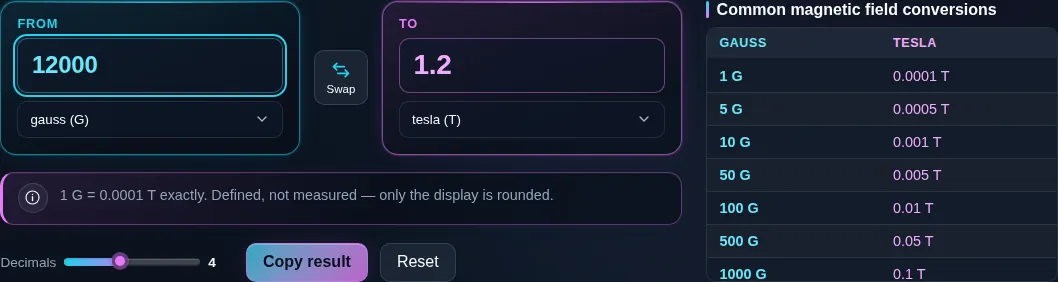
    Magnetic field converter turning 12000 gauss into 1.2 tesla, with the note underneath reading that one gauss is exactly 0.0001 tesla.
    Converting a magnet's 12,000 gauss rating into tesla, with the exact factor underneath
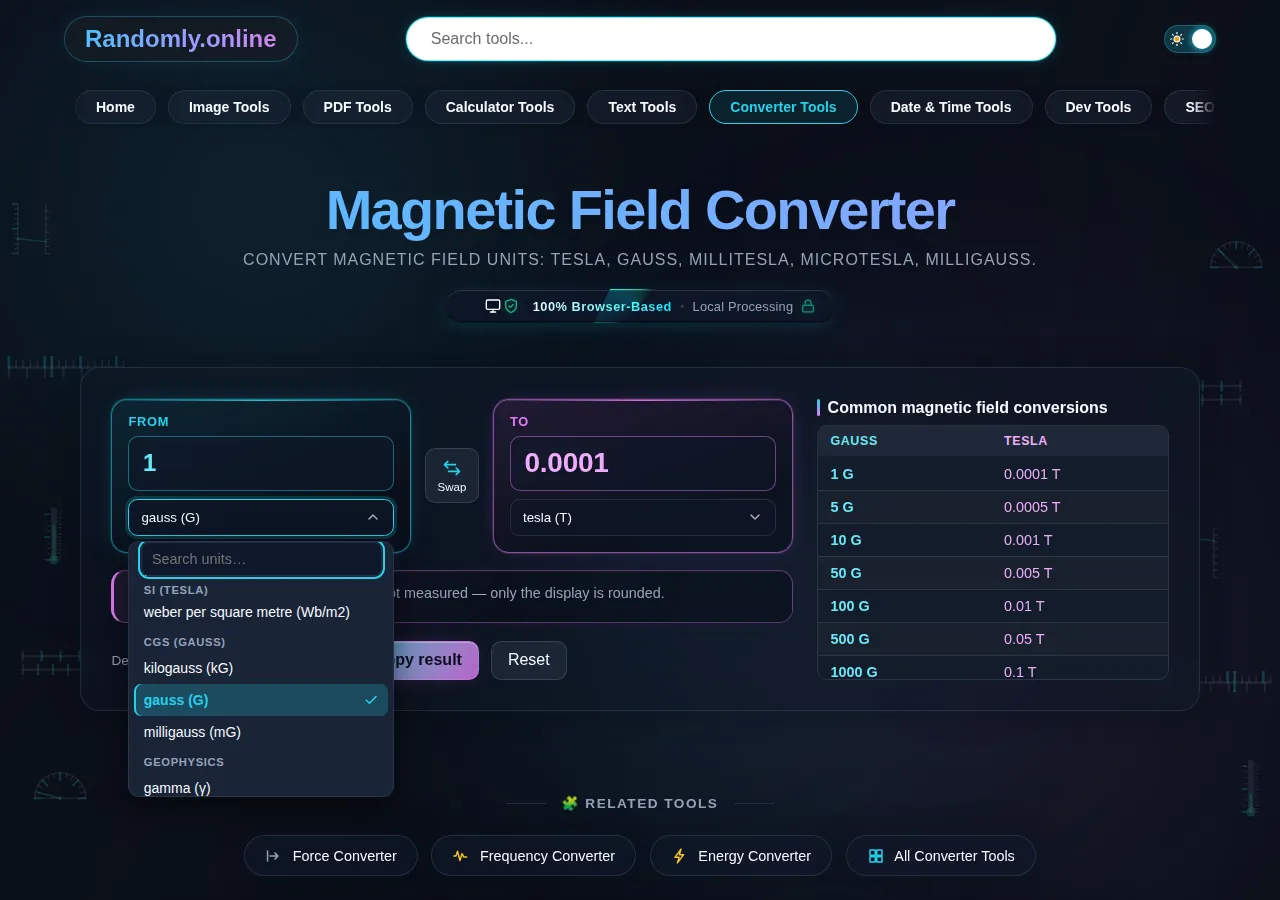
    The magnetic field converter unit list open at the boundary between its SI tesla group and its CGS gauss group, with kilogauss, gauss and milligauss below the heading.
    The unit list, grouped from tesla down to femtotesla and across to the gauss family
    The gauss to tesla reference table listing values from 1 to 30000 gauss beside their tesla readings, covering a fridge magnet at 50 gauss and an MRI scanner at 30000.
    The reference table for the pair on screen
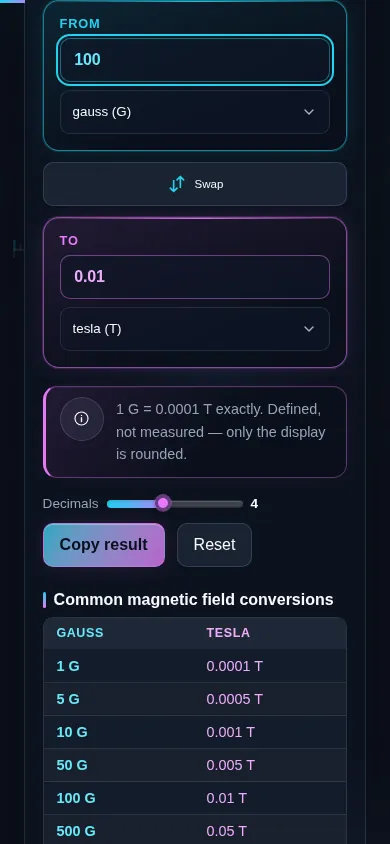
    The magnetic field converter on a phone screen, the two panes stacked with the swap control between them.
    The same tool on a phone

    Frequently Asked Questions

    How many gauss are in one tesla?

    Exactly 10,000. The gauss was defined as one ten-thousandth of a tesla, so this is a definition and not a measured quantity — it carries no uncertainty and never gets revised. Going the other way, 1 gauss is 0.0001 tesla. Every result on this page shows that factor alongside the number, so the arithmetic is visible rather than taken on trust.

    How do I convert gauss to tesla?

    Divide by 10,000. A 12,000 gauss magnet is 1.2 tesla; a 50 gauss fridge magnet is 5 millitesla. To go from tesla to gauss, multiply by 10,000 instead. Because the factor is a power of ten, the conversion is a decimal shift rather than real arithmetic, which is worth knowing when you are reading a datasheet without a tool to hand.

    Is gauss the same as oersted?

    No, and this tool deliberately refuses to convert between them. Gauss measures flux density (B). Oersted measures field strength (H). They are linked by B = µ₀·µr·H, so the answer depends on the material the field passes through. In a vacuum one oersted does correspond to one gauss, which is why the two get treated as interchangeable. Put iron in the path and that breaks badly.

    How do I convert milligauss to microtesla?

    Divide by 10. A meter reading 12 mG is 1.2 µT. This is the conversion domestic EMF readings need most, because consumer meters report in milligauss while exposure standards are written in microtesla. The ICNIRP public reference level for a 50 or 60 Hz field is 200 µT, which is 2,000 mG — a useful number to have in the same units as your meter.

    How strong is Earth's magnetic field?

    Between about 25 and 65 microtesla at the surface, which is 0.25 to 0.65 gauss. It is weakest near the equator and strongest near the poles. That range is a handy sanity check: a magnetometer reading far outside it is either picking up something local or reporting in units you have not identified yet. The field also drifts slowly year to year.

    How strong is an MRI scanner in gauss?

    A 1.5 tesla scanner is 15,000 gauss, and a 3 tesla scanner is 30,000 gauss. Research systems run to 7 T, or 70,000 gauss. The safety boundary around a scanner room is drawn at 5 gauss, which is 0.5 millitesla — that is the line beyond which pacemakers and loose ferromagnetic objects become a problem, and it is why the conversion gets used in facility planning.

    What does a neodymium magnet's gauss rating mean?

    It depends which number you were quoted. Remanence, written Br, is the material property, typically 1.2 to 1.4 tesla or 12,000 to 14,000 gauss. Surface field is what a gaussmeter actually reads against the magnet's face, and it is considerably lower because the field spreads. Suppliers quote both as "gauss". The conversion is exact either way; the interpretation is the part to check.

    What is a gamma in magnetics?

    One gamma (γ) is one nanotesla, exactly. It is a geophysics and magnetometry unit, still common in survey data, aeromagnetic maps, and older literature. Since it maps onto the nanotesla with no factor at all, data published in gamma can be read straight across. In gauss terms, one gamma is 10⁻⁵ G, which is where the units start feeling awkward and SI prefixes start earning their keep.

    Why does the unit list go down to femtotesla?

    Because real measurements go that low. Magnetoencephalography picks up brain activity at roughly 10 femtotesla, and SQUID magnetometers work in that range routinely. An MRI bore sits twelve orders of magnitude above it. A converter that stops at nanotesla cannot express biomagnetic data at all, so the list runs from fT up to kilogauss to cover the whole span in one place.

    Is a weber per square metre the same as a tesla?

    Yes, exactly — the tesla is one weber per square metre. It is the same quantity under two names, much like the joule and the newton-metre. Older engineering texts and some transformer datasheets still write Wb/m², so the unit is in the list for reading those documents. There is no factor involved and no rounding to worry about.

    Is this converter exact, or does it round the answer?

    The conversion is exact. Every factor here is fixed by definition (1 T = 10,000 G, 1 nT = 1 γ, 1 Wb/m² = 1 T), and the arithmetic runs on integers underneath, so nothing accumulates error. Only the displayed value is rounded, and the number of decimal places is adjustable. The physical reference figures on the page are typical ranges rather than exact values, and they are labelled that way.

    Does the tool work offline, and does it upload my data?

    It works fully offline once the page has loaded, and it uploads nothing. Every conversion is arithmetic on fixed factors, done on your own device — no server call, no account, no tracking. That makes it usable in a shielded room or a basement with no signal, which is where magnetic measurements often happen, and it means your readings stay yours.

    Still have questions?

    If you can't find the answer you're looking for, feel free to contact our support team.

    Contact Us