Frequency Converter

Convert frequency — Hz, kHz, MHz, GHz, rpm, rps.

100% Browser-Based Local Processing

How this conversion works

The relation

Worked example

    4

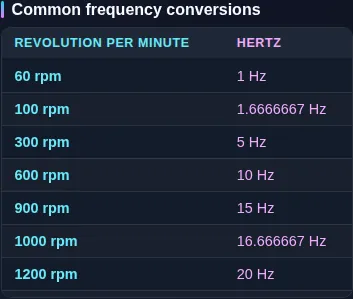
    Common frequency conversions

    rpmHz

    Privacy Focused

    🔒 Local Processing. The values you enter never leave your device.

    Instant Results

    🌐 Fully Client-Side. Runs instantly in your browser.

    No Signup

    ⚡ No accounts. No API keys. Just open and use.

    Browser Based

    🚀 No installs, no sign-ups, no conversion limits.

    What is a Frequency Converter?

    > Frequency Converter turns any frequency between hertz, kilohertz, megahertz, gigahertz, rpm, and rps. Enter a value, pick your units, and read the result with the exact factor shown (1 MHz = 1,000,000 Hz). For rotation, 1 Hz = 60 rpm, so rpm = Hz × 60. It works offline. ---

    ### H2: Convert frequency — hertz, radio bands, and rpm

    Frequency counts how often something repeats each second, measured in hertz (Hz). This converter handles the units people meet across electronics and machinery: kilohertz (kHz), megahertz (MHz), and gigahertz (GHz) for signals, radio, and processor speeds, plus revolutions per minute (rpm) and revolutions per second (rps) for motors, engines, and spinning parts. Type a value, choose *from* and *to*, and the answer appears instantly, with a swap button and an all-units table. Every result shows the exact factor.

    The radio and signal units follow the usual metric pattern: one kilohertz is 1000 Hz, one megahertz is a million Hz, and one gigahertz is a billion Hz. So a 2.4 GHz Wi-Fi signal is 2,400,000,000 Hz, and a 100 MHz FM station is 100,000,000 Hz.

    The most useful practical conversion here is rpm to Hz. A revolution per second (rps) is exactly one hertz — both count one full cycle per second. Since a minute has 60 seconds, 1 Hz equals 60 rpm, and to convert rpm to Hz you divide by 60. So a motor at 3000 rpm is spinning at 50 Hz, and a hard drive at 7200 rpm is 120 Hz. This is exact, and the tool shows the relationship so you can check it.

    Two honest notes. First, angular velocity (radians per second) is related but not the same as frequency: one full turn is 2π radians, so 1 Hz equals 2π rad/s (about 6.283 rad/s) — a different quantity, kept separate. Second, "frequency converter" can also mean a piece of *hardware* (a variable-frequency drive that changes AC mains frequency); this page is a unit converter for the numbers. Everything runs on your own device, offline, with nothing uploaded.
    ---

    How to use the Frequency Converter

    Step 1: Enter your value. Type the frequency or rotational speed you want to convert into the input box

    Decimals are fine.

    Step 2: Pick the "from" unit. Choose the unit your number is currently in — for example, rpm

    Pick the "from" unit. Choose the unit your number is currently in — for example, rpm.

    Step 3: Pick the "to" unit. Choose the unit you want the answer in — for example, hertz (Hz)

    The result updates instantly.

    Step 4: Read the result and the factor. The converted value appears with the exact relationship used (for example, 1 Hz = 60 rpm), so you can verify it

    Read the result and the factor. The converted value appears with the exact relationship used (for example, 1 Hz = 60 rpm), so you can verify it.

    Step 5: Copy, swap, or expand. Use Copy to grab the number, the swap button to reverse the direction, or open the all-units table to see your value in every unit at once

    Adjust the decimal places for more precision.

    Frequency Converter in action

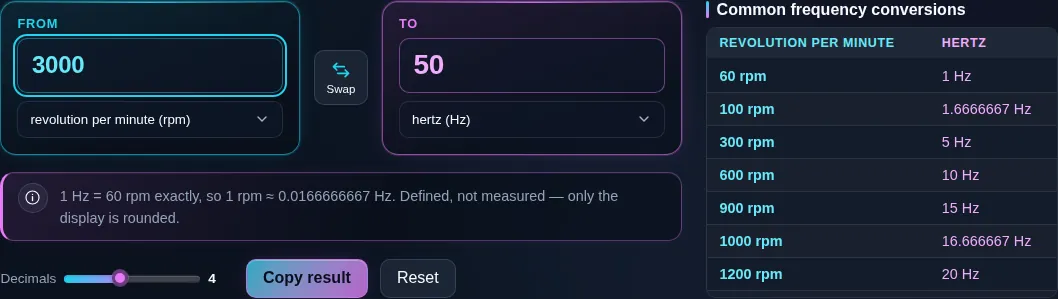
    Frequency converter turning 3000 revolutions per minute into 50 hertz, with the note underneath reading that one hertz is exactly 60 rpm.
    Converting rpm to hertz, with the exact factor underneath
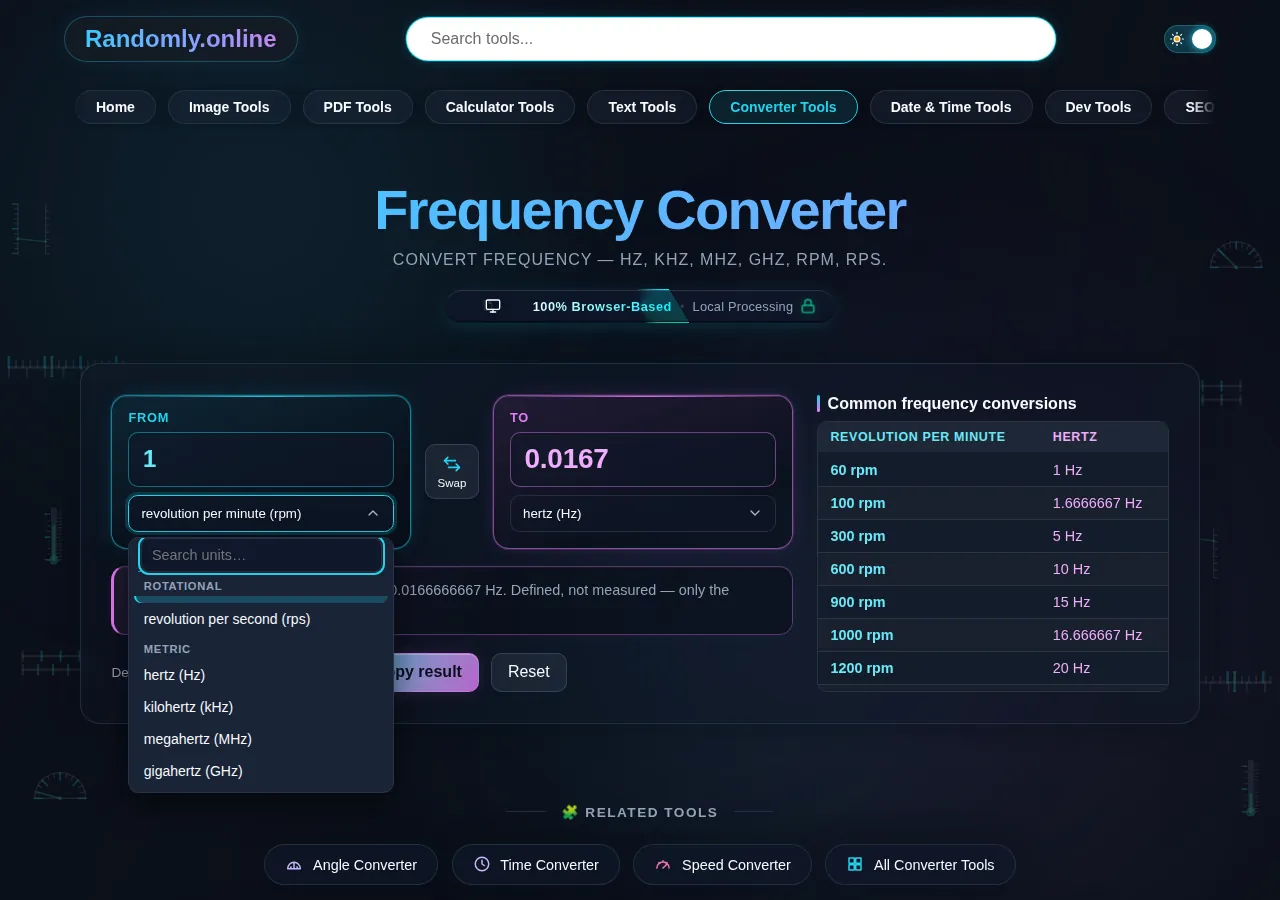
    The frequency converter unit list open at the boundary between its rotational group and its metric group, with hertz, kilohertz, megahertz and gigahertz below the heading.
    The unit list, grouped and searchable
    The rpm to hertz reference table listing motor speeds from 60 rpm to 7200 rpm beside their hertz readings.
    The reference table for the pair on screen
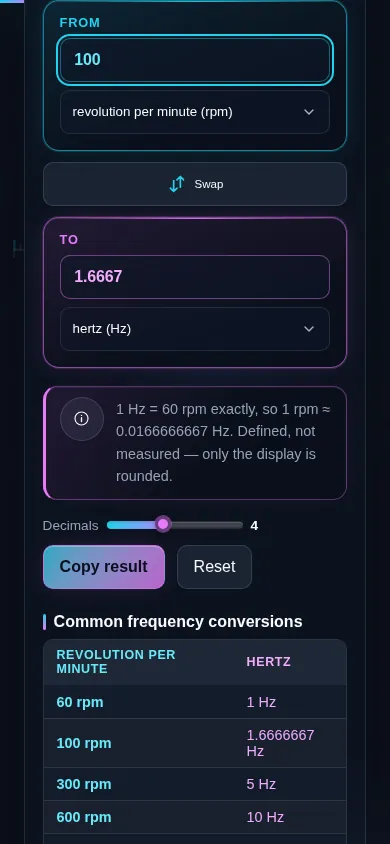
    The frequency converter on a phone screen, the two panes stacked with the swap control between them.
    The same tool on a phone

    Frequently Asked Questions

    How many rpm is 1 Hz?

    Exactly 60 rpm. One hertz is one cycle (or revolution) per second, and a minute has 60 seconds, so 1 Hz equals 60 revolutions per minute. To convert Hz to rpm, multiply by 60; to convert rpm to Hz, divide by 60. So 10 Hz is 600 rpm. The tool shows this exact relationship with every result.

    ---

    How do I convert rpm to Hz and back?

    Divide rpm by 60 to get hertz, or multiply Hz by 60 to get rpm. Because rpm counts revolutions per minute and Hz counts them per second, the only difference is the 60 seconds in a minute. For example, 1800 rpm ÷ 60 = 30 Hz, and 25 Hz × 60 = 1500 rpm. The tool applies this exact factor automatically.

    ---

    What is 3000 rpm in Hz?

    50 Hz. Divide 3000 by 60: 3000 ÷ 60 = 50 revolutions per second, which is 50 Hz. Similarly, 3600 rpm is 60 Hz, and 1500 rpm is 25 Hz. This is why motor speeds and mains frequency are closely linked — a 2-pole motor on 50 Hz mains runs near 3000 rpm. The tool converts any rpm value to Hz with the factor shown.

    ---

    Is rps the same as Hz?

    Yes, exactly. One revolution per second (rps) is one hertz — both mean one complete cycle every second. So 20 rps is simply 20 Hz. The distinction people usually need is between rps and *rpm* (per minute), where 1 rps = 60 rpm. The tool treats rps and Hz as equal and handles the ×60 step for rpm.

    ---

    How many Hz are in a MHz, kHz, and GHz?

    One kilohertz is 1000 Hz, one megahertz is 1,000,000 Hz, and one gigahertz is 1,000,000,000 Hz — the standard metric prefixes (kilo, mega, giga). So a 2.4 GHz signal is 2,400,000,000 Hz, and a 100 MHz FM station is 100,000,000 Hz. To step up, divide by 1000 each time; to step down, multiply by 1000. The tool does this instantly.

    ---

    Is rpm a frequency?

    Yes — rpm is a measure of rotational frequency, counting how many full revolutions happen per minute. It's dimensionally the same as hertz (cycles per unit time), just per minute instead of per second. That's why rpm converts to Hz by dividing by 60. Physicists usually prefer Hz or rad/s, while engineers and drivers use rpm for motors and engines.

    ---

    What's the difference between Hz and angular velocity (rad/s)?

    Hertz counts complete cycles per second; angular velocity (radians per second) measures the angle swept per second. Since one full revolution is 2π radians, one hertz equals 2π rad/s, about 6.283 rad/s. So they describe the same rotation but in different terms — cycles versus angle. They're related by the factor 2π, and this tool keeps frequency (Hz, rpm) separate from angular velocity to avoid mixing them up.

    ---

    Does "frequency converter" also mean a hardware device?

    Yes — in electrical engineering, a "frequency converter" (or variable-frequency drive, VFD) is hardware that changes the frequency of AC power, for example to control motor speed. This page is different: it's a unit converter that changes the *numbers* between Hz, kHz, MHz, GHz, rpm, and rps. If you need to change the actual mains frequency of a device, that's the hardware kind.

    ---

    How do I convert MHz to Hz for radio or a CPU?

    Multiply megahertz by 1,000,000. Since 1 MHz is a million hertz, a 3.2 GHz processor is 3200 MHz or 3,200,000,000 Hz, and a 101.5 MHz radio station is 101,500,000 Hz. To go from GHz to MHz, multiply by 1000. The tool handles all the signal-band prefixes (kHz, MHz, GHz) with the exact factor shown.

    ---

    Is this converter exact, or does it round the answer?

    The math is exact — it uses defined relationships (1 Hz = 60 rpm, 1 rps = 1 Hz, 1 MHz = 1,000,000 Hz). Only the *displayed* value is rounded for readability, and you can add decimal places for more precision. The factor shown with each result lets you verify the figure yourself.

    ---

    What's the formula to convert frequency units?

    Convert everything through hertz. Multiply your value by its factor to Hz (kHz → ×1000, MHz → ×1,000,000, GHz → ×1e9, rps → ×1, rpm → ÷60), then divide by the target unit's factor. For rpm to Hz it's simply value ÷ 60; for MHz to Hz it's value × 1,000,000. The tool applies this two-step method for any pair.

    ---

    Does the tool work offline, and does it upload my data?

    It works fully offline once the page has loaded, and it never uploads anything. All conversions are pure arithmetic using fixed factors, so the calculation happens on your own device — no server, no account, no tracking. That makes it dependable in a workshop with no signal, and private by design, since there's nothing to send anywhere.

    Still have questions?

    If you can't find the answer you're looking for, feel free to contact our support team.

    Contact Us