Angle Converter

Convert angles — degrees, radians, gradians, arcminutes, arcseconds.

100% Browser-Based Local Processing

How this conversion works

The relation

Worked example

    4

    Common angle conversions

    DegreesRadians

    Privacy Focused

    🔒 Local Processing. The values you enter never leave your device.

    Instant Results

    🌐 Fully Client-Side. Runs instantly in your browser.

    No Signup

    ⚡ No accounts. No API keys. Just open and use.

    Browser Based

    🚀 No installs, no sign-ups, no conversion limits.

    What is a Angle Converter?

    > Angle Converter turns any angle between degrees, radians, gradians, arcminutes, and arcseconds. Enter a value, pick your units, and read the result with the exact formula shown. To convert degrees to radians, multiply by π/180 — so 180° = π rad, and 90° = π/2. It works offline. ---

    ### H2: Convert angles — degrees, radians, and gradians

    Angles are measured in several units depending on the field. Everyday and geometry work uses degrees (°); trigonometry and higher maths use radians (rad); surveying uses gradians (gon); and astronomy and GPS use arcminutes (′) and arcseconds (″). This converter handles all five, so a degree value becomes radians, or a survey angle in gradians becomes degrees, in one step. Every result shows the exact formula, with a swap button and an all-units table.

    The relationship to remember is that a full circle is 360° = 2π radians = 400 gradians. From that, 180° = π radians, so to convert degrees to radians you multiply by π/180 (about 0.0174533), and to convert radians to degrees you multiply by 180/π (about 57.29578). So one radian is about 57.3° — the angle at which the arc length equals the radius.

    Because radians so often come out as tidy fractions of π, the tool shows the π-multiple wherever it's clean, not just a decimal: 30° is π/6, 45° is π/4, 60° is π/3, 90° is π/2, and 180° is π. That's usually the form students and engineers actually want, since π is irrational and its decimal (3.14159…) never ends.

    A few honest notes. A radian is technically dimensionless — it's a ratio of arc length to radius — but it's treated as a unit for convenience. A gradian (or gon) divides the circle into 400 parts instead of 360, which makes right angles a round 100 gon; it's used mainly in surveying. And arcminutes and arcseconds are subdivisions of a degree (1/60 and 1/3600), used for very small angles in astronomy and navigation — despite the names, they're not related to time. Everything runs on your own device, offline, with nothing uploaded.
    ---

    How to use the Angle Converter

    Step 1: Enter your value. Type the angle you want to convert into the input box

    Decimals are fine.

    Step 2: Pick the "from" unit. Choose the unit your number is currently in — for example, degrees (°)

    Pick the "from" unit. Choose the unit your number is currently in — for example, degrees (°).

    Step 3: Pick the "to" unit. Choose the unit you want the answer in — for example, radians (rad)

    The result updates instantly.

    Step 4: Read the result and the formula. The converted value appears with the formula used (for example, radians = degrees × π/180), and the π-multiple where it's clean, so you can verify it

    Read the result and the formula. The converted value appears with the formula used (for example, radians = degrees × π/180), and the π-multiple where it's clean, so you can verify it.

    Step 5: Copy, swap, or expand. Use Copy to grab the number, the swap button to reverse the direction, or open the all-units table to see your value in every unit at once

    Adjust the decimal places for more precision.

    Angle Converter in action

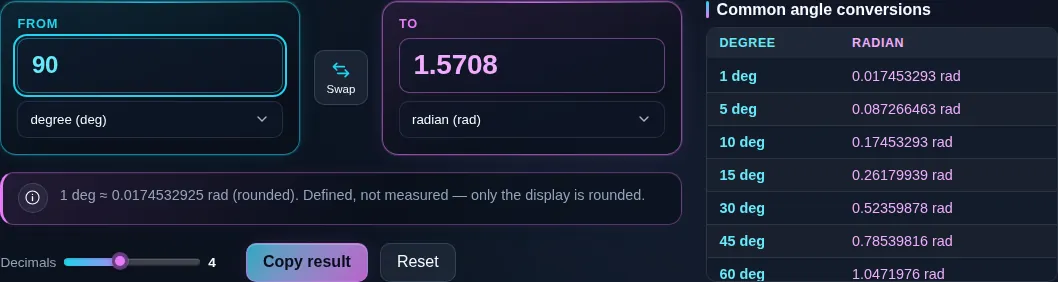
    Angle converter turning 90 degrees into 1.5708 radians, with the note underneath reading that one degree is about 0.0174532925 radians.
    Converting degrees to radians, with the exact factor underneath
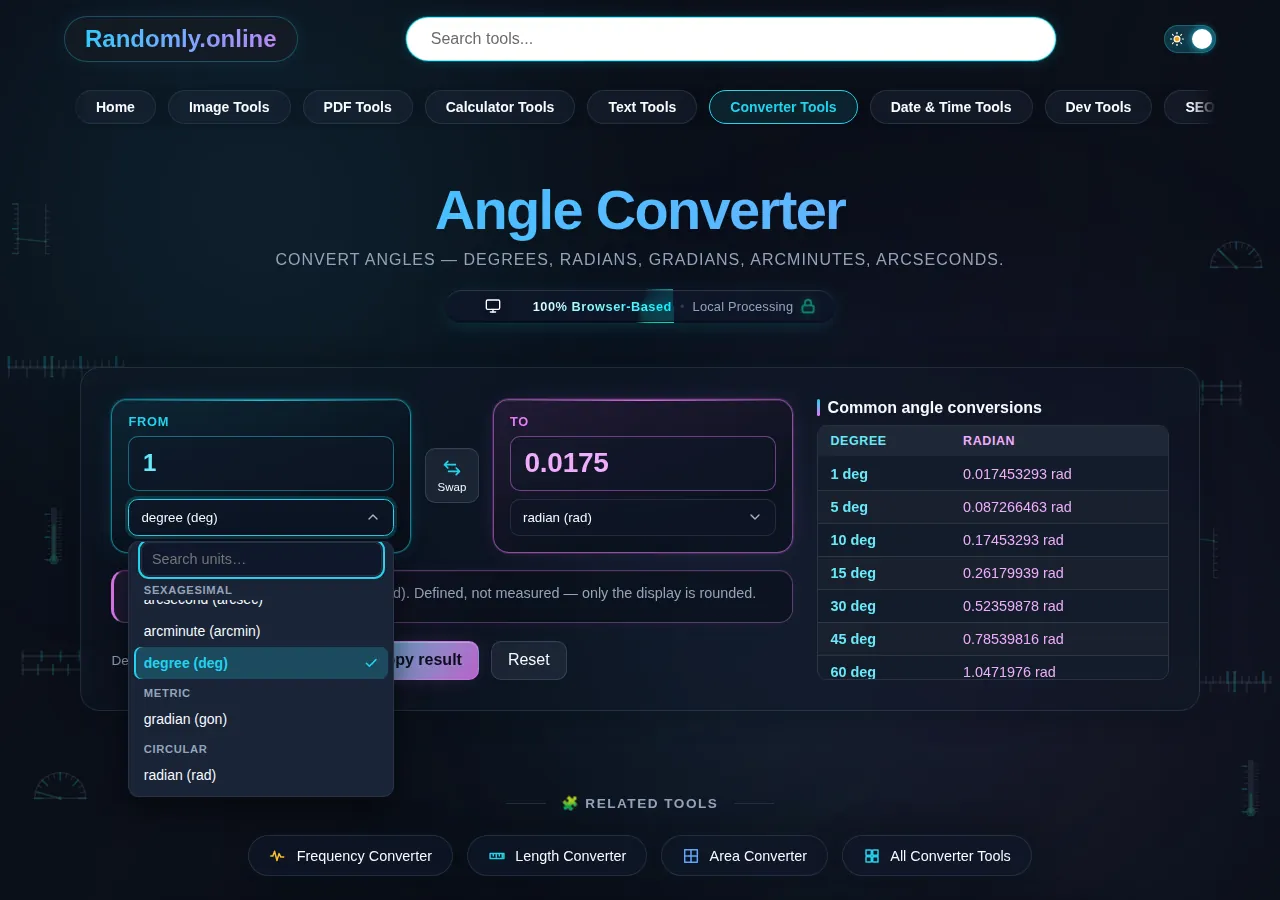
    The angle converter unit list showing arcsecond, arcminute and degree under its sexagesimal heading, gradian under metric, and radian under circular.
    The unit list, grouped and searchable
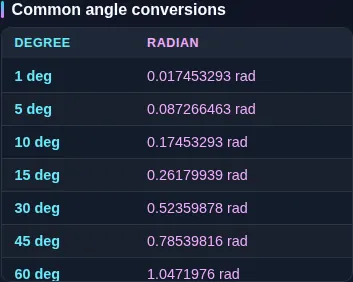
    The degrees to radians reference table listing the angles from 1 degree to 360 degrees beside their radian readings.
    The reference table for the pair on screen
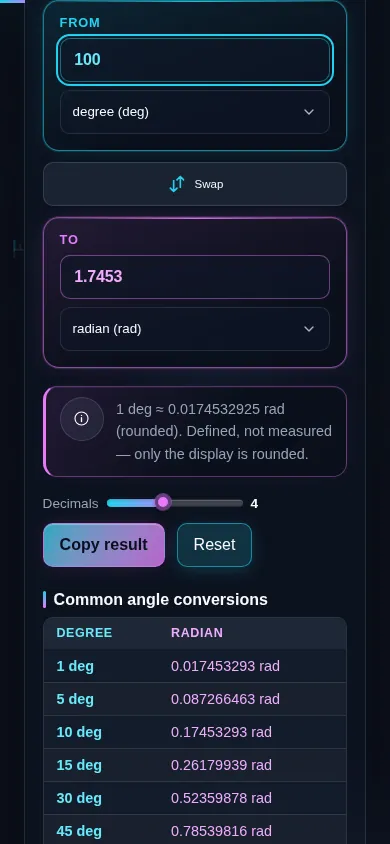
    The angle converter on a phone screen, the two panes stacked with the swap control between them.
    The same tool on a phone

    Frequently Asked Questions

    How do I convert degrees to radians?

    Multiply the degrees by π/180 (about 0.0174533). This comes from 180° = π radians, so radians = degrees × π/180. For example, 60° × π/180 = π/3 ≈ 1.0472 rad. The tool shows both the decimal and the clean π-multiple, and displays the formula so you can follow it.

    ---

    What is 90 degrees in radians?

    90° is π/2 radians, which is about 1.5708. Using radians = degrees × π/180: 90 × π/180 = π/2. It's a right angle, one quarter of a full circle (2π). Other common ones: 30° = π/6, 45° = π/4, 60° = π/3, and 180° = π. The tool shows the exact π-form alongside the decimal.

    ---

    How many degrees are in a radian?

    One radian is about 57.29578 degrees. It comes from 180/π: since 180° = π radians, one radian = 180 ÷ π ≈ 57.2958°. Geometrically, a radian is the angle where the arc length equals the circle's radius. So a full circle, 2π radians, is 360°. The tool converts any radian value to degrees with the factor shown.

    ---

    How do I convert radians to degrees?

    Multiply the radians by 180/π (about 57.29578). Because 180° equals π radians, degrees = radians × 180/π. For example, 2 rad × 57.2958 ≈ 114.59°, and π/4 rad × 180/π = 45°. The tool applies this exact formula and shows it, so you don't have to remember which way π goes.

    ---

    What is 180 degrees in radians?

    Exactly π radians, which is about 3.14159. This is the key relationship the whole conversion rests on: a straight angle of 180° equals π radians, so half of that (90°) is π/2, and a full circle (360°) is 2π. Whenever a radian value is a neat fraction of π, the tool shows that form rather than only the endless decimal.

    ---

    How many radians are in a full circle?

    2π radians, which is about 6.28319. A full circle is 360°, and since 180° = π radians, 360° = 2π radians. So a half-circle is π, a quarter-circle (right angle) is π/2, and so on. In gradians a full circle is 400. The tool converts full or partial turns between all these units.

    ---

    Is a radian a unit?

    Technically, a radian is dimensionless — it's defined as the ratio of an arc's length to the circle's radius, so the units cancel. But it's treated as a unit for practical purposes, like degrees, because it tells you which angle measure you're using. This is why radians can appear or disappear in physics formulas (for example, in angular velocity) without breaking the units.

    ---

    What is a gradian (gon)?

    A gradian, also called a gon or grad, divides a full circle into 400 equal parts instead of 360. That makes a right angle exactly 100 gon and a straight angle 200 gon, which is convenient for surveying and some engineering. One gradian equals 0.9°, or π/200 radians. It's a niche unit, but the tool converts it alongside degrees and radians.

    ---

    What are arcminutes and arcseconds?

    They're subdivisions of a degree for measuring very small angles. One degree is 60 arcminutes (′), and one arcminute is 60 arcseconds (″), so a degree is 3600 arcseconds. They're used in astronomy, navigation, and GPS coordinates (as degrees-minutes-seconds). Despite the names, they have nothing to do with minutes and seconds of *time* — they just borrow the sexagesimal (base-60) structure.

    ---

    Is this converter exact, or does it round the answer?

    The conversions are exact — they use the exact relationship 180° = π radians. Because π is irrational, decimal radian values are necessarily rounded for display, but the tool also shows the exact π-multiple (like π/3) whenever the angle lands on one. You can add decimal places for more precision, and the formula shown lets you verify any result.

    ---

    What's the formula for each conversion?

    Radians = degrees × π/180; degrees = radians × 180/π. Gradians = degrees × 10/9 (since 400 gon = 360°); degrees = gradians × 0.9. Arcminutes = degrees × 60; arcseconds = degrees × 3600. Each is exact, derived from the 360°/2π/400 circle, and the tool displays the relationship it used with every result.

    ---

    Does the tool work offline, and does it upload my data?

    It works fully offline once the page has loaded, and it never uploads anything. All conversions are pure arithmetic using fixed factors, so the calculation happens on your own device — no server, no account, no tracking. That makes it dependable with no signal, and private by design, since there's nothing to send anywhere.

    Still have questions?

    If you can't find the answer you're looking for, feel free to contact our support team.

    Contact Us