VAT / GST Calculator

Add or remove VAT, GST, or sales tax at any rate: gross = net × (1 + rate); to reverse it, net = gross ÷ (1 + rate).

100% Browser-Based Local Processing
%

You supply the rate, because it depends on the country, the goods and sometimes the date — a calculator that hardcodes one gives a confidently wrong answer everywhere else. Reduced and zero rates are common on food, books, children's clothing and medicine. Removing tax is not the same as subtracting the rate: 20% of the tax-inclusive price is more than the tax it contains.

Total with tax

300.00

Before tax250.00
Tax50.00
Tax as a share of the total16.67%
Per unit300.00
Formula and working

The formula

Adding: tax = net × rate. Removing: net = gross ÷ (1 + rate)

Your numbers

Waiting for your numbers.

An estimate, not financial advice. Figures are indicative, and the assumptions behind them are stated on the tool itself. Tax rules, rates and fees vary by country and change over time — check against your provider or a qualified adviser before acting on a number.

Privacy Focused

🔒 Local Processing. Your salary and balances never leave your device.

Instant Results

🌐 Fully Client-Side. Runs instantly in your browser.

No Signup

⚡ No accounts. No API keys. Just open and use.

Browser Based

🚀 No installs, no sign-ups, no bank account linking.

What is a VAT / GST Calculator?

A VAT / GST Calculator adds or removes tax at the rate you enter. To add: gross = net × (1 + rate), and the tax is net × rate. To remove it from a tax-inclusive price: net = gross ÷ (1 + rate). You can't just subtract the rate from the gross.

VAT (value-added tax), GST (goods and services tax), and sales tax all work the same way arithmetically: a percentage added to a net price. This calculator does both directions cleanly — adding tax to a net (tax-exclusive) price, or removing it from a gross (tax-inclusive) price — at any rate you enter.

To add tax, the tool multiplies your net amount by the rate to get the tax, then adds it: gross = net × (1 + rate). So £100 at 20% becomes £20 tax and £120 gross. To remove tax — the case people most often get wrong — you divide, not subtract: net = gross ÷ (1 + rate), and the tax is the difference. So a £120 tax-inclusive price at 20% is £100 net and £20 tax. (Subtracting 20% of £120 would wrongly give £96, because the 20% was calculated on the smaller net figure, not the gross.) Enter your amount, choose add or remove, and the tool shows the net, the tax, and the gross, each clearly labelled, with an optional quantity for line totals.
How to add or remove VAT / GST

Step 1: Enter the amount. The price you're working from

Enter the amount. The price you're working from.

Step 2: Enter the tax rate. Your local VAT, GST, or sales-tax percentage

Enter the tax rate. Your local VAT, GST, or sales-tax percentage.

Step 3: Choose a mode. "Add tax" if your amount is net, or "Remove tax" if it's tax-inclusive

Choose a mode. "Add tax" if your amount is net, or "Remove tax" if it's tax-inclusive.

Step 4: Read net, tax, and gross. Each clearly labelled

Read net, tax, and gross. Each clearly labelled.

Step 5: Optional: add a quantity. For per-line and total figures

Copy any result.

VAT / GST Calculator in action

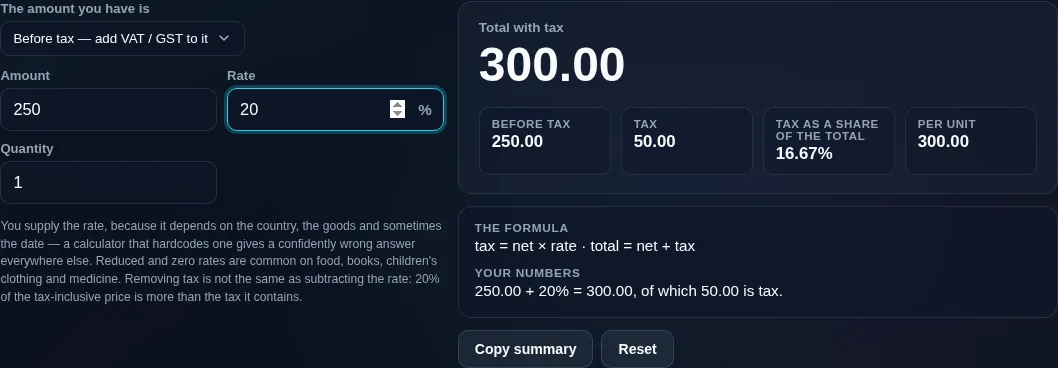
VAT GST calculator adding 20% to 250 to give 50 of tax and a 300 total, with the tax shown as 16.67% of that total
Adding tax to a net price, with the tax shown as a share of the total
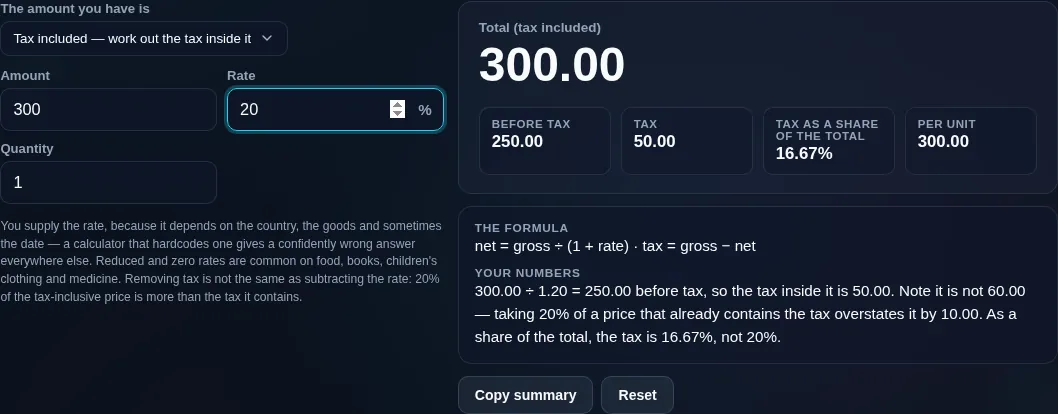
VAT GST calculator removing 20% from a 300 gross price to give 250 net and 50 of tax, noting that subtracting the rate would have overstated it by 10
Taking the tax back out of a gross price, and what subtracting the rate would have cost
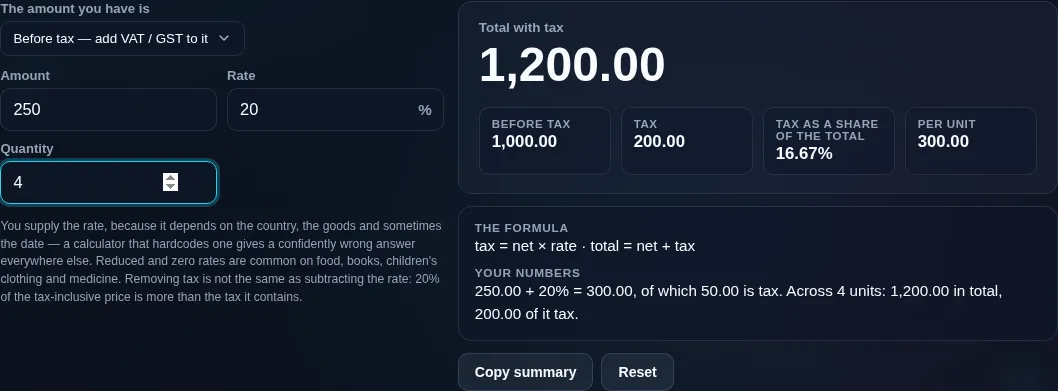
VAT GST calculator totalling four units at 300 each, keeping the per-unit price beside the total
The same unit price across a quantity, with the per-unit figure kept alongside
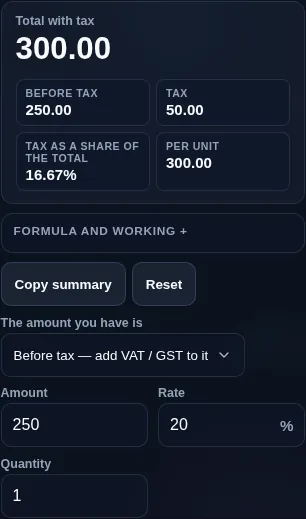
VAT GST calculator running in a phone browser with the add and remove modes in one control
Mobile browser

When a VAT / GST calculator helps

The tool is rate-agnostic by design, and that's deliberate. VAT and GST rates differ by country, and often by product category, and they change over time — so instead of hard-coding one country's rate, you enter the rate. That means the same tool works whether you're on a 20% UK VAT, a 10% Australian GST, an 18% Indian GST, or a US state sales tax, and it never goes out of date. Any rate presets, if shown, are dated and should be verified locally.

A note on scope: this is a calculator, not tax advice. It applies one rate to one amount. It doesn't handle reduced or zero rates per item, exemptions, reverse-charge rules, or VAT returns and filing. For those, check your local tax authority. For general percentages, see the Percentage Calculator. Everything runs privately in your browser.

  • Invoicing. Add the right tax to a net price for a quote or invoice.
  • Reverse VAT. Back the tax out of a tax-inclusive price.
  • Shopping. Work out the tax portion of a displayed price.
  • Any country. Enter your local VAT/GST/sales-tax rate.
  • Bookkeeping. Split a gross total into net and tax.

Realistic example (add). £250 net at 20% VAT: tax = 250 × 0.20 = £50, gross = £300.

Realistic example (remove). £300 gross at 20% VAT: net = 300 ÷ 1.20 = £250, so the VAT was £50 — not the £60 you'd wrongly get by taking 20% of £300.

Advanced tip. Change only the rate to instantly re-price for a different country or a reduced rate.

Common mistake to avoid. To remove VAT, divide by (1 + rate) — don't subtract the rate percentage from the gross, or you'll overstate the tax.

Related. For the underlying maths, see the Percentage Calculator.

What to keep in mind

  • Rate-agnostic — you enter the rate. No rate is hard-coded, so it works for any country and never goes stale; any presets are dated, verify locally.
  • Removing tax means dividing. net = gross ÷ (1 + rate); don't subtract the rate from the gross.
  • Not tax advice. It applies one rate to one amount — it doesn't handle exemptions, reduced rates, reverse charge, or filing.
  • VAT/GST vs sales tax. The mechanics differ (multi-stage vs single-stage) even though the arithmetic here is the same.
  • Private. All math runs on your device — nothing is uploaded.

Frequently Asked Questions

How do I add VAT or GST to a price?

Multiply the net price by the rate to get the tax, then add it: gross = net × (1 + rate). For example, £250 at 20% is £50 tax and £300 gross. Enter your net amount and rate, choose "Add tax", and the tool shows the tax and the tax-inclusive total. It works with any rate, so it fits any country.

---

How do I remove (reverse) VAT or GST from a gross price?

Divide the gross (tax-inclusive) price by (1 + rate): net = gross ÷ (1 + rate); the tax is the difference. For example, £300 including 20% VAT is £300 ÷ 1.20 = £250 net, so the VAT is £50. Choose "Remove tax" and the tool does this for you. This is the reverse-VAT case people most often get wrong.

---

How is VAT or GST calculated?

As a percentage of the net price. The tax equals net × rate, and the gross is net + tax, or net × (1 + rate). Whether you start from a net or a gross figure just decides the direction: add (multiply up) or remove (divide down). The tool applies the rate you enter and shows net, tax, and gross so every part is clear.

---

Why can't I just subtract the rate to remove VAT?

Because the tax was calculated on the smaller net price, not the gross. If you take 20% off a £120 gross price you get £96, but the correct net is £120 ÷ 1.20 = £100 (and £20 VAT). Subtracting the rate overstates the tax and understates the net. Always divide by (1 + rate) to reverse VAT — which is exactly what the remove mode does.

---

What rate should I use?

Whatever rate applies to your situation — you enter it, because VAT and GST rates vary by country and often by product category. Common examples include 20% UK VAT, 10% Australian GST, and 18% Indian GST, but reduced and zero rates exist too. Use the correct current rate from your local tax authority; the tool doesn't assume one, so it works everywhere.

---

What's the difference between VAT and GST?

They're essentially the same idea under different names: a broad consumption tax charged at each stage of the supply chain, with businesses reclaiming the tax they pay on inputs. "VAT" is common in the UK, EU, and much of the world; "GST" is used in Australia, India, Canada, New Zealand, and others. Mechanically similar enough that this calculator handles both — you just enter the rate.

---

How is VAT/GST different from US sales tax?

VAT and GST are multi-stage taxes collected at each step of production and distribution, with credits for input tax, whereas US sales tax is a single-stage tax charged only at the final retail sale. The end arithmetic on a price is the same — a percentage added — so this tool handles all of them, but the underlying systems and compliance differ.

---

Does this handle reduced rates or exemptions?

No. It applies the single rate you enter to the amount you enter. Real-world VAT/GST has reduced rates, zero rates, and exemptions for certain goods and services, plus rules like reverse charge — none of which this calculator models. Calculate each rate separately if a transaction mixes them, and check your local rules for what qualifies.

---

Is the amount tax-inclusive or tax-exclusive?

That's what the mode decides. In Add tax mode, your amount is treated as net (tax-exclusive) and the tool adds the tax. In Remove tax mode, your amount is treated as gross (tax-inclusive) and the tool backs the tax out. Picking the right mode is the key to getting the correct net, tax, and gross — the tool labels all three.

---

Does this work for my country?

Yes. Because you enter the tax rate yourself, the calculator works for any country's VAT, GST, or sales tax, and for any reduced or special rate. Nothing is hard-coded to one jurisdiction, so it stays accurate even when rates change — you just update the rate. Confirm your current local rate with your tax authority.

---

Is this tax advice?

No. This calculator does arithmetic — adding or removing a percentage — on the amount and rate you enter. It isn't tax advice and doesn't determine which rate applies, handle exemptions or reverse charge, or help you file a return. For those, consult your local tax authority or a qualified professional.

---

Is my data uploaded, and does it work offline?

No upload, and yes it works offline. Every calculation runs entirely in your browser, so your amounts are never sent to a server, there's no account, and no tracking. Once the page has loaded it keeps working with no connection — handy for quick invoicing or checkout maths anywhere.

Still have questions?

If you can't find the answer you're looking for, feel free to contact our support team.

Contact Us