Self-Employment Tax Calculator

Estimate US self-employment tax (Social Security + Medicare): net profit × 92.35% × 15.3%.

100% Browser-Based Local Processing
Rates — a 2026 snapshot, edit them if they have moved
%
%
%
%

This is the US SECA tax and nothing else — the Social Security and Medicare you owe as your own employer. It is not income tax, which is worked out separately on top of it, and it is not a filing-grade figure: the QBI deduction, credits, state rules and quarterly estimates all sit outside it. The wage base changes every year, so the defaults above are a dated snapshot rather than a fact — check them against the current IRS and SSA figures and edit them here. An estimate, not tax advice.

Self-employment tax

11,303.64

Net earnings from self-employment 73,880.00
Social Security portion 9,161.12
Medicare portion 2,142.52
Deductible half 5,651.82
Formula and working

The formula

Net earnings = profit × 92.35% · SE tax = min(net earnings, remaining wage base) × 12.4% + net earnings × 2.9%

Your numbers

Waiting for your numbers.

An estimate, not financial advice. Figures are indicative, and the assumptions behind them are stated on the tool itself. Tax rules, rates and fees vary by country and change over time — check against your provider or a qualified adviser before acting on a number.

Privacy Focused

🔒 Local Processing. Your salary and balances never leave your device.

Instant Results

🌐 Fully Client-Side. Runs instantly in your browser.

No Signup

⚡ No accounts. No API keys. Just open and use.

Browser Based

🚀 No installs, no sign-ups, no bank account linking.

What is a Self-Employment Tax Calculator?

A Self-Employment Tax Calculator estimates the US Social Security and Medicare tax the self-employed owe. SE tax = net profit × 92.35% × the combined rate — 15.3% (12.4% Social Security up to the wage base + 2.9% Medicare). Half is deductible against income tax. Income tax is separate.

If you're self-employed in the US — freelancing, contracting, gig work, or running a small business — you pay self-employment (SECA) tax to cover Social Security and Medicare, because there's no employer to split it with you. This calculator estimates it transparently.

The math has a step that trips people up. You first multiply your net profit by 92.35% to get your net earnings from self-employment (this adjusts for the employer-share equivalent). Then you apply the combined rate: 12.4% for Social Security, but only up to the annual wage base, plus 2.9% for Medicare on all of it — a headline 15.3%. High earners also pay an Additional Medicare Tax above a threshold. Enter your profit (and any W-2 wages already taxed for Social Security, which reduce the remaining Social Security base), and the tool shows your total SE tax, the Social Security and Medicare split, the deductible half, and the effective percentage of your profit.
How to calculate your self-employment tax

Step 1: Enter your net profit. Business income minus deductible expenses

Enter your net profit. Business income minus deductible expenses.

Step 2: Add W-2 Social Security wages (optional). Wages already taxed for Social Security reduce the remaining base

Add W-2 Social Security wages (optional). Wages already taxed for Social Security reduce the remaining base.

Step 3: Confirm or edit the rates. The 92.35% factor, 12.4% Social Security, wage base, 2.9% Medicare, and Additional Medicare threshold — all dated and editable

Confirm or edit the rates. The 92.35% factor, 12.4% Social Security, wage base, 2.9% Medicare, and Additional Medicare threshold — all dated and editable.

Step 4: Read your SE tax. Total, the Social Security and Medicare split, and the effective percentage

Read your SE tax. Total, the Social Security and Medicare split, and the effective percentage.

Step 5: Note the deductible half. Shown as an income-tax adjustment

Copy any figure.

Self-Employment Tax Calculator in action

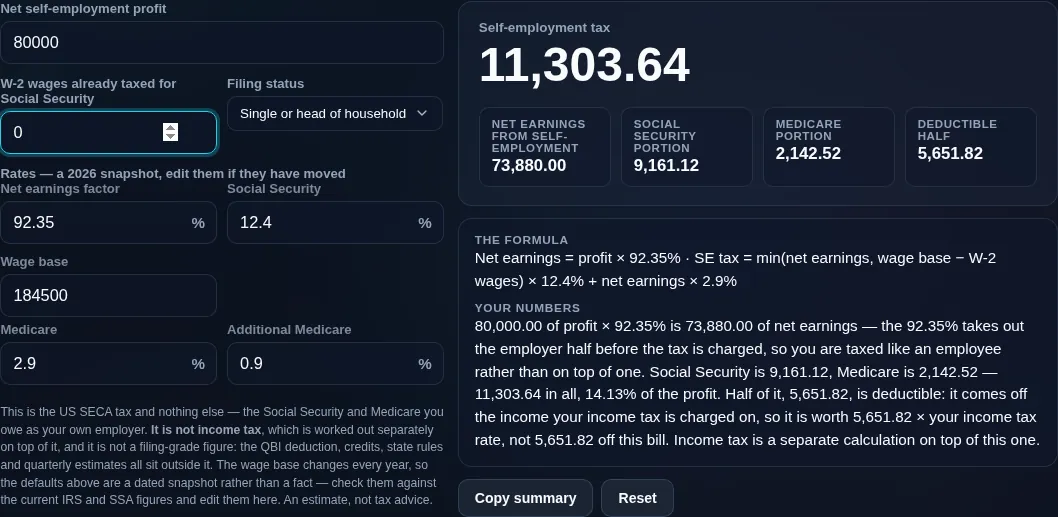
Self-employment tax calculator turning 80,000 of profit into 73,880 of net earnings and 11,303.64 of tax, with the deductible half shown separately
Net earnings, the Social Security and Medicare split, and the deductible half
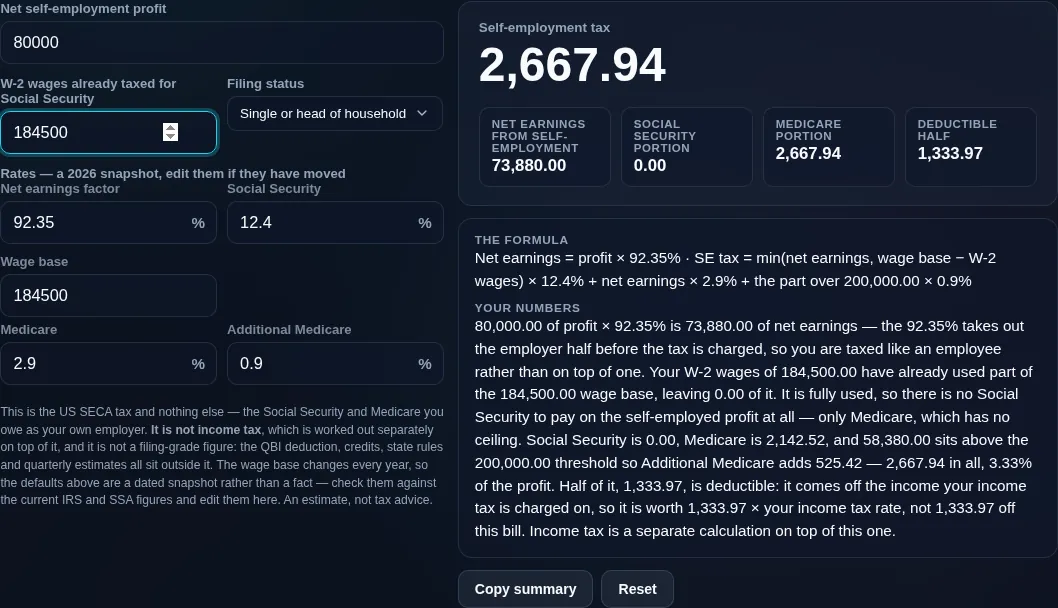
Self-employment tax calculator with W-2 wages that fill the Social Security wage base, leaving Medicare as the only tax on the profit
A day job that has already used the whole wage base, leaving no Social Security to pay
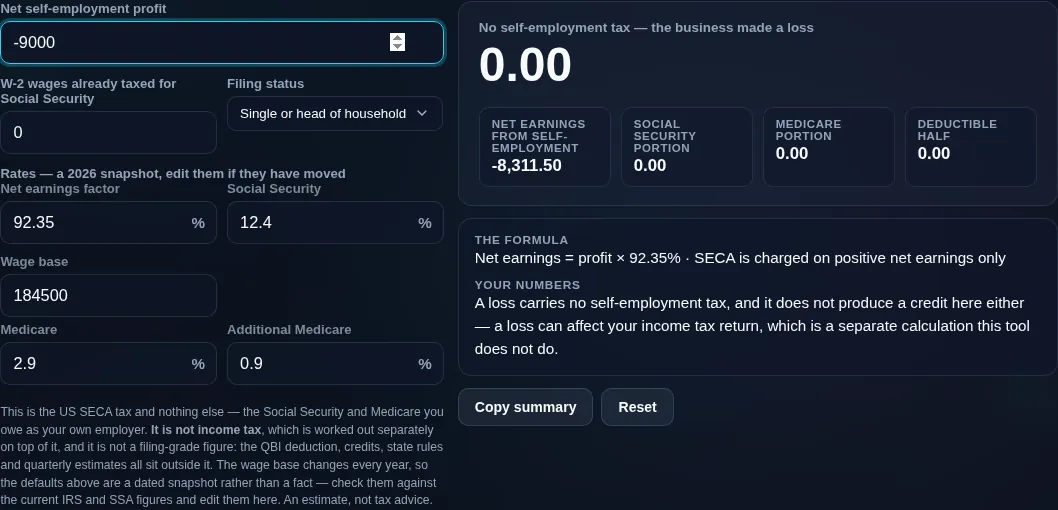
Self-employment tax calculator reporting no tax on a loss, and saying the loss does not produce a credit here
A year that made a loss, which carries no tax and no credit
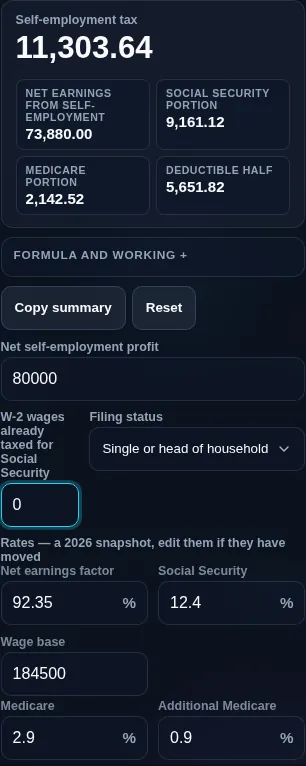
Self-employment tax calculator running in a phone browser with the rate controls stacked
Mobile browser

When a self-employment tax calculator helps

This is where honesty is essential. The tool is US-specific and dated: SE tax rates and especially the Social Security wage base change every year, so it ships with dated defaults you can edit — always confirm the current figures with the IRS. Two things people frequently confuse: self-employment tax is not income tax. SE tax only covers Social Security and Medicare; federal and state income tax are separate and stack on top, so your total tax bill is higher than SE tax alone — see the Income Tax Estimator. And the deductible half is an income-tax deduction (an adjustment to income), not a refund of the tax you paid. Real returns also involve the QBI deduction and state rules this simplifies.

None of this is tax advice; it's an estimate. For a broader paycheck view, see the Take-Home Pay Calculator. Everything runs privately in your browser.

  • Freelancers & 1099. Estimate SE tax on your net profit.
  • Side hustles. See the tax on extra self-employed income.
  • Quarterly estimates. Ballpark what to set aside for estimated taxes.
  • W-2 plus freelance. Coordinate the Social Security cap across both.
  • Pricing. Understand the tax bite when setting your rates.

Realistic example. On $50,000 of net profit: net earnings = 50,000 × 92.35% = $46,175; SE tax = 46,175 × 15.3% = about $7,065, of which roughly $3,532 is deductible against income tax.

Advanced tip. Once your net earnings plus any W-2 wages exceed the Social Security wage base, only the 2.9% Medicare portion applies to the excess — the marginal rate drops.

Common mistake to avoid. Don't forget income tax. SE tax is on top of federal and state income tax, not instead of it.

Related. Estimate the income-tax layer with the Income Tax Estimator.

What to keep in mind

  • US-specific and dated. SE tax rates and the Social Security wage base change yearly; defaults are dated and editable — verify with the IRS.
  • SE tax is not income tax. It only covers Social Security and Medicare; income tax is separate and stacks on top.
  • The deductible half is a deduction, not a refund. It reduces your taxable income, not your SE tax.
  • Simplified. Excludes the QBI deduction, state taxes, and other return details.
  • Not tax advice, and private. An estimate — and all math runs on your device, nothing uploaded.

Frequently Asked Questions

How is self-employment tax calculated?

Multiply your net profit by 92.35% to get net earnings, then apply the combined self-employment rate: 12.4% for Social Security (up to the wage base) plus 2.9% for Medicare — 15.3% overall. For example, $50,000 profit gives net earnings of $46,175, and 15.3% of that is about $7,065. The tool applies the 92.35% step, the wage-base cap, and the rates you confirm.

---

What is the self-employment tax rate?

The headline US rate is 15.3% — made up of 12.4% for Social Security and 2.9% for Medicare — but it applies to 92.35% of your net profit, not the full amount, so the effective rate on profit is closer to 14.1%. The Social Security portion only applies up to the annual wage base; above that, just the 2.9% Medicare (plus any Additional Medicare) continues.

---

What is the 92.35% step for?

Multiplying net profit by 92.35% before applying the rate accounts for the fact that employees don't pay Social Security and Medicare on their employer's half. It effectively removes the employer-share equivalent so the self-employed aren't taxed on tax. It's 100% minus 7.65% (half of 15.3%). This is why SE tax is calculated on net earnings, not raw profit, and the tool does this automatically.

---

Is self-employment tax the same as income tax?

No — and confusing the two is a common and costly mistake. Self-employment tax only covers Social Security and Medicare. Federal and state income tax are entirely separate and stack on top, so your total tax bill is more than SE tax alone. This tool estimates just the SE tax; estimate the income-tax layer with the Income Tax Estimator.

---

What is the deductible half?

You can deduct half of your self-employment tax when figuring your income tax — it's an adjustment to income, roughly mirroring the employer-share deduction a business gets. Importantly, it's a deduction, not a refund: it lowers your taxable income, not the SE tax you owe. The tool shows the deductible half so you can carry it into your income-tax calculation.

---

Does the Social Security portion have a cap?

Yes. The 12.4% Social Security part only applies to net earnings up to the annual Social Security wage base; earnings above it aren't subject to that 12.4%. The 2.9% Medicare part has no cap and applies to all net earnings. Because the wage base changes yearly, this tool uses a dated figure you can edit — check the current amount with the IRS.

---

What if I also have a W-2 job?

Wages from a W-2 job that are already subject to Social Security count toward the wage base, reducing how much of your self-employment income the 12.4% applies to. Medicare still applies to all of it. Enter your W-2 Social Security wages and the tool reduces the remaining Social Security base accordingly, so you don't overpay the capped portion.

---

What is the Additional Medicare Tax?

Higher earners pay an extra Medicare tax above an income threshold that depends on filing status, on top of the standard 2.9%. It applies to combined wages and self-employment earnings over the threshold. The tool includes an editable Additional Medicare rate and threshold so high earners can factor it in — confirm the current figures, as they can change.

---

Are these rates and the wage base current?

The rates, wage base, and thresholds in this tool are dated and provided for convenience — US figures, especially the Social Security wage base, change most years. Always confirm the current numbers with the IRS before relying on a result, and use the editable fields to enter the right figures for your tax year.

---

Do I need to pay this quarterly?

Usually, yes. The self-employed generally pay estimated taxes — including SE tax and income tax — in quarterly installments to the IRS, rather than through withholding. This tool estimates the annual SE tax; divide by four for a rough quarterly figure, but check the IRS rules and safe-harbor amounts, since underpaying can trigger penalties.

---

Is this tax advice?

No. This calculator does the standard SE-tax arithmetic on the profit you enter, using rates you confirm — it's an estimate, not tax advice, and it doesn't handle the QBI deduction, state taxes, or your full return. For filing and planning, especially with a W-2 job or high income, consult the IRS or a qualified tax professional.

---

Is my data uploaded, and does it work offline?

No upload, and yes it works offline. Every calculation runs entirely in your browser, so your income figures are never sent to a server, there's no account, and no tracking. Once the page has loaded it keeps working with no connection — useful for private income planning without handing your numbers to a tax-software funnel.

Still have questions?

If you can't find the answer you're looking for, feel free to contact our support team.

Contact Us