Break-Even Calculator

Find the units and revenue you need to cover costs: break-even = fixed costs ÷ (price − variable cost).

100% Browser-Based Local Processing
units

Assumes the price and the variable cost per unit hold at every volume. Real discounts, bulk pricing and economies of scale move break-even, and the split between fixed and variable costs is a judgement call the answer inherits. A planning estimate, not business or financial advice.

Break-even point

445 units

Break-even revenue 20,000.00
Contribution per unit 27.00
Contribution margin 60.00%
Formula and working

The formula

Break-even units = fixed costs ÷ (price − variable cost per unit)

Your numbers

12,000.00 ÷ (45.00 − 18.00) = 444.4, so 445 units to cover costs — 20,000.00 of revenue.

An estimate, not financial advice. Figures are indicative, and the assumptions behind them are stated on the tool itself. Tax rules, rates and fees vary by country and change over time — check against your provider or a qualified adviser before acting on a number.

Privacy Focused

🔒 Local Processing. Your salary and balances never leave your device.

Instant Results

🌐 Fully Client-Side. Runs instantly in your browser.

No Signup

⚡ No accounts. No API keys. Just open and use.

Browser Based

🚀 No installs, no sign-ups, no bank account linking.

What is a Break-Even Calculator?

A Break-Even Calculator finds how much you must sell to cover your costs. Break-even units = fixed costs ÷ (price − variable cost per unit). The denominator is your contribution margin — the profit each sale adds before fixed costs. Multiply by price to get break-even revenue.

Your break-even point is the sales level where total revenue exactly covers total costs — no profit, no loss. Above it you make money; below it you don't. It's one of the most useful numbers for pricing, launching a product, or sanity-checking a business idea.

The formula is straightforward: break-even units = fixed costs ÷ (price − variable cost per unit). That denominator — price minus variable cost — is your contribution margin, the amount each sale contributes toward covering fixed costs. Once you've sold enough units for the total contribution to equal your fixed costs, you've broken even. Multiply the break-even units by your price and you get break-even revenue. This calculator shows both, along with your contribution margin per unit and as a ratio.

How to calculate your break-even point

Step 1: Enter your fixed costs. Rent, salaries, and other costs that don't change with volume, per period

Enter your fixed costs. Rent, salaries, and other costs that don't change with volume, per period.

Step 2: Enter your price per unit. What you sell each unit for

Enter your price per unit. What you sell each unit for.

Step 3: Enter your variable cost per unit. Materials, shipping, and per-unit costs

Enter your variable cost per unit. Materials, shipping, and per-unit costs.

Step 4: Read your break-even. Units and revenue to cover costs, plus contribution margin

Read your break-even. Units and revenue to cover costs, plus contribution margin.

Step 5: Optional: add a target profit or expected volume. For units-to-target and margin of safety

Copy any figure.

Break-Even Calculator in action

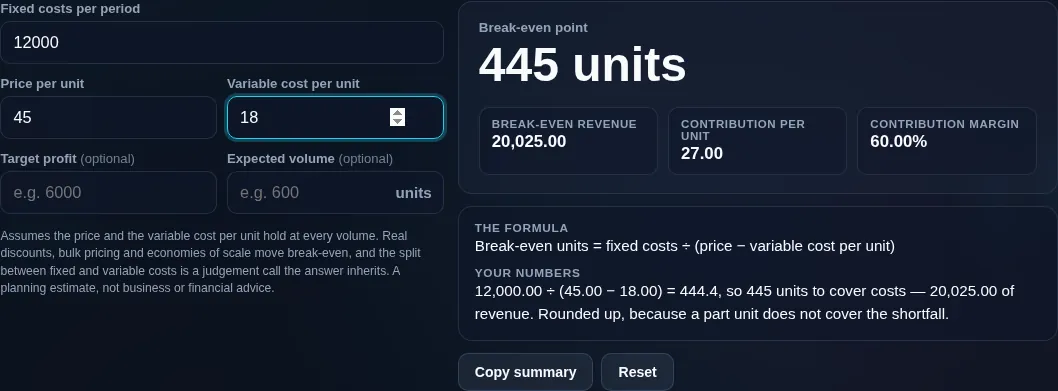
Break-even calculator turning 12,000 of fixed costs, a 45.00 price and an 18.00 variable cost into 445 units and 20,025.00 of revenue, at a 60% contribution margin
Break-even units and revenue from fixed costs, price and variable cost
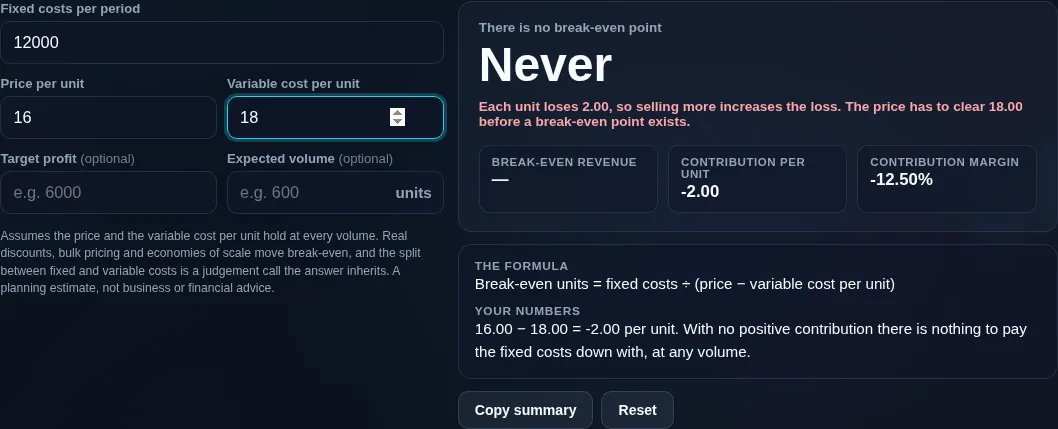
The same fixed costs with the price set below the variable cost, where the answer is Never — each unit loses 2.00, so selling more increases the loss
A price at or below the variable cost, where no break-even exists
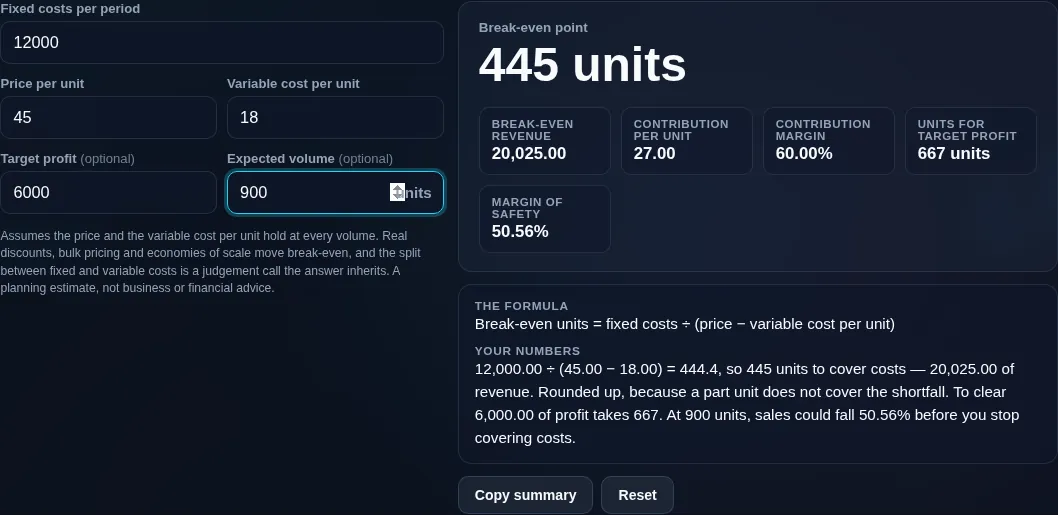
The same calculator with a 6,000 profit target and 900 units expected, reporting 667 units to clear the target and a 50.56% margin of safety
Target profit and margin of safety at an expected volume
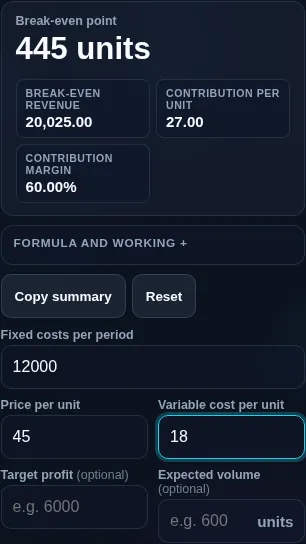
Break-even calculator running in a phone browser, with the cost inputs and the unit result stacked
Mobile browser

When a break-even calculator helps

It also goes further than the bare formula. Enter a target profit and it tells you the units and revenue needed to reach it — just add the profit to fixed costs before dividing. Enter your expected volume and it shows your margin of safety: how far sales can fall before you hit break-even.

A few honest points. The model assumes a constant price and a constant variable cost per unit, which is a simplification — real businesses offer discounts, and costs per unit can fall with scale, both of which shift the break-even point. The answer is also only as reliable as how you split fixed from variable costs; semi-variable costs (like utilities that have a base charge plus usage) take judgement. And critically, break-even only exists if your contribution margin is positive — if your price is at or below your variable cost, you lose money on every unit and never break even. The tool flags that rather than returning a nonsense number. These figures are a planning estimate, not financial or business advice.

For pricing and profitability, pair this with the Profit Margin Calculator. Everything runs privately in your browser.

  • Pricing a product. See how price changes move your break-even.
  • Launch planning. Know how many units make a launch worthwhile.
  • Target profit. Work out the volume for a profit goal.
  • Risk check. Use margin of safety to see how much room you have.
  • Idea validation. Test whether the numbers can realistically work.

Realistic example. Fixed costs of $10,000, a price of $50, and $30 variable cost give a contribution margin of $20. Break-even = 10,000 ÷ 20 = 500 units, or $25,000 in revenue. To make $4,000 profit, you'd need (10,000 + 4,000) ÷ 20 = 700 units.

Advanced tip. Raising price or cutting variable cost widens your margin and lowers break-even faster than cutting fixed costs — small margin changes have big leverage.

Common mistake to avoid. Make sure your contribution margin is positive. If price ≤ variable cost, there's no break-even — you lose money on every sale.

Related. To set the price in the first place, see the Profit Margin Calculator.

What to keep in mind

  • Constant-cost assumption. It assumes one price and one variable cost per unit; discounts and economies of scale shift break-even.
  • Needs a positive margin. If price ≤ variable cost, there's no break-even — the tool says so rather than dividing by a negative.
  • Fixed vs variable is a judgement call. Semi-variable costs affect the answer; classify carefully.
  • Not financial or business advice. A planning estimate, not a guarantee of demand.
  • Private. All math runs on your device — nothing is uploaded.
Frequently Asked Questions

How do you calculate the break-even point?

Divide your fixed costs by your contribution margin per unit: break-even units = fixed costs ÷ (price − variable cost per unit). The contribution margin is what each sale adds toward fixed costs. For example, $10,000 fixed costs, a $50 price, and $30 variable cost give a $20 margin, so break-even = 10,000 ÷ 20 = 500 units. Multiply by price for break-even revenue.

---

What is contribution margin?

Contribution margin is the money each sale contributes toward covering fixed costs, calculated as price minus variable cost per unit. If you sell for $50 and it costs $30 to make and deliver, your contribution margin is $20 per unit. As a ratio it's margin ÷ price, here 40%. The higher the margin, the fewer units you need to break even.

---

What's the difference between break-even in units and in revenue?

Break-even in units is how many you must sell; break-even in revenue is the sales dollars that represents. Units = fixed costs ÷ contribution margin per unit; revenue = those units × price, which also equals fixed costs ÷ contribution margin ratio. Units are handy for a single product; revenue is handy when you think in sales totals or sell a mix. The tool shows both.

---

How do I find the units needed for a target profit?

Add your target profit to your fixed costs, then divide by the contribution margin per unit: target units = (fixed costs + target profit) ÷ (price − variable cost). For example, to make $4,000 profit on top of $10,000 fixed costs with a $20 margin, you need (10,000 + 4,000) ÷ 20 = 700 units. Enter a target and the tool does this for you.

---

What's the margin of safety?

The margin of safety is how far your sales can drop before you hit break-even, shown as a percentage: (expected units − break-even units) ÷ expected units. If you expect to sell 700 units and break even at 500, your margin of safety is about 29% — sales could fall by that much before you start losing money. A bigger margin of safety means less risk.

---

What counts as a fixed cost versus a variable cost?

Fixed costs stay the same regardless of how much you sell — rent, salaries, insurance, software subscriptions. Variable costs rise and fall with each unit — materials, packaging, shipping, payment fees. Some costs are semi-variable (a base charge plus usage), and how you classify them affects the result, so use judgement. The accuracy of your break-even depends on splitting these correctly.

---

What if my price is below my variable cost?

Then you lose money on every unit and there's no break-even point — selling more only deepens the loss. Mathematically the contribution margin is zero or negative, so the formula can't give a positive answer. The tool flags this instead of returning a misleading number. The fix is to raise your price or cut your variable cost until the margin is positive.

---

Does break-even include tax or my own salary?

Only if you put them in. If you treat your salary as a fixed cost, it's covered; if you don't, break-even reflects the business covering its other costs but not paying you. Tax isn't modelled separately, and break-even is usually calculated pre-tax. Decide what to include in fixed costs based on what "covering costs" means for you, and be consistent.

---

Does this assume the price stays constant?

Yes. The standard break-even model assumes one selling price and one variable cost per unit across all units. In reality you might discount for volume, and per-unit costs can fall as you scale — both of which move the true break-even point. Treat the result as a clean baseline, and re-run it with different prices or costs to see how sensitive it is.

---

Can I use this for a service business?

Yes, with a bit of translation. Treat a "unit" as whatever you sell — an hour, a project, a subscription — with a price and a variable cost per unit (the direct cost of delivering one). Fixed costs are your overheads. The same formula gives the number of units, hours, or subscriptions you need to cover costs.

---

Is this financial advice?

No. This calculator does arithmetic on the costs and price you enter — it shows your break-even and contribution margin, but it doesn't predict demand, recommend a price, or advise on whether a business will succeed. Real results depend on the market. For business decisions, consult a qualified accountant or adviser.

---

Is my data uploaded, and does it work offline?

No upload, and yes it works offline. Every calculation runs entirely in your browser, so your cost and pricing figures are never sent to a server, there's no account, and no tracking. Once the page has loaded it keeps working with no connection — useful for modelling a business idea privately.

Still have questions?

If you can't find the answer you're looking for, feel free to contact our support team.

Contact Us