Lease vs Buy Calculator

Compare the true net cost of leasing vs buying over the same period — crediting the resale value you keep when you buy.

100% Browser-Based Local Processing
yr

If you buy it

%
yr

If you lease it

The buying figure is only as good as the resale value, and that is a guess about a market years away — so the tool also prints the resale value at which the two options cost the same, which is the number to argue with. If the loan outlasts the holding period the balance still owed is settled out of the sale, and that is counted here. Cost is not the whole decision either: mileage limits, wear charges, warranty cover and the freedom to change car are real and are not money. Business use, depreciation and tax treatment vary by country and are not modelled.

Leasing costs less, by

5,369.08

Buying, net of resale23,533.08
Leasing18,164.00
Buying, a month653.70
They tie at a resale of23,369.08
Formula and working

The formula

Buy = down + payments + balance still owed + maintenance − resale · Lease = due at signing + payments + fees

Your numbers

Waiting for your numbers.

An estimate, not financial advice. Figures are indicative, and the assumptions behind them are stated on the tool itself. Tax rules, rates and fees vary by country and change over time — check against your provider or a qualified adviser before acting on a number.

Privacy Focused

🔒 Local Processing. Your salary and balances never leave your device.

Instant Results

🌐 Fully Client-Side. Runs instantly in your browser.

No Signup

⚡ No accounts. No API keys. Just open and use.

Browser Based

🚀 No installs, no sign-ups, no bank account linking.

What is a Lease vs Buy Calculator?

A Lease vs Buy Calculator compares the true cost of each over the same period. Buying's net cost = down payment + loan payments + maintenance − the resale value you keep. Leasing's cost = drive-off + payments + fees, with nothing retained. The lower net cost wins.

Comparing a lease payment to a loan payment is misleading, because they don't buy you the same thing. This calculator makes a fair, apples-to-apples comparison by looking at the total net cost of each option over the same holding period — and, crucially, by crediting the resale value you still own when you buy.

On the buy side, your net cost is your down payment plus loan payments plus any maintenance, minus the resale value of the asset at the end of the period (you can sell it, so that value comes back to you). On the lease side, your cost is the drive-off amount plus all the lease payments plus fees — at the end you hand the asset back and keep nothing. Enter the asset price, your buy assumptions (down payment, loan rate and term, expected resale value, optional maintenance) and your lease assumptions (monthly payment, term, drive-off, fees), pick a holding period, and the tool shows the net cost of each, the difference, and which is cheaper. If you enter a discount rate, it can also compare on a present-value basis.
How to compare leasing and buying

Step 1: Enter the asset price and holding period. The period must be the same for both to compare fairly

Enter the asset price and holding period. The period must be the same for both to compare fairly.

Step 2: Fill in the buy path. Down payment, loan rate and term, expected resale value, optional maintenance

Fill in the buy path. Down payment, loan rate and term, expected resale value, optional maintenance.

Step 3: Fill in the lease path. Monthly payment, term, drive-off amount, and fees

Fill in the lease path. Monthly payment, term, drive-off amount, and fees.

Step 4: Read the net cost of each. Total cost of buying (net of resale) vs leasing, and the difference

Read the net cost of each. Total cost of buying (net of resale) vs leasing, and the difference.

Step 5: Optional: add a discount rate. For a present-value comparison

Copy any figure.

Lease vs Buy Calculator in action

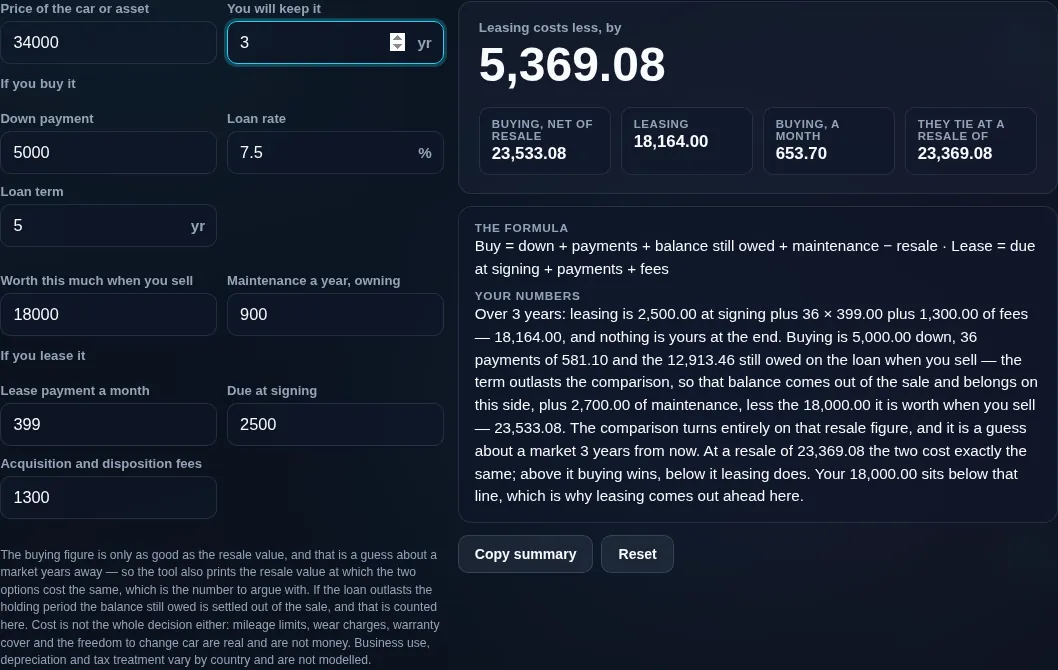
Lease vs buy calculator over three years on a 34,000 car, netting buying to 23,533.08 against 18,164.00 of leasing, with the 12,913.46 still owed on the loan counted on the buy side
The net comparison over three years, with the balance still owed on the buy side
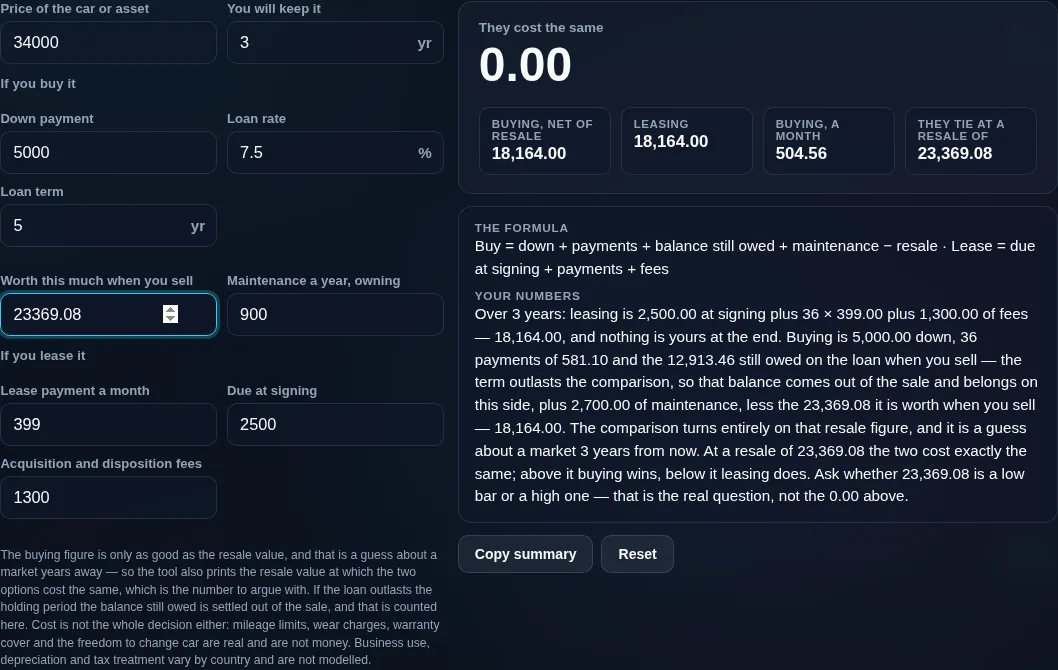
The same comparison with the resale value set to 23,369.08, the point the calculator prints as the tie — both options cost the same and the verdict reads zero
The resale value at which the two cost exactly the same, fed back in
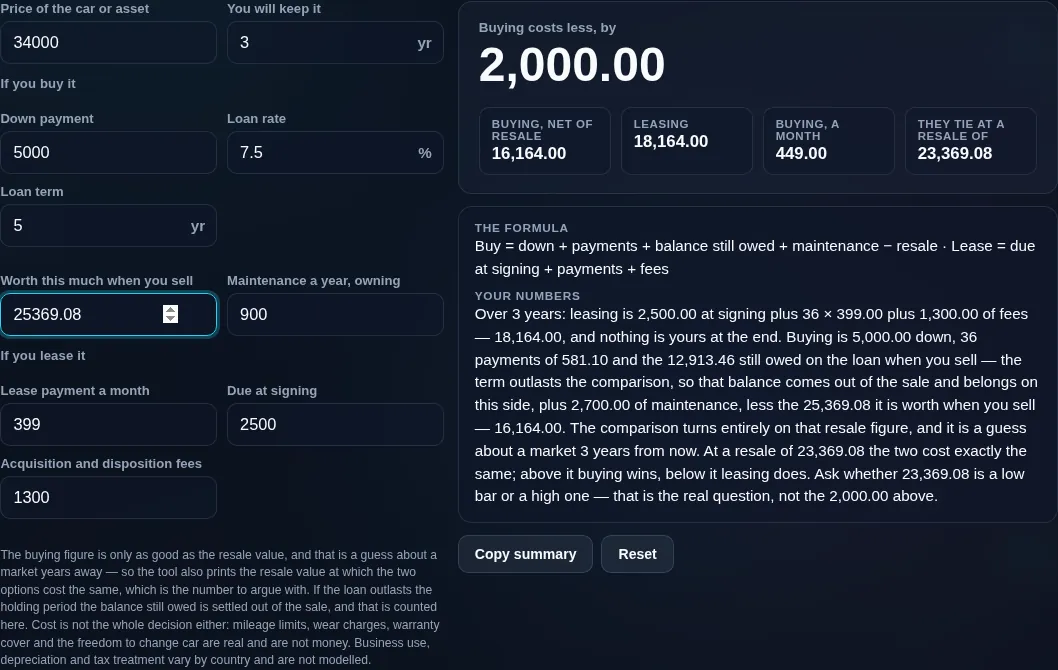
The same comparison with the resale two thousand above the tie point, where buying costs less by exactly 2,000.00
A resale above that line, where the verdict flips to buying
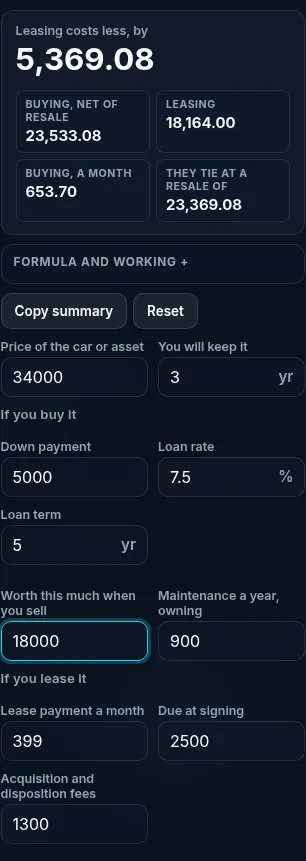
Lease vs buy calculator running in a phone browser, with the buy and lease columns stacked
Mobile browser

When a lease vs buy calculator helps

Now the honesty, because this decision has real traps. The buy result is highly sensitive to the resale value you assume — and that's a genuine guess, since no one knows what the asset will be worth years from now. Nudge it and the winner can flip, so treat the buy figure as a range, not a certainty. Cost also isn't everything: leasing caps your mileage and charges for wear, but gives you a newer asset more often and more flexibility; buying builds equity and has no mileage limits but ties up more money. And business use and tax (lease deductions, depreciation) vary by country and aren't modelled here.

This is an estimate, not financial advice. For the loan side, see the Loan Calculator and APR Calculator. Everything runs privately in your browser.

  • Cars. The classic lease-or-buy decision over 3–5 years.
  • Equipment. Compare leasing vs buying a business asset.
  • Testing resale assumptions. See how the winner shifts with resale value.
  • Same-period fairness. Compare like-for-like, not payment-to-payment.
  • Present value. Factor in the opportunity cost of tied-up money.

Realistic example. A $30,000 car: buying with $3,000 down, a 6% 5-year loan, and a $13,000 resale value after 5 years might net around $22,000. Leasing at $350/month with $2,000 drive-off over the same 5 years costs about $23,000 — close, and the winner flips if resale comes in higher or lower.

Advanced tip. Run the buy side with an optimistic and a pessimistic resale value to bracket the outcome.

Common mistake to avoid. Don't compare monthly payments alone — leasing leaves you with nothing, buying leaves you an asset.

Related. To pin down the loan's real cost, use the APR Calculator.

What to keep in mind

  • Resale value is a guess. The buy result is very sensitive to it; treat the outcome as a range.
  • Cost isn't everything. Mileage limits, wear charges, flexibility, and having a newer asset all matter beyond the numbers.
  • Business and tax vary. Lease deductions and depreciation differ by country and aren't modelled.
  • Not financial advice. An estimate driven by your assumptions.
  • Works for any asset, and private. Not just cars — and all math runs on your device, nothing uploaded.

Frequently Asked Questions

Is it cheaper to lease or buy?

It depends on the numbers, and often on the resale value you assume. Buying usually wins over a long horizon because you keep an asset you can sell, while leasing tends to have lower payments but leaves you with nothing. Over a short period with strong lease terms, leasing can win. Enter both and the tool compares the net cost over the same period.

---

How do you compare leasing and buying fairly?

Compare the total net cost over the same holding period, not the monthly payments. For buying: down payment + loan payments + maintenance − the resale value you keep at the end. For leasing: drive-off + all payments + fees, with nothing retained. Subtracting resale on the buy side is what makes it apples-to-apples, because leasing gives you no asset at the end.

---

Why does resale (residual) value matter so much?

Because it's money you get back when you buy but not when you lease — it directly reduces the net cost of buying. The trouble is it's a genuine unknown years ahead, so the buy figure swings a lot with it, and the winner can flip. That's why it's wise to run the comparison with both an optimistic and a pessimistic resale value to see a range.

---

Does leasing build equity?

No. With a lease you're paying to use the asset for a set time, then you return it — you never own it and build no equity. Buying (even with a loan) means each payment moves you toward owning something with resale value. That retained value is the main financial argument for buying, and it's exactly what this calculator credits on the buy side.

---

What is residual value?

Residual value is the estimated worth of the asset at the end of the lease or holding period. On a lease, the residual set by the lender helps determine your payment — a higher residual means lower payments. When you buy, the equivalent is the resale value you'd get by selling. Because it's an estimate of the future, treat any residual or resale figure with healthy caution.

---

What non-financial factors should I weigh?

Plenty that cost alone misses. Leasing usually caps your annual mileage and charges for excess wear, but lets you drive a newer asset more often with predictable payments and less resale hassle. Buying has no mileage limits, builds equity, and is cheaper long-term if you keep the asset — but ties up more money and carries resale risk. Weigh flexibility, usage, and preference alongside the numbers.

---

How does mileage affect a lease?

Leases include an annual mileage allowance, and exceeding it triggers a per-mile charge at the end that can be substantial. If you drive a lot, a lease that looks cheap can become expensive, or you'll pay upfront for a higher allowance. Buying has no such limit. Factor your real mileage into the decision — this tool compares cost, but the mileage cap is a lease-specific risk to keep in mind.

---

Is leasing better for a business?

Sometimes, but it depends on your country's tax rules. Businesses may deduct lease payments or claim depreciation and interest when buying, and the treatment varies widely by jurisdiction and asset. Those tax effects can change the answer and aren't modelled here. Use this tool for the pre-tax cash comparison, then check the tax treatment with an accountant for your specific situation.

---

Should I include an opportunity cost on the money?

You can. If you enter a discount rate, the tool can compare on a present-value basis, which accounts for the fact that money spent sooner (like a large down payment) has an opportunity cost versus money spent later. For most short-horizon car decisions the effect is modest, but for larger assets or longer periods it can matter.

---

Can I use this for things other than cars?

Yes. The logic applies to any asset you could either lease or buy — equipment, machinery, technology, even property in simplified terms. Enter the purchase price, financing, expected resale, and the lease terms, and the same net-cost comparison works. Cars are just the most common case, so the examples use them.

---

Is this financial advice?

No. This calculator compares the cost of the lease and buy scenarios you enter — it doesn't recommend which to choose, predict resale values, or account for your tax situation and preferences. The result depends heavily on your assumptions, especially resale value. For a significant decision, consult a qualified financial professional.

---

Is my data uploaded, and does it work offline?

No upload, and yes it works offline. Every calculation runs entirely in your browser, so your figures are never sent to a server, there's no account, and no tracking. Once the page has loaded it keeps working with no connection — handy for comparing options privately, including on a dealer's lot.

Still have questions?

If you can't find the answer you're looking for, feel free to contact our support team.

Contact Us