mL to cups Converter

Convert mL to cups instantly (and back).

100% Browser-Based Local Processing

millilitre (mL)

cup, US (cupUS)

How this conversion works

The relation

Worked example

    4

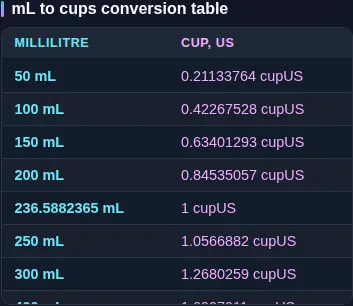
    mL to cups conversion table

    MillilitresUS cups

    Privacy Focused

    🔒 Local Processing. The values you enter never leave your device.

    Instant Results

    🌐 Fully Client-Side. Runs instantly in your browser.

    No Signup

    ⚡ No accounts. No API keys. Just open and use.

    Browser Based

    🚀 No installs, no sign-ups, no conversion limits.

    What is a mL to cups Converter?

    > To convert mL to cups, divide by your cup size: a US cup is 236.588 mL, a metric cup is 250 mL, and a UK cup is 284 mL. So 500 mL is about 2.11 US cups or 2 metric cups. The tool lets you pick the cup and works offline. ---

    ### H2: Convert millilitres to cups — with the right cup

    Millilitres-to-cups is a baking conversion, and it has one big trap: a "cup" isn't the same size everywhere. A US customary cup is about 236.6 mL, a metric cup (Australia, New Zealand, most modern recipes) is exactly 250 mL, and an old UK/imperial cup is about 284 mL. Convert with the wrong one and a recipe can be off by 5–20%, which matters a lot in baking.

    This page is a focused mL-to-cups tool that fixes that. First pick which cup you mean, then enter a value in millilitres and it shows the cups instantly — or enter cups to go the other way. The fields mirror each other, and every result shows which cup and factor it used (for example, 1 US cup = 236.588 mL), so you can trust the number.

    There's an extra US wrinkle worth knowing: the US legal cup used on nutrition labels is rounded to 240 mL, while the US customary cup used in recipes is 236.588 mL. The difference is small, but the tool lets you choose so your baking matches your source.

    One honest limit: this converts volume, and dry ingredients don't map neatly from volume to weight — a cup of flour weighs far less than a cup of sugar. If your recipe really wants grams of a specific ingredient, use the ingredient-aware Cooking Measurement Converter instead.

    A common-values table below lists the millilitre amounts bakers look up most, in each cup standard. And if you need gallons, pints, or fluid ounces, use the full Volume Converter. Everything here runs on your own device, offline, with nothing uploaded.
    ---

    How to use the mL to cups Converter

    Step 1: Pick your cup standard. Choose US customary (236.6 mL), US legal (240 mL), metric (250 mL), or UK (284 mL) — match your recipe's origin

    Pick your cup standard. Choose US customary (236.6 mL), US legal (240 mL), metric (250 mL), or UK (284 mL) — match your recipe's origin.

    Step 2: Enter the millilitres. Type your value into the mL field

    Decimals are fine.

    Step 3: Read the cups. The result appears instantly, with the cup and factor used shown beside it

    Read the cups. The result appears instantly, with the cup and factor used shown beside it.

    Step 4: Or go the other way. Type into the cups field instead to convert cups back to millilitres

    Or go the other way. Type into the cups field instead to convert cups back to millilitres.

    Step 5: Copy or refine. Use Copy to grab the result, or adjust the decimal places for more precision

    Copy or refine. Use Copy to grab the result, or adjust the decimal places for more precision.

    mL to cups Converter in action

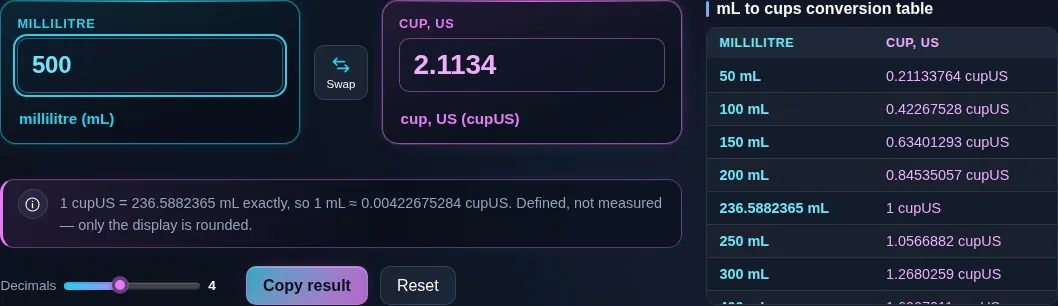
    mL to cups converter turning 500 millilitres into 2.1134 US cups, with the note underneath reading that one US cup is exactly 236.5882365 mL, so one millilitre is about 0.00422675284 US cups.
    Converting, with the exact cup definition stated underneath
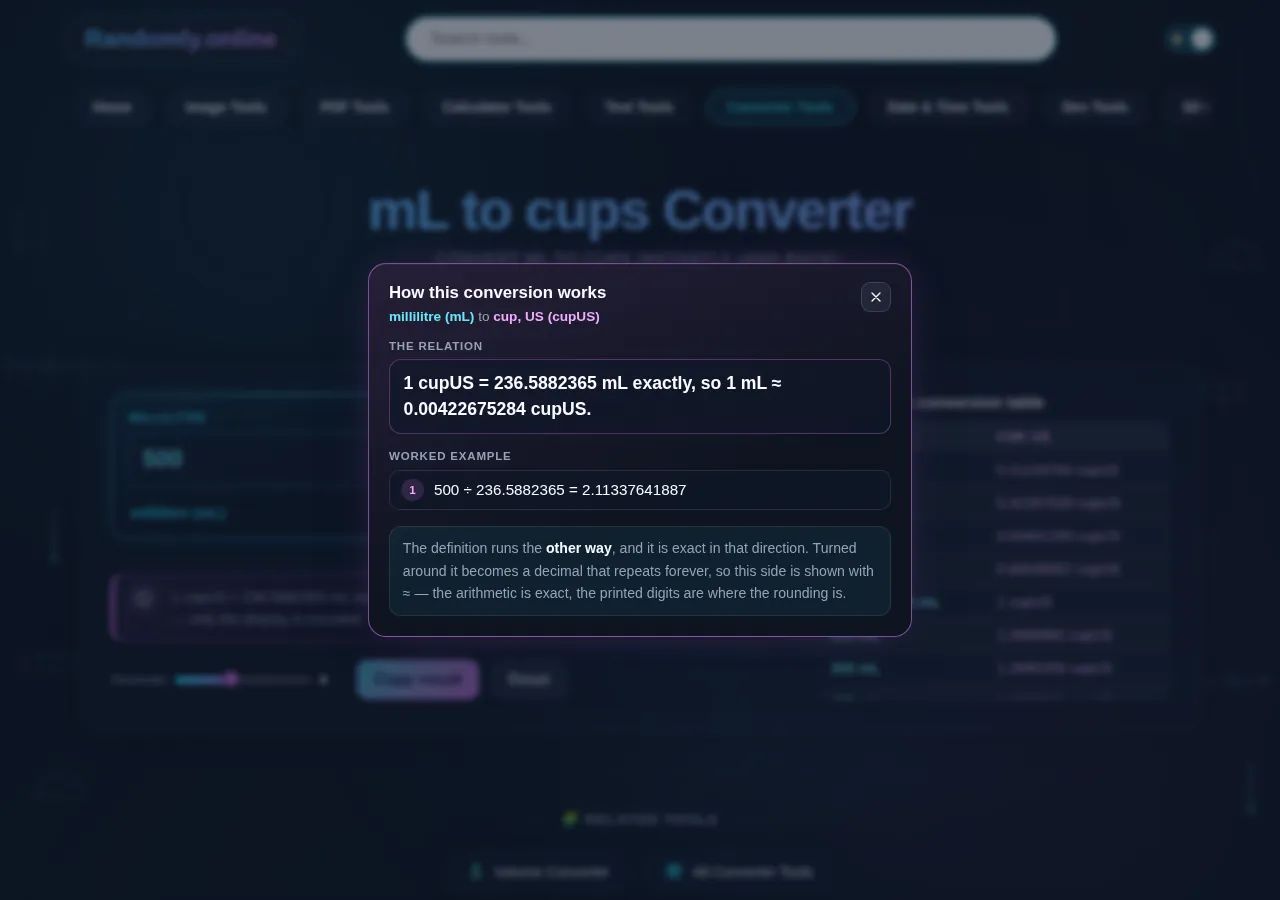
    The worked example dialog showing 500 divided by 236.5882365 giving about 2.11337641887, above a note saying the definition runs the other way and is exact there, and that only this direction repeats.
    The arithmetic behind the answer, step by step
    The millilitres to US cups baking table listing amounts from 50 mL to 1000 mL side by side beneath the converter.
    A baking table, ready to read without typing
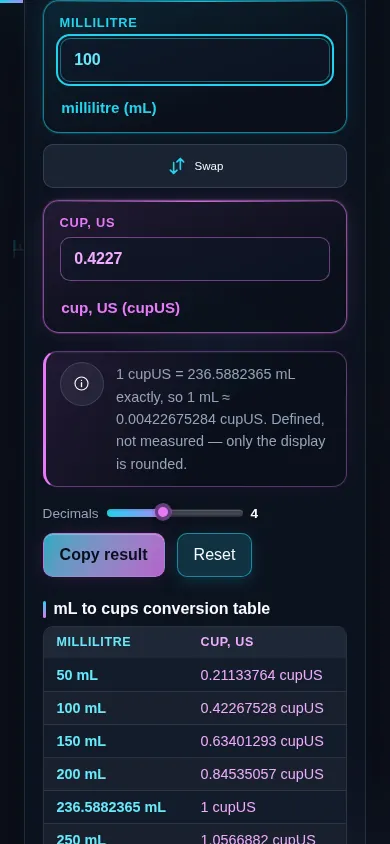
    The mL to cups converter on a phone screen, the two panes stacked with the swap control between them.
    The same tool on a phone

    Frequently Asked Questions

    How many mL are in a cup?

    It depends on the cup. A US customary cup is 236.588 mL, a US legal cup (nutrition labels) is 240 mL, a metric cup is 250 mL, and a UK/imperial cup is about 284 mL. Because they differ, the tool lets you pick which one you mean and shows the exact factor. For most US recipes, use 236.6 mL.

    ---

    Is a cup 240 mL or 250 mL?

    Both exist, for different systems. 240 mL is the US "legal" cup used on nutrition labels; 250 mL is the metric cup used in Australia, New Zealand, and most modern recipes. US recipes usually mean the customary cup of 236.588 mL, which is close to 240. So there's no single answer — match the cup to your recipe's origin, which the tool's selector makes easy.

    ---

    What is 250 mL in cups?

    250 mL is exactly 1 metric cup. In US customary cups it's about 1.06 cups, and in UK cups about 0.88 cup. This is why "250 mL" appears so often in metric recipes — it's a round one-cup measure there. Pick the metric cup in the tool and 250 mL reads as a clean 1.00 cup.

    ---

    What is 500 mL in cups?

    In metric cups, 500 mL is exactly 2 cups. In US customary cups it's about 2.11 cups, and in UK cups about 1.76 cups. So half a litre is a tidy two cups in a metric recipe, but slightly over two in an American one. Choose your cup standard in the tool for the exact figure.

    ---

    What's the difference between a US cup and a metric cup?

    Size. A US customary cup is 236.588 mL (8 US fluid ounces), while a metric cup is 250 mL — about 5.6% larger. Over a full recipe that gap adds up, so using the wrong cup can noticeably change the result. Australian, New Zealand, and most modern recipes use the 250 mL metric cup; American recipes use 236.6 mL.

    ---

    How do I convert mL to cups?

    Divide the millilitres by your cup's size. For US customary cups, divide by 236.588; for metric cups, divide by 250; for UK cups, divide by 284.13. For example, 300 mL ÷ 236.588 = 1.27 US cups, or 300 ÷ 250 = 1.2 metric cups. The tool does this automatically once you pick the cup standard, and shows the factor.

    ---

    How do I convert cups back to mL?

    Multiply the cups by your cup's size. A US customary cup is 236.588 mL, a metric cup is 250 mL, and a UK cup is 284.13 mL — so 2 US cups is 473.18 mL, while 2 metric cups is 500 mL. Type into the cups field and the tool converts to millilitres automatically for the standard you've selected.

    ---

    Which cup should I use for a recipe?

    Match the recipe's country. Use the US cup (236.6 mL) for American recipes, the metric cup (250 mL) for Australian, New Zealand, and most modern recipes, and the UK cup (284 mL) only for older British ones (British baking usually weighs ingredients instead). When a recipe doesn't say, its origin is the best clue — the tool's selector handles all of them.

    ---

    Does this work for dry ingredients like flour?

    For volume, yes — but dry ingredients are better measured by weight. A cup of flour and a cup of sugar hold the same volume but very different grams, so converting mL to cups won't tell you the weight. For accurate baking with flour, sugar, or butter, use the ingredient-aware Cooking Measurement Converter, which gives grams per ingredient.

    ---

    Is this converter exact, or does it round the answer?

    The math is exact — it uses defined cup sizes (US customary 236.588 mL, metric 250 mL, UK 284.13 mL). Only the *displayed* value is rounded for readability, and you can add decimal places for more precision. The cup standard and factor shown with each result let you verify the figure yourself.

    ---

    Where can I convert gallons, pints, or fluid ounces?

    Use the full Volume Converter. This page focuses on the mL-to-cups pair, but the Volume Converter handles metric, US, and UK units — litres, millilitres, gallons, pints, cups, and fluid ounces — with US and UK clearly labelled and the exact factor shown for each.

    ---

    Does the tool work offline, and does it upload my data?

    It works fully offline once the page has loaded, and it never uploads anything. The conversion is a single division by your chosen cup size, done on your own device — no server, no account, no tracking. That makes it dependable in the kitchen with no signal, and private by design, since there's nothing to send anywhere.

    Still have questions?

    If you can't find the answer you're looking for, feel free to contact our support team.

    Contact Us