Cooking Measurement Converter

Convert cooking measures — cups, tablespoons, teaspoons, mL — and get grams per ingredient (flour, sugar, butter).

100% Browser-Based Local Processing

How this conversion works

The relation

Worked example

    2

    Cups to grams, for this ingredient

    VolumeGrams

    Privacy Focused

    🔒 Local Processing. The values you enter never leave your device.

    Instant Results

    🌐 Fully Client-Side. Runs instantly in your browser.

    No Signup

    ⚡ No accounts. No API keys. Just open and use.

    Browser Based

    🚀 No installs, no sign-ups, no conversion limits.

    What is a Cooking Measurement Converter?

    > Cooking Measurement Converter switches between cups, tablespoons, teaspoons, and millilitres, and gives grams per ingredient. Exact volume facts: 1 US cup = 16 tbsp = 48 tsp. Weight depends on the ingredient — 1 cup of flour is about 120 g, but 1 cup of sugar is about 200 g. Works offline. ---

    ### H2: Convert cooking measurements — cups, spoons, millilitres, and grams

    Recipes rarely agree on units. One lists cups and tablespoons, another uses millilitres, and the most precise ones use grams. This converter handles all three, with one honest distinction built in: converting between *volume* units is exact, but converting *volume to weight* depends entirely on the ingredient.

    For volume to volume, the relationships are fixed: a US cup is 16 tablespoons or 48 teaspoons, a tablespoon is 3 teaspoons (about 14.79 mL), and a teaspoon is about 4.93 mL. These never change, so the tool converts them precisely. There's a cup-standard selector too, because a US cup (236.6 mL) isn't a metric cup (250 mL), and — a detail many tools miss — an Australian tablespoon is 20 mL, not the usual 15.

    For volume to weight, you pick the ingredient. A cup of all-purpose flour weighs about 120 g, a cup of granulated sugar about 200 g, a cup of butter about 227 g, and a cup of honey about 340 g — same volume, very different weights, because each ingredient has a different density. The tool shows the equivalence it used (for example, "1 US cup flour ≈ 120 g") so nothing is hidden.

    The important honesty note: those gram figures are approximate. How you measure matters a lot — scooped flour can weigh 20% more than sifted or spooned flour — and values vary by brand and by how firmly you pack. For baking, where ratios matter, the most reliable approach is a kitchen scale; treat the gram conversions here as good working estimates, not exact truth.

    Need pure volume in gallons or pints, or a straight weight conversion? Use the Volume Converter or Weight Converter. Everything here runs on your own device, offline, with nothing uploaded.
    ---

    How to use the Cooking Measurement Converter

    Step 1: Enter the amount and its unit. Type the quantity on the left and pick its unit

    The US cup, the 250 mL metric cup and the imperial cup are three separate entries in that list, as are the US, metric and Australian tablespoons — there is no separate standard selector to set.

    Step 2: Pick what you want it in. Choose the unit on the right

    Volume to volume is exact; picking grams, kilograms, ounces or pounds crosses into weight, which needs an ingredient.

    Step 3: Pick the ingredient, for weight. Choose flour, sugar, butter, honey, rice and so on, and the tool uses that density

    The control greys out on a volume-to-volume conversion, because there is no density in one.

    Step 4: Read both lines under the panes. The first states the relation and says whether it is exact

    On a weight conversion a second line appears giving the density used, where that figure comes from and how much it varies.

    Step 5: Copy, swap or refine. Copy takes the result, Swap turns the conversion round, and the decimals slider sets how many places the answer shows

    Copy, swap or refine. Copy takes the result, Swap turns the conversion round, and the decimals slider sets how many places the answer shows.

    Cooking Measurement Converter in action

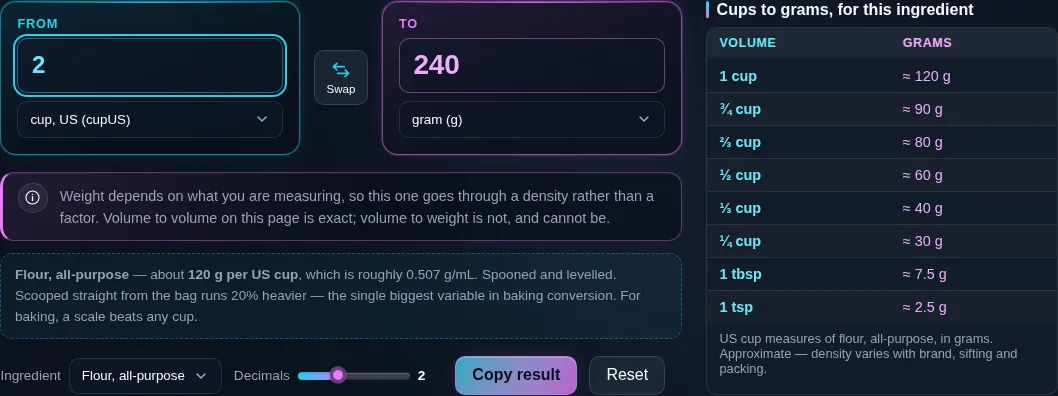
    Cooking measurement converter turning 2 US cups of all-purpose flour into 240 grams, with a second line underneath giving the density it used, about 120 grams per US cup, and where that figure varies.
    Cups to grams, with the density it used
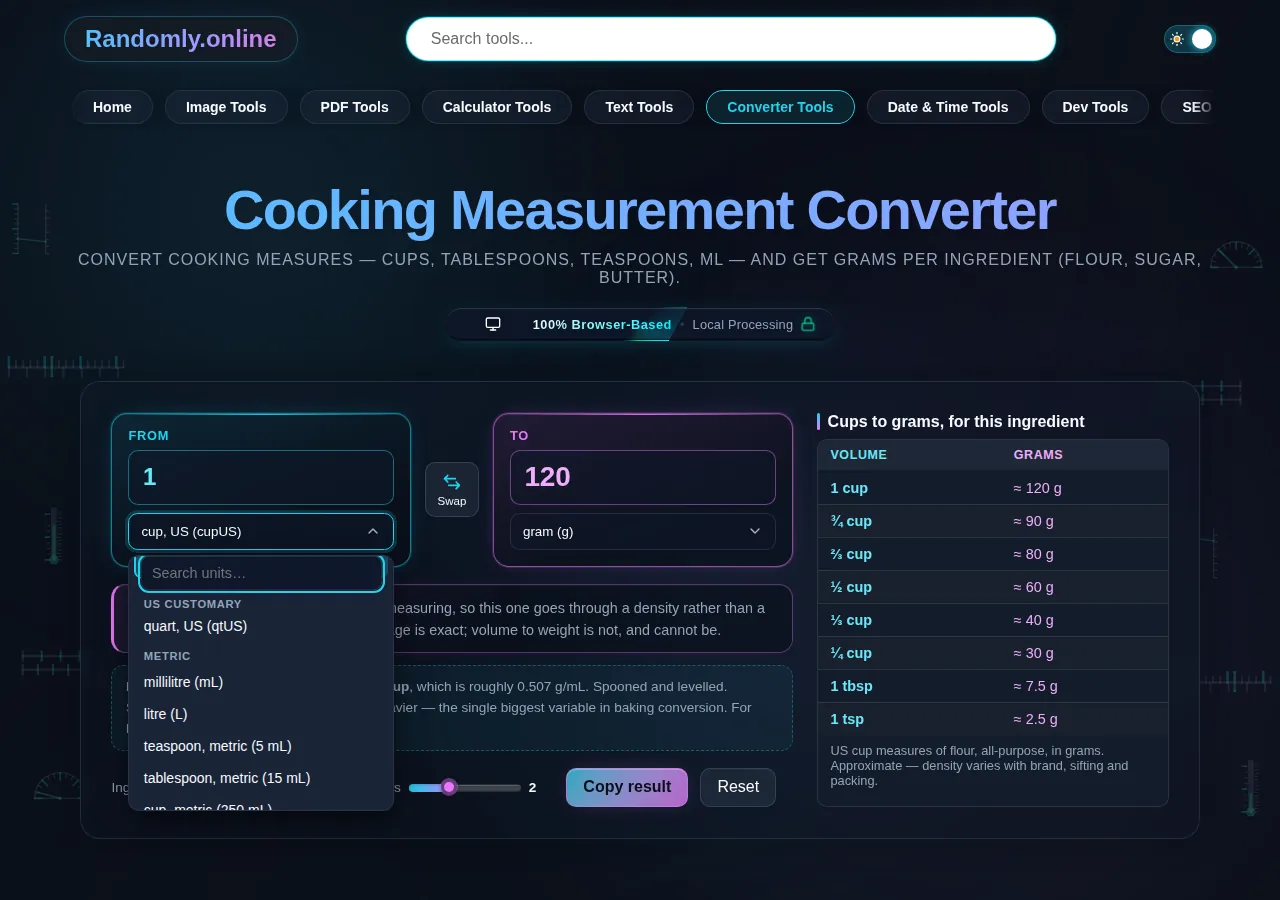
    The open unit list scrolled to the boundary between its two sections, the tail of the US customary group showing the quart, then the metric group listing millilitres, litres, the 5 mL teaspoon and the 15 mL tablespoon.
    Every cup and spoon standard in one list
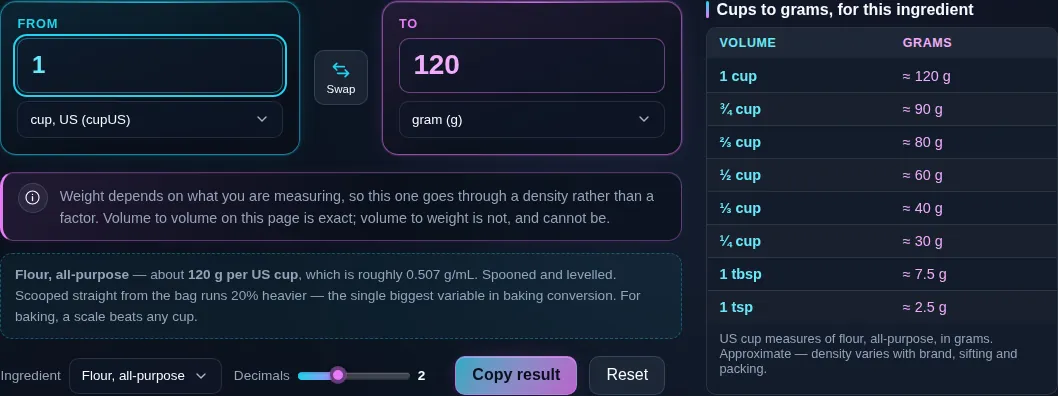
    The flour chart listing one cup down to a quarter cup, plus a tablespoon and a teaspoon, against their weights in grams, every row marked approximate.
    A cup-measure chart for the chosen ingredient
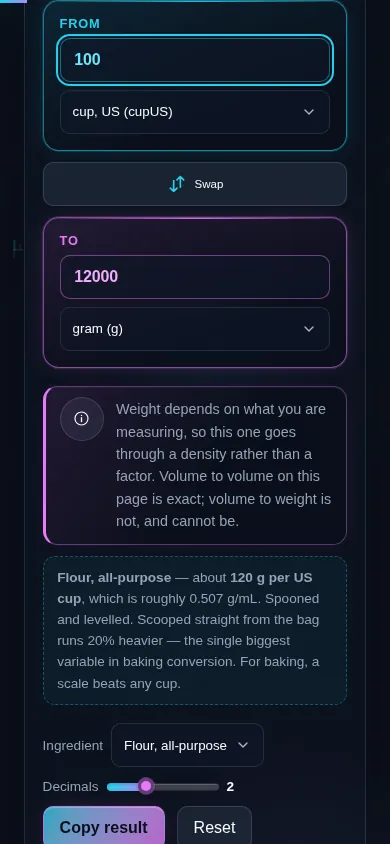
    The cooking measurement converter on a phone screen, the two panes stacked with the swap control between them.
    The same tool on a phone

    Frequently Asked Questions

    How many tablespoons are in a cup?

    In US measures, 16 tablespoons make one cup, so half a cup is 8 tablespoons and a quarter-cup is 4. This is exact for volume. In millilitres, a US cup is 236.6 mL and a US tablespoon is about 14.79 mL. Note that a metric cup (250 mL) holds about 16.7 metric (15 mL) tablespoons, so the round "16" is a US figure.

    ---

    How many teaspoons are in a tablespoon?

    Exactly 3. One tablespoon equals 3 teaspoons in both US and metric systems, so a cup (16 tbsp) is 48 teaspoons. In millilitres, a teaspoon is about 4.93 mL (US) or 5 mL (metric). This is an exact volume relationship, unlike ingredient weights, which depend on what you're measuring.

    ---

    How many grams are in a cup of flour?

    About 120 grams for all-purpose flour — but this is approximate. Scooping flour straight from the bag can pack in 20% more (up to ~150 g), while sifting gives less. That's why baking recipes increasingly list grams: a scale removes the guesswork. The tool uses ~120 g per US cup as a sensible default and labels it as an estimate.

    ---

    How many grams are in a cup of sugar?

    About 200 grams for granulated white sugar, per US cup — roughly 100 g for half a cup. Packed brown sugar is denser, around 220 g per cup. Unlike flour, sugar doesn't compress much, so the figure is fairly reliable. Still, brands vary slightly, so treat it as a close estimate; a scale is best for precise baking.

    ---

    How many grams is a stick of butter?

    A US stick of butter is about 113 grams. It's also half a cup, 8 tablespoons, or 4 ounces — the wrapper is usually marked with tablespoon lines. So two sticks make a cup (227 g). This is a US convention; butter sold in blocks elsewhere is simply weighed, which the tool can convert to cups or tablespoons.

    ---

    Why do different ingredients weigh different amounts per cup?

    Because they have different densities. A cup is a fixed *volume*, but a cup of feathery flour (~120 g) holds far less mass than a cup of dense honey (~340 g) or sugar (~200 g). That's the whole reason this tool asks which ingredient you mean before giving grams — there's no single "cup to grams" number that works for everything.

    ---

    How many mL are in a tablespoon, and is the Australian one different?

    A US tablespoon is about 14.79 mL, and a metric tablespoon is 15 mL — close enough to treat as the same. But an Australian tablespoon is 20 mL, a third larger, which can noticeably change a recipe. The tool lets you pick the standard so an Australian recipe's tablespoons aren't under-measured. A teaspoon is 5 mL in all these systems.

    ---

    Should I measure by volume or weight for baking?

    By weight, whenever accuracy matters. Volume measures like cups vary with how you scoop, sift, or pack — flour especially — so the same "cup" can differ by 20%. A kitchen scale and grams give consistent results every time. This tool's gram conversions are good working estimates, but a scale is the reliable choice for baking that needs to turn out the same twice.

    ---

    How do I convert grams back to cups for an ingredient?

    Pick the ingredient, switch the direction, and enter the grams — the tool divides by that ingredient's density. For example, 240 g of all-purpose flour is about 2 US cups (240 ÷ 120), while 240 g of sugar is only about 1.2 cups (240 ÷ 200). Because the density differs, always choose the ingredient first, and treat the result as approximate.

    ---

    Which cup should I use — US, metric, or UK?

    Match the recipe's origin. American recipes use the US cup (236.6 mL); Australian, New Zealand, and most modern recipes use the metric cup (250 mL); older British recipes may use the UK cup (284 mL), though British baking usually weighs instead. The differences add up across a recipe, so the tool's cup selector helps you stay true to the source.

    ---

    Is the gram conversion exact?

    No — volume-to-weight conversions are approximate by nature. They depend on the ingredient's density and on how it's measured, so brands, sifting, and packing all shift the number. The tool uses widely accepted average weights and labels them as estimates. Volume-to-volume conversions (cups, tablespoons, teaspoons, mL) *are* exact; only the gram figures carry a margin.

    ---

    Does the tool work offline, and does it upload my data?

    It works fully offline once the page has loaded, and it never uploads anything. All conversions run on your own device using fixed volume factors and stored ingredient densities — no server, no account, no tracking. That makes it dependable in the kitchen with no signal, and private by design, since there's nothing to send anywhere.

    Still have questions?

    If you can't find the answer you're looking for, feel free to contact our support team.

    Contact Us