Density Converter

Convert density — kg/m³, g/cm³, g/mL, kg/L, lb/ft³, lb/gal.

100% Browser-Based Local Processing

How this conversion works

The relation

Worked example

    4

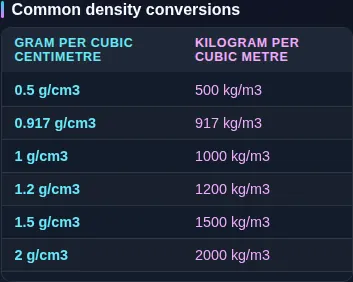
    Common density conversions

    g/cm3kg/m3

    Privacy Focused

    🔒 Local Processing. The values you enter never leave your device.

    Instant Results

    🌐 Fully Client-Side. Runs instantly in your browser.

    No Signup

    ⚡ No accounts. No API keys. Just open and use.

    Browser Based

    🚀 No installs, no sign-ups, no conversion limits.

    What is a Density Converter?

    > Density Converter turns any density between kg/m³, g/cm³, g/mL, kg/L, lb/ft³, and lb/gal. Enter a value, pick your units, and read the result with the exact factor shown (1 g/cm³ = 1000 kg/m³). As a handy anchor, water is about 1000 kg/m³, or 1 g/cm³. It works offline. ---

    ### H2: Convert density — with water as your anchor

    Density is mass per unit volume, and it's written in several units depending on the field. Science uses kilograms per cubic metre (kg/m³) and grams per cubic centimetre (g/cm³); chemistry often uses grams per millilitre (g/mL) or kilograms per litre (kg/L); and imperial engineering uses pounds per cubic foot (lb/ft³) or pounds per gallon (lb/gal). This converter handles all six, so a material spec in lb/ft³ becomes kg/m³, or a lab value in g/mL becomes kg/m³, in one step. Every result shows the exact factor, with a swap button and an all-units table.

    The easiest way to sanity-check density is to remember water: it's about 1000 kg/m³, which is exactly 1 g/cm³, 1 g/mL, or 1 kg/L. Anything denser than water sinks in it; anything lighter floats. So aluminium (about 2700 kg/m³) is 2.7 times water, steel (about 7850) is nearly 8 times, and gold (about 19,300) is over 19 times — while dry air, at roughly 1.225 kg/m³, is about 800 times lighter than water.

    That water anchor also reveals a neat fact the tool makes explicit: g/cm³, g/mL, and kg/L are all the same number. One of each equals 1000 kg/m³, because a cubic centimetre and a millilitre are the same volume, and a litre is 1000 of them against a kilogram. So you never need to convert between those three — they're identical.

    Two honest notes: pounds per gallon depends on the gallon — the tool uses the US gallon by default (1 lb/US gal ≈ 119.83 kg/m³); the UK gallon differs. And density changes with temperature and pressure, especially for liquids and gases, so reference values are for stated conditions and are approximate for real materials. The unit conversion itself is exact. Everything runs on your own device, offline, with nothing uploaded.

    ---

    How to use the Density Converter

    Step 1: Enter your value. Type the density you want to convert into the input box

    Decimals are fine.

    Step 2: Pick the "from" unit. Choose the unit your number is currently in — for example, g/cm³

    Pick the "from" unit. Choose the unit your number is currently in — for example, g/cm³.

    Step 3: Pick the "to" unit. Choose the unit you want the answer in — for example, kg/m³

    The result updates instantly.

    Step 4: Read the result and the factor. The converted value appears with the exact relationship used (for example, 1 g/cm³ = 1000 kg/m³), so you can verify it

    Read the result and the factor. The converted value appears with the exact relationship used (for example, 1 g/cm³ = 1000 kg/m³), so you can verify it.

    Step 5: Copy, swap, or expand. Use Copy to grab the number, the swap button to reverse the direction, or open the all-units table to see your value in every unit at once

    Adjust the decimal places for more precision.

    Density Converter in action

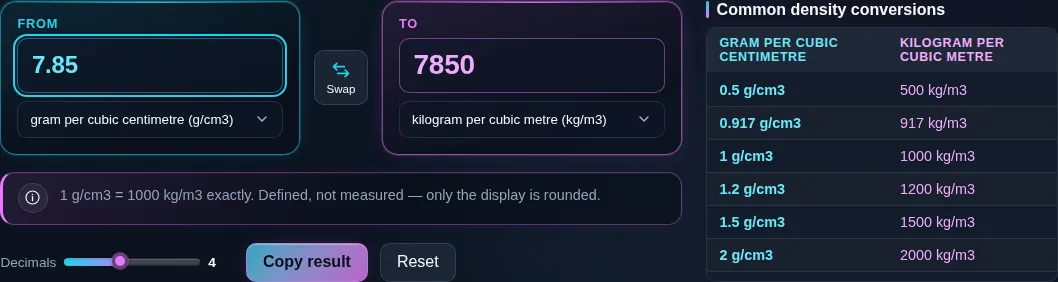
    Density converter turning 7.85 grams per cubic centimetre into 7850 kilograms per cubic metre, with the note underneath reading that one gram per cubic centimetre is exactly 1000 kilograms per cubic metre.
    Converting grams per cubic centimetre to kilograms per cubic metre, with the exact factor underneath
    The density converter unit list open at the boundary between its metric group and its imperial and US group, with pound per cubic foot and pound per US gallon below the heading.
    The unit list, grouped and searchable
    The grams per cubic centimetre to kilograms per cubic metre reference table listing values from 0.5 to 19.3 beside their kilograms per cubic metre readings.
    The reference table for the pair on screen
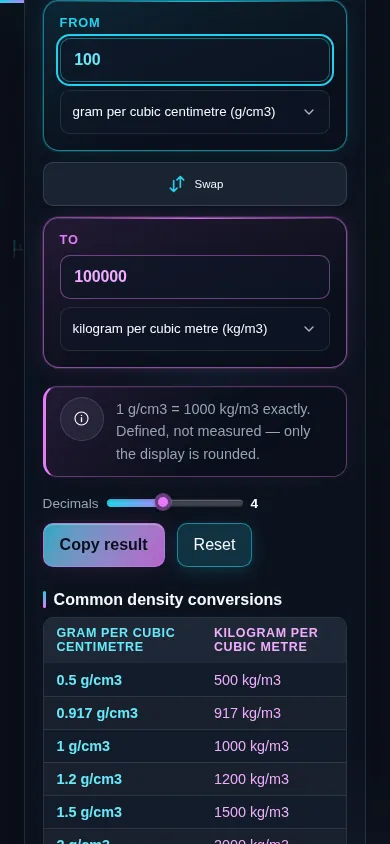
    The density converter on a phone screen, the two panes stacked with the swap control between them.
    The same tool on a phone

    Frequently Asked Questions

    How do I convert g/cm³ to kg/m³?

    Multiply by 1000. One gram per cubic centimetre equals 1000 kilograms per cubic metre, because a kilogram is 1000 grams and a cubic metre is 1,000,000 cubic centimetres (1,000,000 ÷ 1000 = 1000). So 2.7 g/cm³ is 2700 kg/m³. To reverse it, divide kg/m³ by 1000. The tool shows this exact factor with every result.

    ---

    What is the density of water in kg/m³ and g/cm³?

    Water is about 1000 kg/m³, which is exactly 1 g/cm³ (at 4 °C, its densest point). This is the handiest reference in the tool: anything with a density above 1000 kg/m³ sinks in water, and anything below floats. Warm water is slightly less dense (around 997 kg/m³ at 25 °C), but 1000 kg/m³ is the standard figure.

    ---

    Is g/cm³ the same as g/mL?

    Yes, exactly. A cubic centimetre (cm³) and a millilitre (mL) are the same volume — 1 cm³ = 1 mL by definition. So a density of 1 g/cm³ is identical to 1 g/mL. That's why lab densities in g/mL and physics densities in g/cm³ can be read as the same number, and both equal 1000 kg/m³.

    ---

    Are g/cm³, kg/L, and g/mL all the same?

    Yes — all three are identical, and each equals 1000 kg/m³. One gram per cubic centimetre, one gram per millilitre, and one kilogram per litre are the same density, because the volume units (cm³, mL) match and the mass-to-volume ratio works out the same. So you never need to convert between them; the tool treats them as equal and only the kg/m³ or imperial values differ.

    ---

    How do I convert lb/ft³ to kg/m³?

    Multiply pounds per cubic foot by 16.0185. One lb/ft³ equals 16.0185 kg/m³, from the pound (0.4536 kg) divided by the cubic foot (0.0283 m³). So a material at 50 lb/ft³ is about 801 kg/m³. To reverse it, divide kg/m³ by 16.0185. The tool applies this exact factor and shows it with the result.

    ---

    Does lb/gal depend on US versus UK gallons?

    Yes. A pound per US gallon is about 119.83 kg/m³, while a pound per UK (imperial) gallon is about 99.78 kg/m³ — because a UK gallon is larger. So the same "lb/gal" figure means a different density depending on the gallon. This tool uses the US gallon by default; check your source if it's British, since the two differ by about 20%.

    ---

    What are the densities of common materials?

    Approximate values: dry air is about 1.2 kg/m³, water is 1000, ice is 917 (which is why ice floats), aluminium is about 2700, steel about 7850, and gold about 19,300 kg/m³. These are typical figures — real values vary with temperature, alloy, and purity. The reference strip on this page lets you sanity-check a conversion against a known material.

    ---

    What is specific gravity, and how does it relate to density?

    Specific gravity (or relative density) is a material's density divided by the density of water. Because water is 1000 kg/m³ (1 g/cm³), a material's specific gravity is numerically the same as its density in g/cm³. So aluminium's specific gravity is about 2.7, and gold's is about 19.3. It's a dimensionless ratio, handy for comparing how heavy materials are relative to water.

    ---

    Does density change with temperature?

    Yes, especially for liquids and gases. Materials generally expand when heated, so they become less dense — water is densest at 4 °C (1000 kg/m³) and slightly lighter when warmer or frozen. Gases change a lot with both temperature and pressure. So reference densities apply at stated conditions and are approximate for real materials. The unit conversion the tool performs is exact regardless.

    ---

    Is this converter exact, or does it round the answer?

    The unit conversion is exact — it uses defined factors (1 g/cm³ = 1000 kg/m³, 1 lb/ft³ = 16.0185 kg/m³). Only the *displayed* value is rounded for readability, and you can add decimal places for more precision. Note that *material* reference densities are typical values, not exact; the conversion between units, however, is precise.

    ---

    What's the formula to convert density units?

    Convert everything through kg/m³. Multiply your value by its factor to kg/m³ (g/cm³ → ×1000, lb/ft³ → ×16.0185, lb/US gal → ×119.826), then divide by the target unit's factor. Since g/cm³, g/mL, and kg/L are all ×1000, they read the same. For g/cm³ to lb/ft³ it's value × 1000 ÷ 16.0185 ≈ value × 62.428. The tool applies this for any pair.

    ---

    Does the tool work offline, and does it upload my data?

    It works fully offline once the page has loaded, and it never uploads anything. All conversions are pure arithmetic using fixed factors, so the calculation happens on your own device — no server, no account, no tracking. That makes it dependable with no signal, and private by design, since there's nothing to send anywhere.

    Still have questions?

    If you can't find the answer you're looking for, feel free to contact our support team.

    Contact Us